

Key Takeaways
- Documentation fees, dealer add-ons, and registration costs can collectively add $1,000-$5,000 or more to a vehicle's price.
- Many dealer-installed extras are optional and can often be declined or negotiated before signing.
- Understanding each line item on a purchase contract helps you avoid paying for things you didn't request.
- Destination charges and advertising fees are sometimes passed to buyers and are rarely disclosed upfront.
- Reviewing the out-the-door price - not just the sticker - gives a clearer picture of your actual purchase cost.
Why the Sticker Price Is Just the Beginning
When shoppers fixate on a vehicle's advertised price, they're looking at only part of the equation. The true cost of buying a car includes a collection of charges layered in at the dealership that aren't reflected on the window sticker. For some buyers, these additions can push the final bill well beyond what they budgeted.
Understanding the true cost of owning a car means looking beyond the sticker long before you sign anything. The fees below are among the most common - and most misunderstood - charges that inflate what you actually pay at closing.
Documentation (Doc) Fee
The documentation fee - often called the doc fee - covers the dealership's cost of preparing paperwork: the purchase agreement, title application, and related forms. In practice, it functions as a profit center. Doc fees vary widely: some states cap them (California limits them to around $85, for example), while others have no cap at all, allowing dealers to charge $500-$900 or more.
Ask what your state's cap is before visiting a dealership. If a quoted doc fee exceeds the legal ceiling, that's a red flag worth raising directly.
Doc fees vary from under $100 to nearly $1,000 depending on state law and dealer discretion.
Dealer-Installed Add-Ons
These are products or services installed or applied by the dealership - paint sealant, fabric protection, window tinting, nitrogen-filled tires, or a security etching - often bundled without the buyer's explicit request. They appear as line items on the contract and can total $500-$2,000 or more.
Most add-ons are optional. If you didn't ask for them and don't want them, you can typically decline. The key is reading the contract carefully before signing rather than assuming the listed items are mandatory.
Dealer-installed add-ons are usually optional - declining unwanted ones can save hundreds immediately.
Destination and Delivery Charge
This fee covers the cost of shipping a vehicle from the manufacturer's plant to the dealership. It is set by the manufacturer - not the dealer - and is the same regardless of how close the dealership is to the factory. Destination charges typically range from roughly $1,000 to over $1,800 depending on vehicle type and origin point.
Because this fee is manufacturer-set, it isn't negotiable. However, it should always be disclosed upfront; some buyers are surprised to find it added only at contract signing.
Destination charges are set by manufacturers, not dealers, and cannot be negotiated away.
Advertising Fee
Some dealers pass along a portion of regional advertising costs to buyers as a separate line item, sometimes labeled as a regional advertising fee or dealer advertising assessment. These fees are less common than they once were, but can still appear, typically ranging from $100 to $400.
Unlike destination charges, advertising fees originate at the dealer or regional association level. Ask whether this fee is negotiable - in some cases, dealers will reduce or waive it when asked directly.
Advertising fees passed to buyers are sometimes negotiable - simply asking can be enough to reduce them.
Title, Registration, and Government Fees
State and local governments charge fees to register a vehicle, transfer its title, and issue license plates. These are legitimate, non-negotiable costs - but their amounts vary considerably by state and sometimes by the vehicle's weight, value, or age. In some states, registration fees on a new vehicle can exceed $500 in the first year.
Research your state's fee schedule in advance so these charges don't come as a surprise. A dealership cannot waive government fees, but knowing what to expect helps confirm you're being charged the correct amount.
Government registration and title fees are mandatory but vary by state - research them before visiting a dealer.
Extended Warranty or Service Contract
Dealers frequently present extended warranties or vehicle service contracts during the finance office portion of a sale. These are presented as protection against future repair bills and can cost anywhere from $1,000 to $3,500 or more depending on coverage and term length.
These products are almost always optional and are rarely required to obtain financing, despite how they may be presented. Before purchasing one, consider the vehicle's manufacturer warranty coverage that remains, the contract's specific exclusions, and whether the same coverage might be available elsewhere. For a broader look at costs that quietly drain ownership budgets, see where drivers commonly overspend.
Extended warranties are optional and almost always negotiable - review coverage terms before agreeing to purchase one.
GAP Insurance Rolled Into the Sale
GAP insurance (Guaranteed Asset Protection) covers the difference between what you owe on a loan and what your car is worth if it's totaled or stolen - a real gap that can emerge quickly due to vehicle depreciation. Dealers often sell GAP coverage as part of the financing package, sometimes at a significant markup over what an insurer would charge separately.
If you need GAP coverage, compare what your auto insurer charges for the equivalent product before accepting the dealer's offer. Purchasing through the dealer is convenient, but it may cost considerably more over the life of the loan.
GAP insurance bought through a dealer can cost significantly more than the same coverage from your auto insurer.
Making Sense of the Final Number
Once you understand where extra charges come from, you're in a much stronger position to ask questions and push back where appropriate. Before agreeing to any deal, request an itemized out-the-door price - a single figure that includes every fee, tax, and add-on. Comparing that number across different situations gives you a far more honest basis for decision-making than the advertised price alone.
Always Request the Out-the-Door Price in Writing
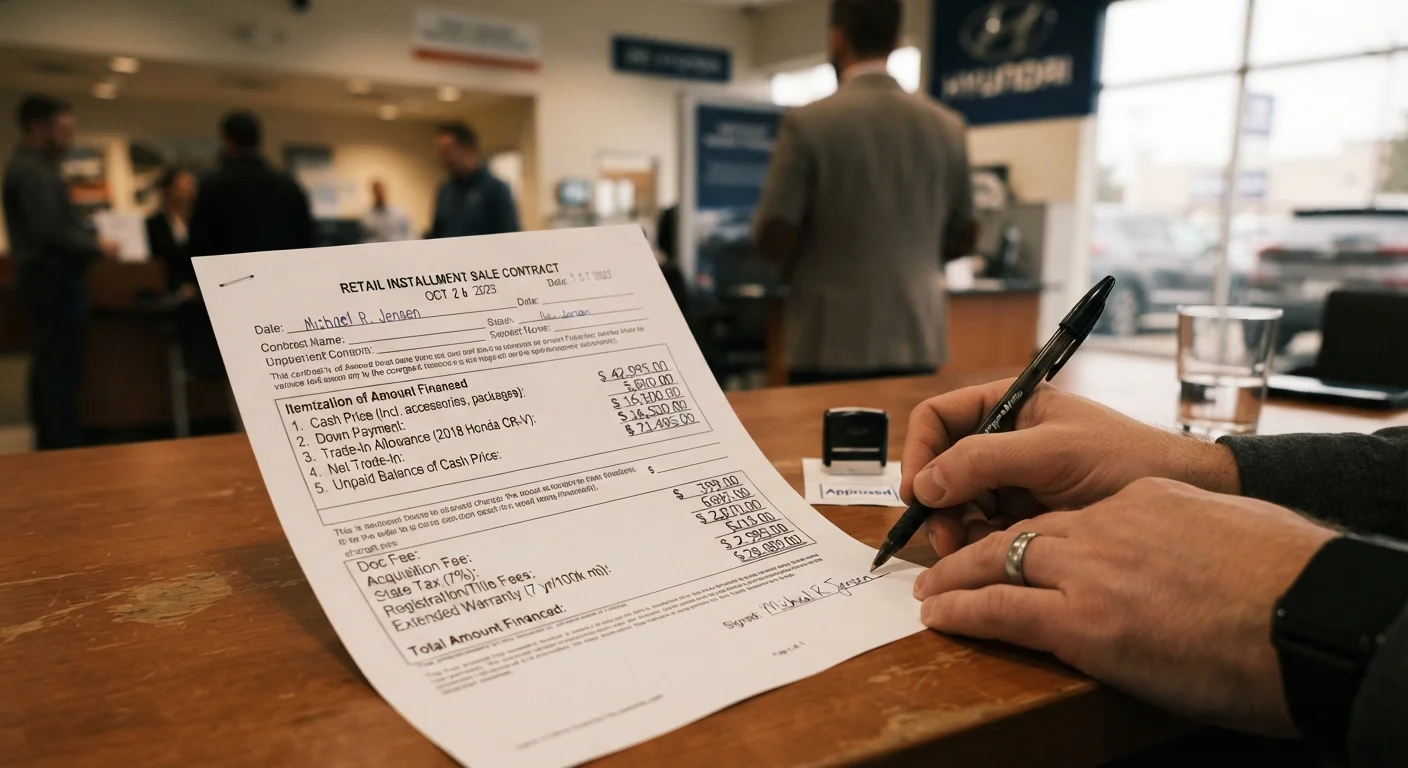
Before any negotiation concludes, ask the dealer to provide a written, itemized breakdown of every charge - taxes, fees, and add-ons included. This 'out-the-door' figure is the only number that reflects what you'll actually pay. Reviewing it line by line gives you a clear opportunity to question items you didn't agree to or that seem inflated.
Hidden fees at purchase are only one part of the broader ownership picture. Overspending on vehicles often continues well after the sale - through unnecessary extended warranties, premium fuel for standard engines, and other habitual costs that erode budgets quietly. And if you're financing, be sure to review your loan terms carefully before committing - the interest paid over time can dwarf any fee at the point of sale.
This article is for general informational purposes only and does not constitute financial or legal advice. Fees, regulations, and practices vary by state and dealership. Consult appropriate professionals for guidance specific to your situation.