

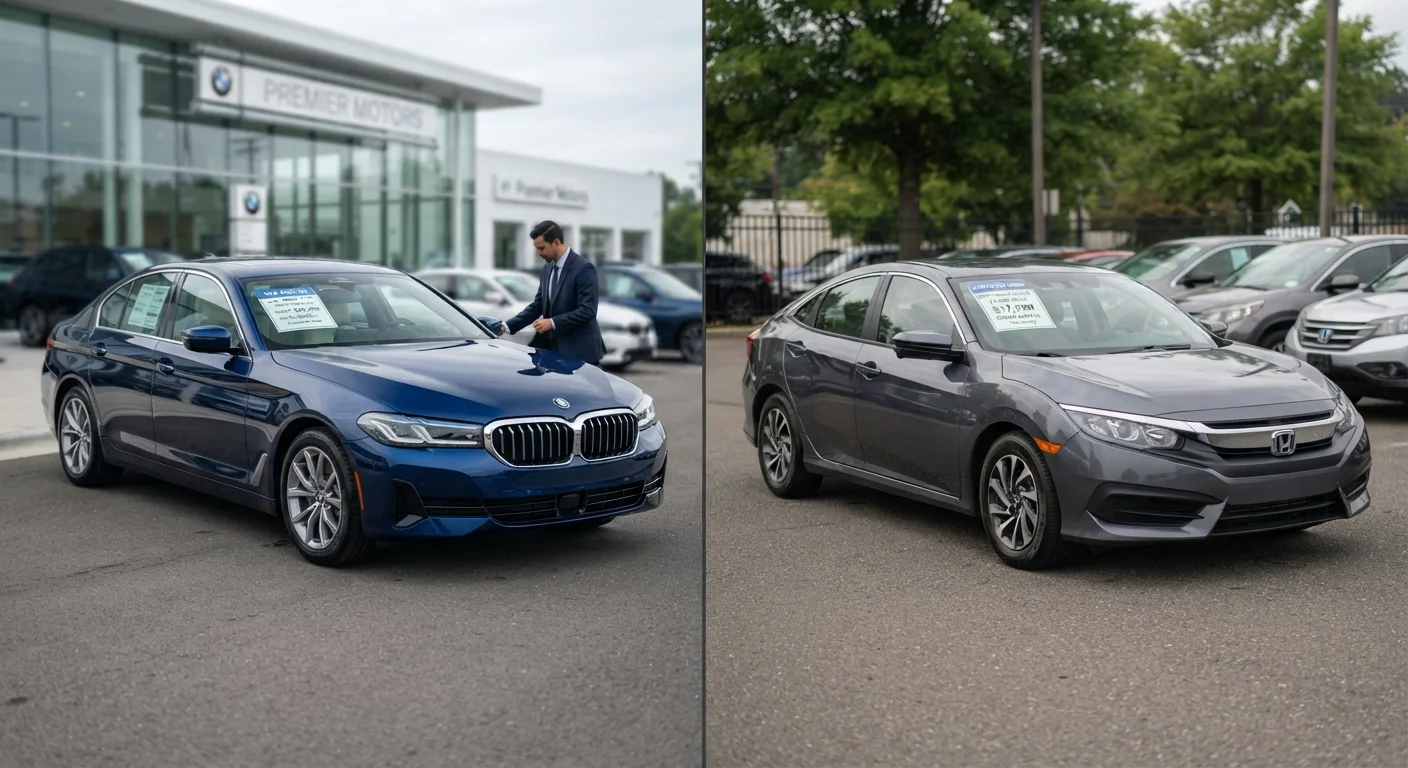
Key Takeaways
- New cars depreciate roughly 20-30% in the first year, making used vehicles financially attractive from day one.
- Insurance premiums are typically higher for new vehicles due to their replacement value.
- Used cars may carry higher repair costs, especially beyond 100,000 miles without a warranty.
- Interest rates on used car loans are generally higher than those offered for new vehicles.
- Fuel economy differences between model years can meaningfully affect lifetime running costs.
Our Verdict
Neither new nor used is universally the better financial choice - it depends on your driving habits, budget flexibility, and risk tolerance. New cars offer predictability and lower financing rates but lose value quickly. Used cars lower your entry cost but may bring hidden expenses, especially without a remaining warranty.
| Best for | Recommended |
|---|---|
| Drivers who prioritize budget certainty and low short-term repair risk | New Car |
| Those seeking the lowest purchase price and willing to manage variability | Used Car |
| Buyers wanting some warranty protection at a reduced entry cost | Certified Pre-Owned (Used) |
Why Purchase Price Is Only the Beginning
When comparing new and used vehicles, many buyers focus almost entirely on the sticker price or monthly payment. In reality, the total cost of ownership - the full amount you'll spend over the years you own the vehicle - often tells a very different story. That figure includes depreciation, insurance, financing costs, fuel, maintenance, and unexpected repairs.
Understanding what drivers actually spend each year is the foundation of any sound vehicle decision. A lower purchase price does not automatically mean lower overall costs, and a higher-priced new car may be more predictable in its expenses than an older used model with unknown history.
This comparison walks through each major cost category so you can weigh the real financial trade-offs rather than surface-level numbers.
| New Car | Used Car | |
|---|---|---|
| Purchase Price | Higher upfront cost | Lower upfront cost |
| Depreciation Exposure | Steepest in year one | Buyer avoids first-year drop |
| Loan Interest Rate | Generally lower rates | Generally higher rates |
| Insurance Cost | Higher premiums typical | Lower premiums typical |
| Warranty Coverage | Full manufacturer warranty | Varies; may be none |
| Fuel Economy | Newer models often more efficient | Older models may use more fuel |
| Repair Uncertainty | Low in early years | Higher, especially at high mileage |
| Total Cost Predictability | More predictable | More variable |
Depreciation, Financing, and What You Pay Over Time
Depreciation is the single largest cost most car owners never see as a line item. New vehicles typically lose 20-30% of their value in the first year and around 50% within five years, according to commonly cited industry estimates. Buying a used vehicle that is two to four years old means someone else absorbed that steepest depreciation curve.
That said, financing costs can partially offset this advantage. Interest rates on used auto loans are generally higher than rates offered on new vehicle loans, sometimes by 2-4 percentage points or more depending on the lender and the borrower's credit profile. Over a four- or five-year loan term, that gap adds real dollars to your total outlay. Before signing any loan, review the full terms, total interest, and affordability carefully.
If you're weighing another path entirely, a side-by-side look at leasing versus buying can help clarify whether monthly lease payments represent a genuine saving over time.
Calculate Total Interest, Not Just Monthly Payments
When comparing financing offers for new versus used vehicles, ask for the total interest paid over the life of the loan - not just the monthly payment. A lower monthly figure on a used car loan can mask a higher total cost if the interest rate or loan term is unfavorable. Running the full numbers on both options before deciding gives you a much clearer picture.
Insurance, Fuel, and Running Costs
Insurance premiums reflect the vehicle's replacement value, so new cars almost always cost more to insure than comparable older models. Comprehensive and collision coverage on a new vehicle can run several hundred dollars more per year than on a used car of the same make. That difference compounds over a multi-year ownership period.
Fuel economy is another dimension worth modeling carefully. Newer vehicles of many types have meaningfully better fuel efficiency ratings than their predecessors from five or more years ago. Depending on annual mileage and local fuel prices, the efficiency advantage of a newer model may partially or fully offset its higher insurance cost over time. Estimating lifetime fuel costs before and after purchase is a useful exercise for any buyer.
~20-30%
New car value lost in year one
Industry estimates consistently place first-year depreciation in this range for most mainstream new vehicles.
2-4 pts
Typical interest rate gap (used vs. new loans)
Used auto loan rates are commonly higher than new vehicle loan rates, adding meaningful cost over a standard loan term.
~$12,000
Average annual cost to own a vehicle in the US
AAA's annual Your Driving Costs study estimates that average total vehicle ownership runs over $10,000-$12,000 per year when all costs are included.
Routine maintenance costs - oil changes, tires, brakes - are broadly similar across new and used vehicles of the same type. Where used vehicles can diverge is in unexpected repairs, particularly once mileage climbs above 100,000.
Warranties, Reliability Risk, and Long-Term Planning
New vehicles come with manufacturer warranties, typically covering the powertrain for 5 years or 60,000 miles and bumper-to-bumper components for 3 years or 36,000 miles (exact terms vary by manufacturer). This warranty coverage means that most mechanical failures during that period won't become out-of-pocket expenses - a meaningful form of financial protection.
Used vehicles may have no remaining warranty coverage at all, depending on age and mileage. Certified pre-owned (CPO) programs offered through manufacturers provide a middle ground: these vehicles typically undergo inspection and carry extended warranty coverage, though they command a higher price than non-certified used cars of similar age.
Always Verify a Used Vehicle's History and Condition
A vehicle history report and an independent pre-purchase inspection by a qualified mechanic are important steps before buying any used car. Undisclosed accident damage, flood history, or deferred maintenance can turn an apparent bargain into a costly ownership experience. Budget for these checks - they typically cost far less than a single unexpected repair.
Drivers who plan to keep a vehicle well past the loan payoff date may find that the long-term calculus favors used vehicles despite higher repair uncertainty. Driving a paid-off car has real advantages, but aging vehicles bring their own cost profile. For first-time buyers still building their financial footing, a practical introduction to budgeting for all ownership costs is worth reading before committing.
Regardless of which direction you choose, staying current on routine vehicle maintenance is one of the most effective ways to control costs and preserve the vehicle's value over time.