

Key Takeaways
- Habits formed in elementary and middle school directly influence high school academic performance.
- High school course selection and GPA are among the most consequential college readiness factors.
- Accelerated options like AP and dual enrollment can reduce both time and cost to graduation.
- The college application timeline ideally begins no later than the start of junior year.
- A four-year degree requires sustained planning, but flexible pathways exist for nearly every situation.
The Big Picture: Understanding the K-16 Continuum
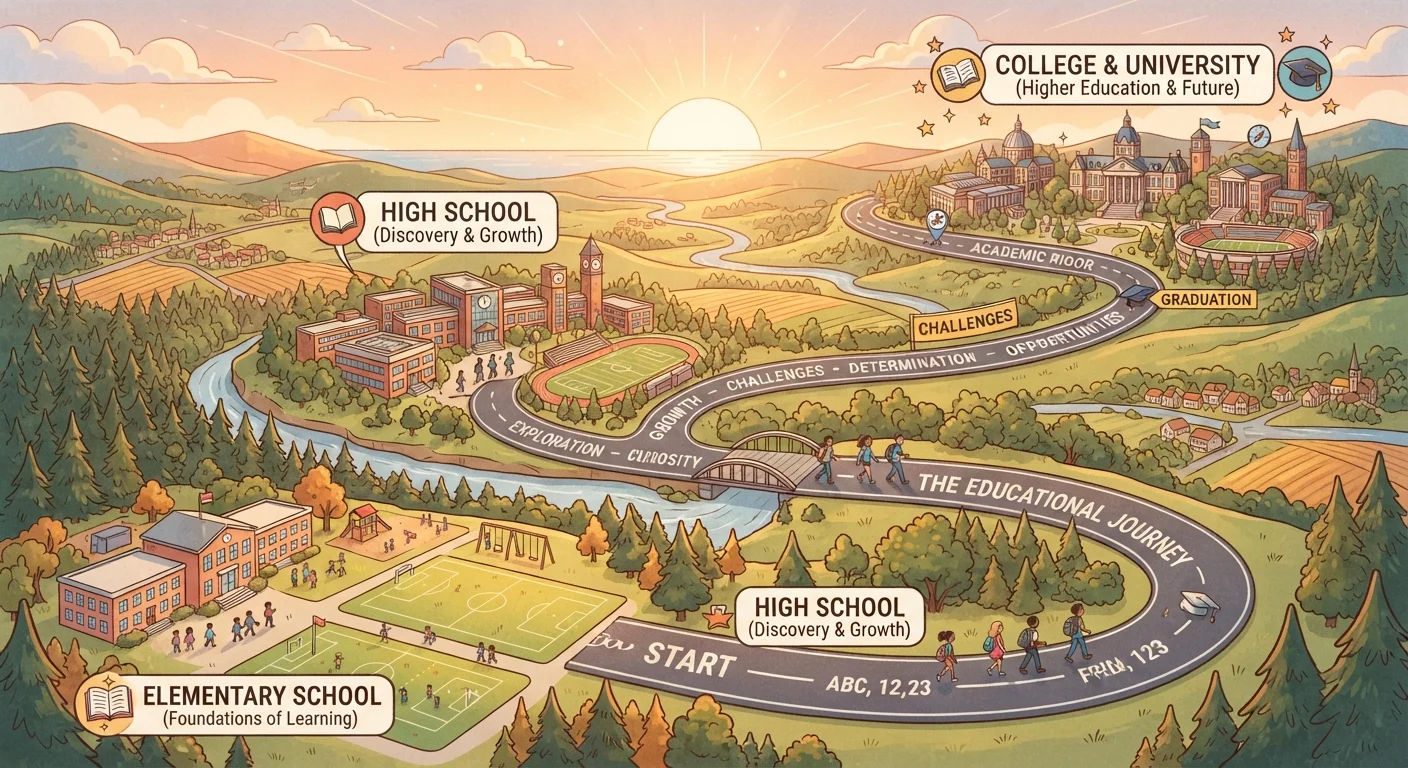
The journey from kindergarten to a bachelor's degree spans roughly 17 years and dozens of decision points. While it can feel overwhelming to think about the entire arc at once, educators and counselors consistently emphasize one insight: each stage directly enables the next. Families who understand how these stages connect are far better positioned to make deliberate choices rather than reactive ones.
The U.S. educational system is generally structured as follows: grades K-5 or K-6 (elementary), grades 6-8 (middle school), grades 9-12 (high school), and then two or four years of postsecondary education. That final stage - the four-year, or baccalaureate, degree - is the focus of this guide, though the groundwork for it is laid much earlier than most families realize.
65%
Jobs requiring postsecondary education by 2031
According to Georgetown University's Center on Education and the Workforce, roughly 65% of U.S. job openings will require some form of postsecondary credential by 2031.
3rd grade
Critical reading proficiency milestone
The Annie E. Casey Foundation identifies on-grade reading by the end of third grade as a significant predictor of long-term high school graduation rates.
40%
Students who transfer before graduating
The National Student Clearinghouse Research Center has reported that roughly 40% of college students transfer institutions at least once before earning a degree.
Whether a student attends public, private, or charter schools, the core academic expectations that colleges look for remain relatively consistent: strong foundational literacy and numeracy, a challenging and coherent high school course sequence, and evidence of readiness for independent, college-level work.
Elementary and Middle School: Building the Foundation
College readiness does not begin with SAT prep - it begins with reading fluency, mathematical reasoning, and study habits developed in the earliest grades. Research in educational psychology consistently links early reading proficiency to long-term academic outcomes. Students who read at grade level by the end of third grade are significantly more likely to graduate high school on time, according to findings from the Annie E. Casey Foundation.
In middle school, the stakes rise. Algebra access in eighth grade - or even seventh - has become a widely recognized milestone. Students who complete Algebra I before high school enter ninth grade with more room in their four-year schedule for advanced coursework. This matters because selective colleges typically expect three to four years of college-preparatory math through at least pre-calculus.
Ask your child's middle school counselor which math course sequence leads to calculus or pre-calculus by senior year, then work backward to confirm eighth-grade placement supports that goal.
Course sequencing in middle school directly determines which advanced courses are available in high school; correcting misalignment is far easier before ninth grade than after.
Encourage students to start a simple 'achievement journal' in ninth grade - a running log of projects, leadership roles, and meaningful experiences that will later inform college essays and activity lists.
College applications ask students to recall and articulate experiences from all four years of high school; contemporaneous notes are far more accurate and useful than memory alone.
Middle school is also when students begin developing intrinsic motivation and self-regulation - skills that predict college persistence more reliably than test scores alone. Families can support this by encouraging curiosity-driven reading, discussing goals openly, and connecting school subjects to real-world applications.
High School: Credits, Courses, and College Readiness
High school is where the path to a four-year degree becomes most concrete. Colleges evaluate applicants primarily on their high school transcript, standardized test scores (where required), and evidence of engagement beyond the classroom.
Understanding how your state and school district count academic credits is essential. Most states use the Carnegie unit system - one unit typically represents one year of study in a subject. To understand how these credits translate into college readiness signals, see our guide to the American credit system.
Students aiming for a four-year degree should prioritize what college counselors call the core academic sequence: four years of English, three to four years of math, three years of laboratory science, three years of social studies, and two or more years of a world language. Beyond this baseline, colleges look for rigor - honors, Advanced Placement, International Baccalaureate, or dual enrollment courses signal that a student can handle college-level work.
Comparing accelerated options is worth doing carefully. Our comparison of dual enrollment and AP classes breaks down how each pathway differs in cost, credit transferability, and workload.
Start College Research Earlier Than You Think
Many families begin exploring colleges seriously only during senior year - but the most effective preparation starts in ninth or tenth grade. Visiting campuses, attending college fairs, and building a broad list of schools early gives students time to make informed, confident decisions rather than rushed ones.
Junior year is particularly high-stakes. It's the last full year of grades colleges will see before making admissions decisions, and it's when most standardized testing, college research, and early application preparation happens. Our junior year planning guide offers a practical checklist for staying on track.
The College Application Process
Most students begin the formal application process during the fall of their senior year, but preparation should start earlier - ideally by the end of sophomore year for standardized testing, and by summer before junior year for college research.
Key components of most four-year college applications include: the academic transcript, standardized test scores (SAT or ACT, though many schools remain test-optional as of this writing), letters of recommendation, a personal essay, and a list of extracurricular activities. Financial aid applications - particularly the FAFSA (Free Application for Federal Student Aid) - run on a separate but parallel timeline.
FAFSA Filing Is Time-Sensitive
The FAFSA opens each October for the following academic year, and many state and institutional aid programs award funds on a first-come, first-served basis. Filing as early as possible after it opens is strongly advisable. Families should not assume that aid is unavailable - even middle-income households may qualify for institutional grants or subsidized loans.
FAFSA Filing Is Time-Sensitive
The FAFSA opens each October for the following academic year, and many state and institutional aid programs award funds on a first-come, first-served basis. Filing as early as possible after it opens is strongly advisable. Families should not assume that aid is unavailable - even middle-income households may qualify for institutional grants or subsidized loans.
Missing Deadlines Has Serious Consequences
Application deadlines for colleges and financial aid programs are firm and rarely waived. Create a master calendar at the start of junior year that includes all target school deadlines, FAFSA opening dates, and scholarship application windows. Missing a key deadline can delay enrollment by a full year or eliminate significant aid eligibility.
Application deadlines vary widely. Early Decision (binding) and Early Action (non-binding) deadlines commonly fall in November, while Regular Decision deadlines range from January to March. Missing a deadline typically means waiting a full year - build a personal calendar with all target school deadlines well in advance.
Navigating the Four-Year Degree
Enrollment in a four-year institution marks the beginning of a new planning cycle, not the end of one. Students who graduate on time - ideally in four years - tend to share common habits: they declare a major by the end of sophomore year, meet regularly with an academic adviser, and track degree requirements proactively rather than waiting for a registrar's audit.
Most bachelor's degree programs are structured around three layers of requirements: general education (breadth requirements covering writing, quantitative reasoning, science, humanities, and social science), major requirements (the disciplinary core of the degree), and electives. Understanding how these layers interact helps students avoid credit overload or gaps late in their college career.
For students interested in developing career-ready skills alongside their academic coursework, our skill-building resource hub offers practical guidance on professional and personal development throughout the college years.
“The students who thrive in college are rarely the ones who had the easiest path - they're the ones who learned how to seek help, manage their time, and adapt when things didn't go as planned.”
— Vincent Tinto, Sociologist and researcher specializing in student retention and college persistence
When Plans Change: Transfers, Gaps, and Alternate Routes
The traditional four-year path - same institution, continuous enrollment, May graduation - describes fewer students than it once did. Transfers, gap years, community college starts, and mid-degree interruptions are all common, and none of them make a four-year degree unattainable.
Students who transfer between institutions face the specific challenge of credit portability. Not all credits transfer cleanly, especially if a student moves between a community college and a selective university, or between institutions in different states. If your family has or anticipates a relocation, the guide to keeping students on track through a school transfer covers the practical steps for managing academic continuity.
Adult learners who interrupted their education and are considering a return will find a different landscape - one increasingly designed around working schedules and prior credit. Our guide for adult learners returning to education addresses degree-completion programs, community college re-entry, and online options built for non-traditional timelines.
The through-line across all these scenarios is the same: informed planning, proactive advising relationships, and a clear understanding of institutional requirements make the difference between a detour and a dead end.
College Board's BigFuture
A free planning resource covering college search, major exploration, financial aid guidance, and application timelines - useful from middle school through senior year.
Federal Student Aid (StudentAid.gov)
The official U.S. government site for FAFSA filing, understanding federal loan types, and tracking aid eligibility - an essential reference for any family navigating college financing.
National Student Clearinghouse Research Center
Publishes publicly accessible data on graduation rates, transfer patterns, and enrollment trends - helpful for families researching realistic outcomes at specific types of institutions.
Khan Academy SAT Practice
Free, personalized SAT preparation created in partnership with College Board, suitable for students beginning test prep as early as ninth grade.