
Traditional College vs. Vocational Training: Understanding the Real Differences

Key Takeaways
- Vocational programs typically take one to two years to complete, compared to four or more years for a bachelor's degree.
- Average annual tuition at trade schools is substantially lower than at four-year colleges or universities.
- Many high-demand trades offer strong earning potential without a four-year degree requirement.
- Traditional college provides broader academic exposure and may open more long-term advancement pathways in certain fields.
- Neither path is universally superior - career goals, learning style, and financial circumstances all shape the better fit.
- Some careers have strict degree requirements, while others actively prefer candidates with hands-on technical credentials.
Option A
Traditional Four-Year College
The broad, credential-intensive route to career and academic advancement.
Best for: Students pursuing careers in fields that require a bachelor's degree as a baseline entry credential, or who want broad academic exploration before specializing.
Option B
Vocational / Trade Training
The focused, skills-first pathway to high-demand technical careers.
Best for: Individuals who want to enter a specific skilled trade or technical field quickly, with lower upfront costs and a direct connection between training and employment.
If your target career explicitly requires a bachelor's degree
Traditional Four-Year College
Fields such as engineering, nursing (BSN track), social work, and most corporate management roles use the bachelor's degree as a non-negotiable entry credential. Bypassing it typically closes those doors.
If you want to enter the workforce quickly with lower debt
Vocational / Trade Training
Programs lasting one to two years allow earlier entry into well-paying technical roles, and lower tuition means many graduates start their careers with significantly less debt.
If you are undecided about a specific career direction
Traditional Four-Year College
General education requirements and elective flexibility let students explore multiple disciplines before committing, making college a reasonable holding pattern for the genuinely undecided.
If you learn best through hands-on, practical application
Vocational / Trade Training
Vocational curricula are structured around direct skill practice - clinicals, shop work, apprenticeships - which suits learners who struggle in lecture-heavy, theory-first environments.
If long-term advancement into management or research is a priority
Traditional Four-Year College
Many senior leadership, research, and policy roles list a bachelor's degree (or higher) as a requirement. A four-year credential keeps more of those upward pathways accessible over time.
What Actually Separates These Two Paths
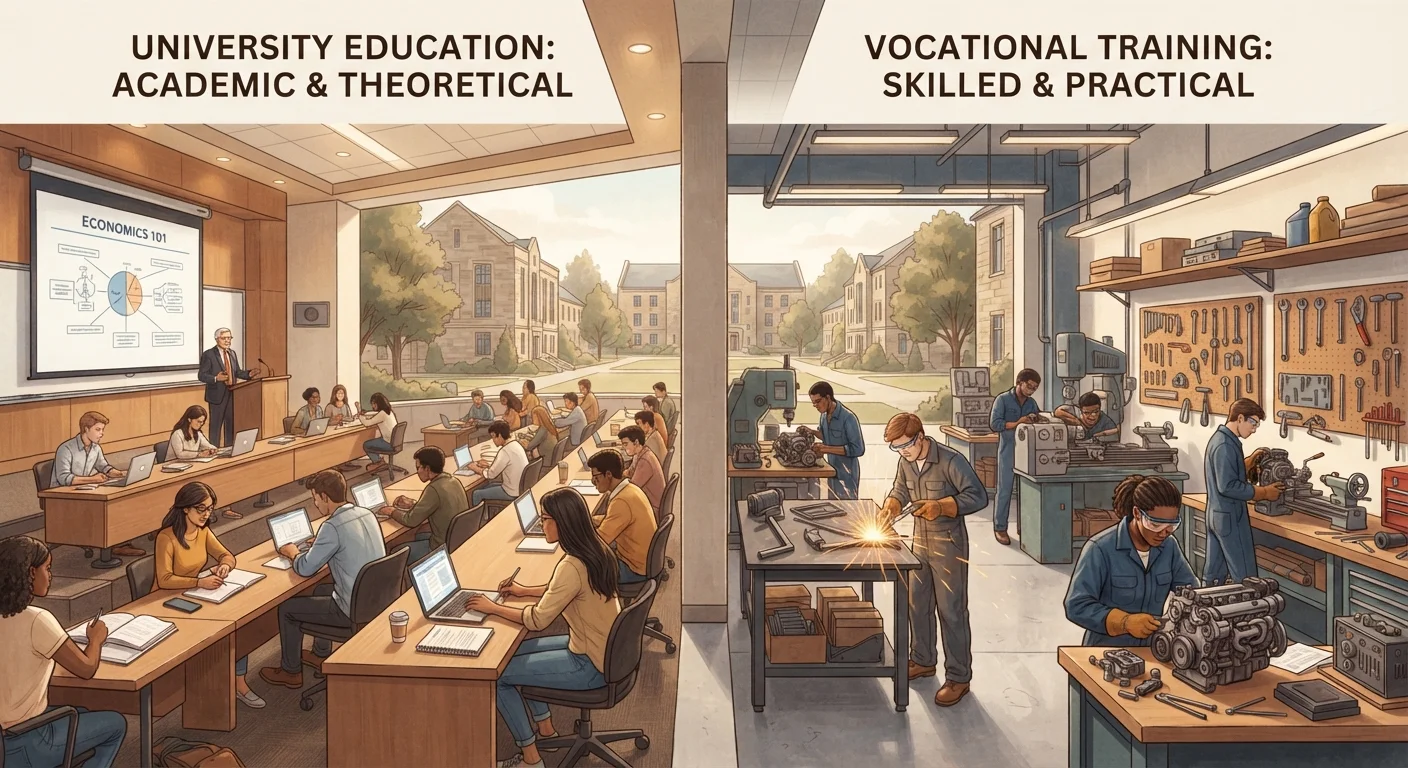
The core distinction between traditional college and vocational training is not prestige - it's purpose and structure. A four-year degree program is designed to develop broad intellectual competencies alongside a declared major, combining general education courses with specialized coursework. A vocational or trade program is designed to produce job-ready skills in a defined occupational area as efficiently as possible.
This structural difference cascades into nearly every practical comparison: cost, time to completion, teaching format, and which employers will consider each credential. Understanding that difference is the starting point for making a well-informed choice. For a closer look at how degree levels within traditional higher education compare, see our article on choosing between an associate and a bachelor's degree.
| Criterion | Traditional Four-Year College | Vocational / Trade Training |
|---|---|---|
| Typical duration | 4-5 years | 1-2 years |
| Average tuition cost | Higher; often $30K-$100K+ total | Lower; often $5K-$20K total |
| Instructional format | Lectures, seminars, research | Hands-on labs, clinicals, apprenticeships |
| Credential awarded | Bachelor's degree | Certificate, diploma, or associate's |
| Time to workforce entry | 4+ years post-enrollment | 1-2 years post-enrollment |
| Career flexibility | Broader; many fields accept the degree | Narrower; tied to specific occupation |
| Graduate school access | Direct pathway to master's/doctoral programs | Typically requires additional coursework first |
Cost and Time: The Numbers That Shape the Decision
Cost is frequently the deciding factor for families and adult learners. According to the National Center for Education Statistics, average annual tuition and fees at public four-year institutions have consistently exceeded those at two-year and vocational programs by a significant margin. When room, board, and four to five years of opportunity cost are added, the total investment in a traditional degree can reach six figures for many students.
Vocational programs, by contrast, commonly run between one and two years and are often offered at community colleges or technical institutes at considerably lower per-credit rates. Some programs also include apprenticeship components that pay a wage while training - partially offsetting costs entirely.
~$11,260
Average annual in-state tuition, public 4-year college
Per the College Board's Trends in College Pricing report, covering tuition and fees only - not room, board, or books.
~$33,000
Median total cost of a vocational/trade certificate program
Estimates from the National Center for Education Statistics suggest total costs for most certificate programs fall well below typical four-year degree costs.
~54%
Six-year bachelor's degree completion rate, public institutions
The National Center for Education Statistics tracks completion rates; roughly half of students who start at public four-year schools earn a degree within six years.
Time matters beyond tuition. A student who completes an electrical apprenticeship or a licensed practical nursing (LPN) program in 18 months and enters the workforce is also earning and building seniority years before a peer who pursues a bachelor's degree finishes coursework. That gap in early earning has compounding effects on long-term financial outcomes that simple tuition comparisons do not capture.
Career Outcomes: What the Evidence Shows
Neither credential automatically guarantees a higher salary or better job security. Outcomes depend heavily on the specific field, regional labor market, and whether the credential matches what employers in that sector actually require.
Fields like plumbing, HVAC, dental hygiene, welding, and automotive technology show strong and durable demand for technically trained workers. The U.S. Bureau of Labor Statistics regularly projects robust job growth across skilled trades, and many of these roles offer median wages well above the national average without requiring a four-year degree.
Meanwhile, fields like secondary education, clinical psychology, architecture, and computer science typically require at minimum a bachelor's degree for entry-level roles, and advanced positions often require graduate credentials. Choosing a vocational path when the target career has mandatory degree requirements is not a shortcut - it's a mismatch.
Before committing to a trade program, it's worth doing your due diligence on program quality. Our guide on what applicants often overlook in trade school admissions covers accreditation, licensure pass rates, and other factors that significantly affect graduate outcomes.
Licensure Requirements Vary by State
Many vocational fields - including electrical work, cosmetology, nursing, and HVAC - require state-issued licenses in addition to program completion. Licensure rules, exam requirements, and reciprocity agreements differ by state. Before enrolling, verify the specific licensure pathway in the state where you intend to work. Program completion alone does not always confer the legal right to practice.
Learning Environment and Personal Fit
Academic fit is a real and underweighted factor. Traditional college front-loads abstract learning - reading, writing, lecture-based instruction, and theoretical frameworks - before students apply knowledge in a professional context. For many students, that environment is engaging and motivating. For others, it creates friction that leads to withdrawal before completion. The National Student Clearinghouse has documented persistently high non-completion rates at four-year institutions, which means the financial investment does not always translate into a credential.
Vocational programs are structured differently. Even in the first weeks, students are typically working with tools, equipment, patients, or code in ways that directly mirror job tasks. This applied structure can improve retention and motivation for learners who find abstract coursework demotivating.
Neither learning style is superior - they are simply different, and choosing the environment more likely to lead to program completion matters enormously. An unfinished four-year degree carries substantial debt with no credential attached. If you are also considering more flexible formats, our comparison of online courses, bootcamps, and community college may offer useful context on additional pathways.