

Key Takeaways
- Mind maps use a central idea with radiating branches to show connections between concepts visually.
- Linear outlines organize information in numbered or bulleted hierarchies, moving from general to specific.
- Research suggests visual-spatial learners and divergent thinkers often benefit more from mind mapping.
- Linear outlines support sequential subjects and are easier to convert into study guides or flashcards.
- Combining both methods - mapping first, then outlining - can deepen comprehension for complex material.
- Neither method is universally superior; subject type and personal thinking style should guide the choice.
Option A
Mind Mapping
The visual, web-like approach to organizing ideas.
Best for: Best for brainstorming, understanding relationships between concepts, and subjects with interconnected topics like biology or history.
Option B
Linear Outlines
The structured, hierarchical method for sequential content.
Best for: Best for subjects with clear sequences or categories, such as math procedures, grammar rules, or law.
If you're studying an interconnected or concept-heavy subject like biology, sociology, or world history
Mind Mapping
Mind maps make relationships between ideas explicit and visible, helping you see the bigger picture before drilling into details.
If you're preparing for exams on procedural or rule-based subjects like math, grammar, or law
Linear Outlines
Outlines mirror the step-by-step logic of these subjects and make it easier to review ordered content efficiently.
If you're a first-time or returning learner building your study system from scratch
Linear Outlines
The familiar structure lowers the learning curve and integrates easily with most textbooks and lecture notes.
If you want to brainstorm an essay, research project, or creative assignment
Mind Mapping
The non-linear format encourages free association and helps surface connections you might miss in a rigid structure.
If you're studying dense material and want to use both methods together
Mind Mapping
Start with a mind map to capture the full concept landscape, then convert key branches into a linear outline for targeted review.
How Each Method Works
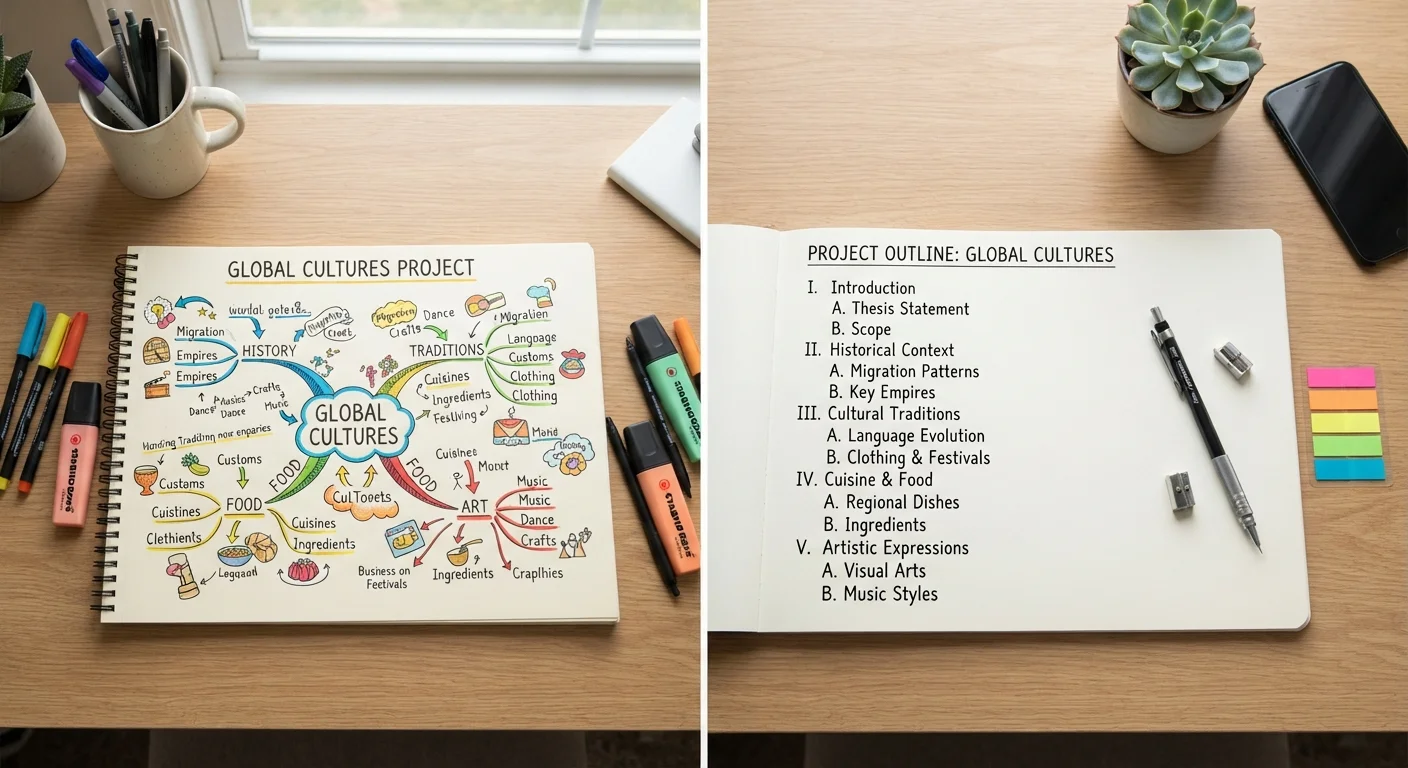
A mind map starts with a central concept written in the middle of a page. Related ideas branch outward like spokes on a wheel, and sub-ideas branch from those. Color coding, icons, and curved lines are common features. The result is a web-like diagram that reflects how concepts relate to one another rather than how they rank in importance.
A linear outline arranges the same information as a top-down hierarchy. Roman numerals, letters, and numbers mark levels of importance - from main topics down to supporting details. Every point has a clear position in the sequence, and the structure mirrors how most textbooks and lectures are organized.
Both methods are forms of elaborative encoding - the cognitive process of connecting new information to what you already know - which research consistently links to stronger retention compared to passive rereading. For more on why active engagement with material matters, see how active recall outperforms rereading.
| Criterion | Mind Mapping | Linear Outlines |
|---|---|---|
| Structure | Radial, web-like branches | Hierarchical, top-down list |
| Best subject fit | Conceptual, interconnected topics | Sequential, rule-based content |
| Creation speed | Fast for brainstorming | Fast for structured material |
| Visual appeal | High - color, icons, layout | Low - text-focused |
| Converts to flashcards | Moderate effort required | Easy to extract Q&A pairs |
| Shows relationships | Strong - connections are explicit | Limited - hierarchy only |
| Learning curve | Moderate - requires practice | Low - familiar format |
What the Research Suggests
Studies in educational psychology indicate that mind mapping can improve recall and comprehension, particularly for learners who process information visually or who are studying topics with many interconnected ideas. A review published in Educational Research Review found that concept mapping - a close relative of mind mapping - produced meaningful learning gains compared to passive note review, though effect sizes varied by subject and task type.
Linear outlines, meanwhile, have a longer track record in formal education and are well-supported for sequential and procedural content. Their structured format also makes them easier to convert into flashcards or practice questions - a natural bridge to retrieval-based study strategies. If you want to understand how different strategies compare overall, study techniques ranked by evidence provides a useful framework.
~15%
Average recall improvement with concept mapping
A meta-analysis in Educational Research Review found concept mapping improved recall by roughly 15% over re-reading on average, though results varied by study design.
2 in 3
Students who prefer visual study aids
Surveys of undergraduate students consistently find a majority report preferring visual or diagrammatic aids when studying complex material, though self-reported preference doesn't always predict performance.
It's worth noting that neither method has been proven universally superior. Individual differences in cognitive style, subject matter, and how the method is applied all affect outcomes. Treating research findings as general guidance - not prescriptions - is the more accurate approach.
Choosing the Right Tool for the Subject
Subject type is often the most reliable guide when choosing between the two methods:
- History, biology, social sciences: Mind maps handle cause-and-effect chains, taxonomies, and thematic relationships well. Branching structures naturally mirror how these disciplines organize knowledge.
- Mathematics, grammar, coding, law: Linear outlines suit sequential logic. A numbered breakdown of steps or rules is easier to follow and review than a branching diagram.
- Literature and essay writing: Mind mapping works well during the planning phase to gather themes and evidence. A linear outline then helps structure the argument before writing begins.
If you're just getting started and unsure which method fits your habits, a practical starting point for new learners can help you build a foundation before committing to any single technique.
You Don't Have to Pick Just One
Many effective learners use both methods at different stages of study. A common workflow is to mind map at the start of a topic to capture the full landscape of ideas, then convert key branches into a linear outline for targeted pre-exam review. This two-phase approach draws on the strengths of each format. Experimenting with the combination over a few study sessions is a low-risk way to find what works for your subject and schedule.
For learners who prefer structured note formats in the classroom, the Cornell note-taking system offers a complementary approach that pairs well with linear outlining during review sessions.