

Key Takeaways
- Map every deadline at the semester's start to avoid last-minute cramming.
- Distribute heavy study loads across weeks rather than concentrating them near deadlines.
- Early warning signs of burnout - like persistent fatigue - require prompt schedule adjustments.
- A recovery plan for disruptions is as important as the original study schedule.
- Spaced repetition in the final weeks outperforms marathon cramming sessions.
Why Semester-Wide Planning Beats Week-to-Week Scrambling
Most students approach studying reactively - opening a textbook the night before a quiz, scrambling to write a paper the weekend it's due. This week-to-week mode may feel manageable early in a semester, but it compounds into stress, lower-quality work, and exhaustion by the midpoint.
Research in cognitive science consistently shows that distributed practice - spreading study sessions over time - leads to stronger long-term retention than massed practice (cramming). Planning at the semester level makes distributed practice the default rather than the exception.
Adult learners juggling jobs and family responsibilities benefit from this approach even more. If you're navigating a packed schedule, see how skill-building on a tight schedule can complement a semester plan. Thinking in the long arc of a semester - roughly 15-16 weeks - also surfaces natural low-pressure windows you can bank for recovery or review.
~2-3x
Retention advantage of spaced over massed practice
A widely cited finding in cognitive psychology research is that distributed practice produces substantially better long-term recall than an equivalent amount of time spent cramming.
~40%
Adult learners enrolled alongside work obligations
According to the National Center for Education Statistics, a significant portion of U.S. undergraduates work while enrolled, making semester-wide time management especially critical.
7-9 hrs
Recommended nightly sleep for adults during exam periods
The American Academy of Sleep Medicine recommends adults get seven or more hours of sleep per night to support cognitive function, including memory consolidation.
Building Your Master Semester Calendar
The first step is a single-source document - digital or paper - that maps the entire semester at a glance. Gather every course syllabus and record these in one place:
- Assignment and project due dates
- Exam and quiz dates
- Lab, clinical, or practicum deadlines
- Personal commitments (work schedules, family events, travel)
Once plotted, look for collision weeks where multiple deadlines cluster. These are your highest-risk periods. Block the two weeks before each collision as active prep windows - not the week of.
Your physical study environment supports this planning habit. A study environment audit can help you confirm your workspace is set up to match the focused work your calendar demands.
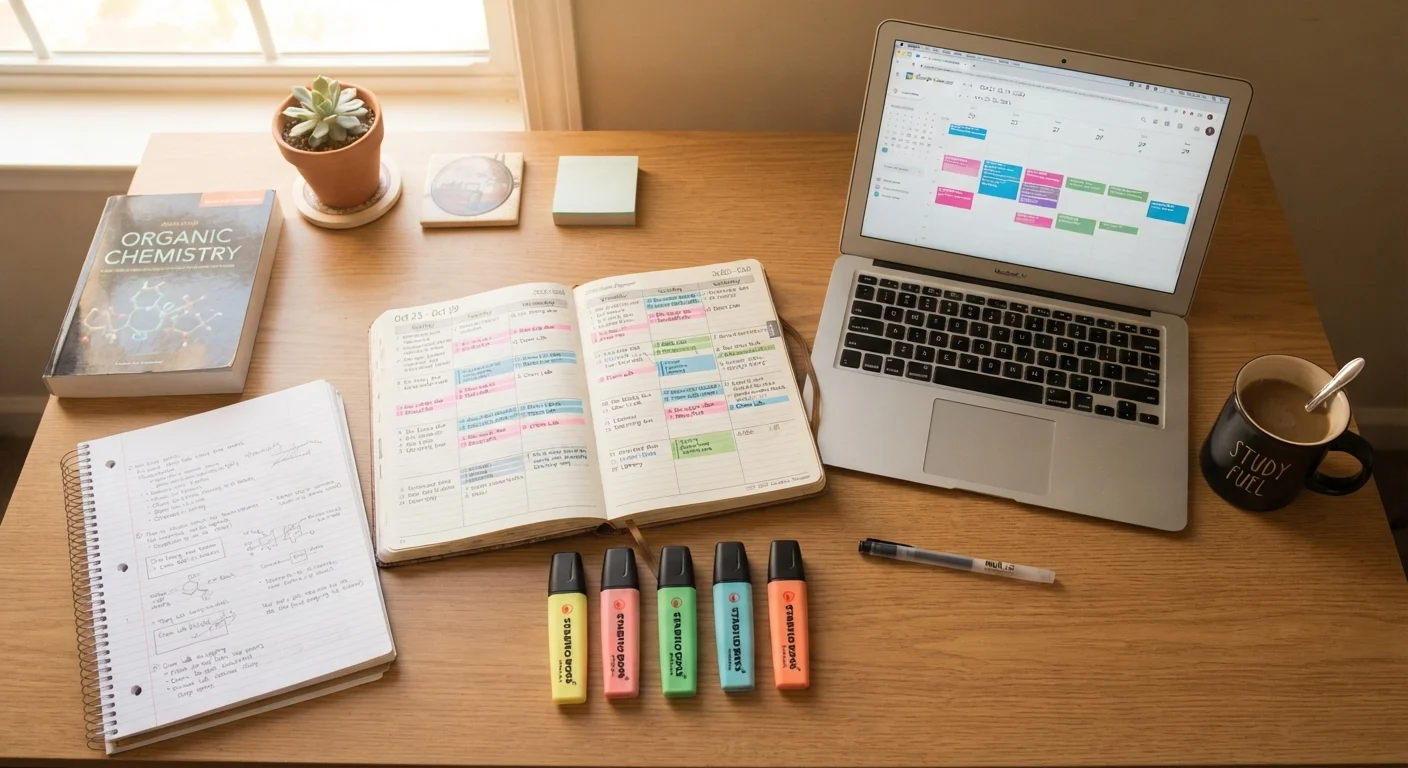
Color-code your master calendar by course or deadline type so collision weeks become visible at a glance - not just intellectually known.
Visual encoding of schedule density helps learners anticipate high-demand periods rather than reacting to them, reducing last-minute cramming.
Add a 'buffer block' of two to three unscheduled hours each week that you can apply wherever the week demands - do not pre-assign these hours.
Unpredictability is guaranteed in a semester. A built-in buffer prevents one derailed day from cascading into a derailed week.
Pacing Yourself: Distributing Study Hours Strategically
A common error is treating all weeks as equal. In practice, a semester has natural phases:
- Weeks 1-3 (Launch Phase)
- Lower assignment load. Use this time to build habits: set recurring study blocks, organize notes systems, and preview upcoming units.
- Weeks 4-10 (Core Phase)
- Heaviest sustained workload. Aim for consistent daily study blocks matched to each course's credit weight. A three-credit course often warrants roughly two to three hours of outside study per week under typical academic expectations, though this varies by course and learner.
- Weeks 11-13 (Pre-Finals)
- Begin consolidating material. Shift some new-content time toward review and self-testing.
- Weeks 14-16 (Finals Phase)
- No new habits - execute the plan already in place.
For structuring the individual sessions within these blocks, building a study session that actually sticks offers evidence-backed session structure from warm-up to wind-down.
Recognizing and Preventing Burnout Mid-Semester
Academic burnout is not simply tiredness - it's a sustained depletion of motivation and cognitive capacity that, once entrenched, is hard to reverse quickly. Warning signs include persistent difficulty concentrating, cynicism about coursework that was once engaging, and physical fatigue that doesn't improve with a night's sleep.
Do Not Wait Until Burnout Is Severe to Adjust
Early-stage burnout warning signs - difficulty starting tasks, creeping cynicism, disrupted sleep - are far easier to address than full exhaustion. If you notice these signs for more than a week, proactively reduce your study load for a few days and reassess your schedule. Pushing through severe burnout typically worsens academic performance rather than preserving it.
Prevention is structural. Build scheduled rest directly into your semester calendar - not as a reward for finishing work, but as a non-negotiable block. Research on cognitive load suggests even brief recovery periods (a full evening off, a weekend morning unplugged) preserve working memory capacity over time.
For a broader framework on managing academic and life stress together, building a personal stress-management plan from scratch provides a practical, step-by-step approach worth reading alongside your study planning.
This article provides general educational guidance and is not a substitute for professional mental health support. If you're experiencing significant distress, please speak with a counselor or qualified healthcare professional.
Recovering When Life Disrupts Your Plan
Every semester includes at least one significant disruption - illness, a family emergency, a demanding work week, or an unexpected financial pressure. The students who manage these best aren't those with the most discipline; they're those with a written recovery protocol prepared in advance.
When a disruption occurs, take these steps in order:
- Triage immediately. List every pending deadline and rank by consequence, not urgency. A quiz worth 5% matters less than a paper worth 30%.
- Contact instructors early. Most institutions have accommodation policies. Reaching out before a deadline - not after - keeps more options open.
- Compress, don't abandon. Identify the minimum viable study plan for the next 48-72 hours that protects your highest-stakes items.
- Rebuild gradually. Return to your full schedule over several days rather than attempting to catch up entirely in one session.
If new learners feel the disruption has exposed gaps in foundational study habits, study skills from scratch is a useful reset point.
The Final Exam Stretch: Reviewing Without Panic
The final two to three weeks of a semester are where semester-long planning pays its largest dividend. Students who have studied consistently arrive here needing to consolidate - a much lighter cognitive lift than students who arrive needing to learn material from scratch.
Effective final-stretch strategies include:
- Spaced self-testing: Use flashcards, practice problems, or past exams spread across multiple sessions rather than one long review marathon.
- Interleaving subjects: Alternating between subjects in a single study day has been shown in learning science research to improve long-term discrimination between concepts.
- Sleep protection: Cognitive consolidation - the process by which the brain cements memories - occurs primarily during sleep. Cutting sleep to gain study hours is generally counterproductive in the final stretch.
Use Practice Exams as Your Primary Final Review Tool
Past exams, instructor-provided practice tests, or textbook end-of-chapter questions are among the highest-yield review formats available. They activate retrieval practice - one of the most robustly supported learning strategies in educational psychology research. Aim to complete at least one full practice set per subject at least five days before the actual exam, leaving time to address gaps you discover.
Maintain realistic expectations: even a well-executed semester plan cannot guarantee specific grades or outcomes. What it reliably delivers is a reduction in last-minute pressure and a stronger foundation of retained knowledge heading into exams and beyond.