

Key Takeaways
- The Pomodoro Technique breaks work into 25-minute focused intervals followed by 5-minute breaks.
- It helps combat procrastination and reduces mental fatigue for many learners.
- The rigid timer structure can frustrate people who need longer uninterrupted flow states.
- Deep, complex tasks may not fit neatly into 25-minute blocks.
- Adapting interval length to your own rhythm often produces better results than following the method strictly.
Lowers the activation energy to start studying
Committing to just 25 minutes is psychologically easier than an open-ended session. This reduces avoidance behavior, a common obstacle for students facing difficult material.
Creates built-in recovery time
Scheduled breaks prevent the gradual attention fade that happens during long uninterrupted sessions. Brief mental rest has been linked to better consolidation of new information.
Makes procrastination visible and manageable
The timer creates an external accountability structure. When it starts, the task is defined; when it ends, progress is measurable - reducing the vague dread that fuels procrastination.
Trains awareness of time and task scope
Regularly estimating how many pomodoros a task requires builds a more accurate sense of effort over time, which improves planning and reduces last-minute cramming.
Requires no special tools or cost
Any clock, phone timer, or basic app is sufficient. The low barrier to entry means learners can trial the method immediately without commitment.
Interrupts deep focus at critical moments
For tasks requiring sustained analytical thinking - complex proofs, essay drafting, coding - a timer going off mid-thought can shatter concentration that took significant time to build.
Fixed intervals don't match all task types
Not every learning task divides cleanly into 25-minute units. A task that takes 10 minutes leaves dead time; one requiring 40 minutes of continuous thought is artificially split.
Can become mechanical without strategy
Completing pomodoros can feel like a goal in itself, leading learners to equate time spent with learning achieved - even when the quality of study is low.
Less useful for collaborative or open-ended work
Group study sessions, mentored learning, or project-based work don't lend themselves to strict individual timer cycles, making the technique awkward in social or collaborative contexts.
May not suit experienced learners with strong focus
Learners who already sustain deep attention naturally may find the interruption structure disruptive rather than helpful, reducing rather than enhancing their performance.
Our Verdict
The Pomodoro Technique is a well-researched, low-barrier tool that genuinely helps many learners manage distraction and build consistent study habits. However, its fixed 25-minute intervals can disrupt deep work and may feel constraining for experienced learners who already maintain strong focus naturally. Like most productivity methods, it works best when treated as a flexible starting point rather than a rigid rule.
Students and adult learners who struggle with procrastination, distraction, or getting started - especially those managing many small tasks or building a new study routine.
What Is the Pomodoro Technique?
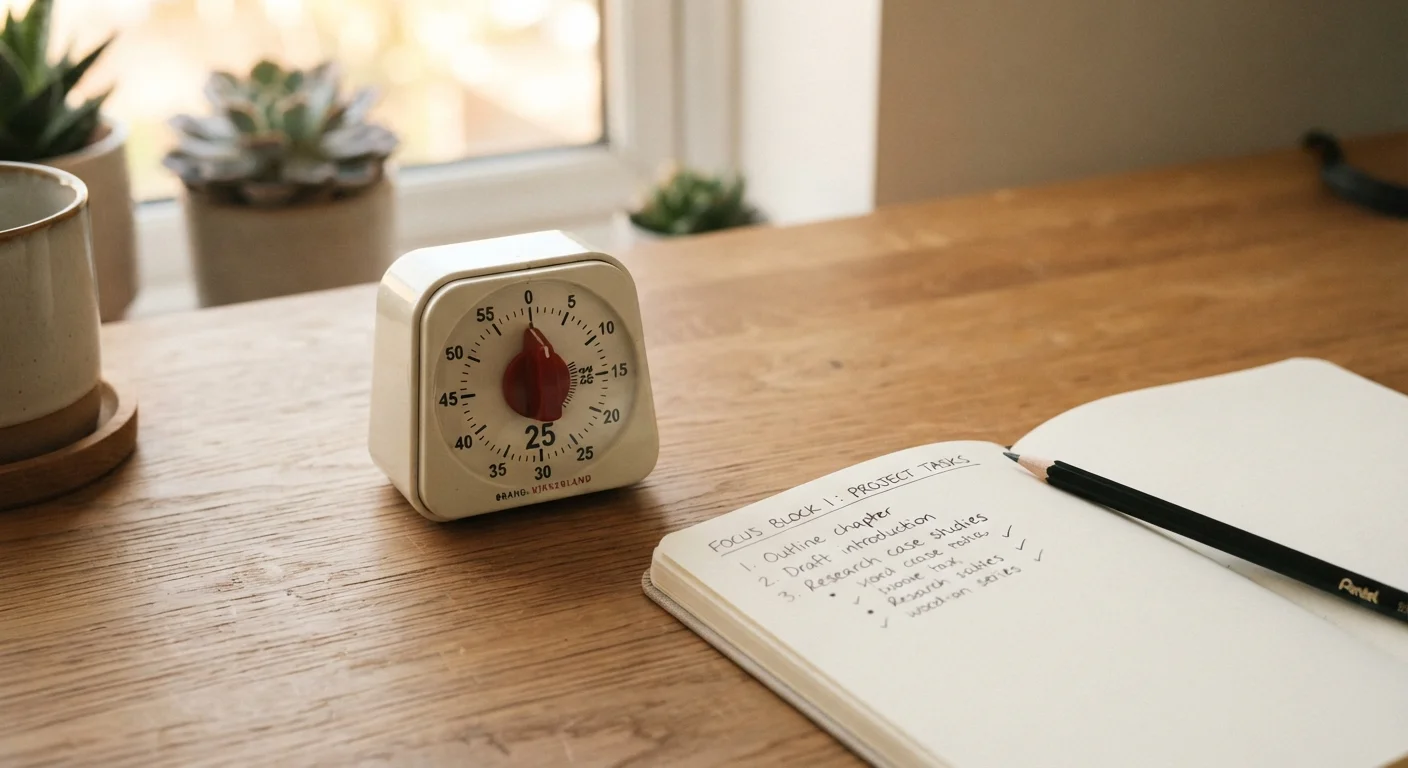
Developed by Francesco Cirillo in the late 1980s, the Pomodoro Technique is a time-management method built around a simple cycle: work with full focus for 25 minutes (one "pomodoro"), then take a 5-minute break. After four consecutive pomodoros, take a longer break of 15-30 minutes. The name comes from the tomato-shaped kitchen timer Cirillo used as a university student.
The method's appeal lies in its simplicity - no app or specialized tool is required. Its core goal is to make the act of starting less daunting and to protect attention from the constant pull of interruptions. For students and adult learners juggling competing demands, that promise carries real weight.
A Note on the Research Base
While the cognitive science behind structured work-rest cycles is well-supported, controlled studies specifically testing the Pomodoro Technique as a named method are limited. Much of its evidence base is drawn from broader research on attention, self-regulation, and fatigue. This doesn't mean it doesn't work - many learners report meaningful benefits - but it does mean claims about its superiority over other methods should be read with appropriate caution.
Where the Pomodoro Technique Genuinely Helps
Research on attention and self-regulation supports several of the technique's core principles, even if studies directly testing the Pomodoro method as a whole are limited.
Lowers the activation energy to start studying
Committing to just 25 minutes is psychologically easier than an open-ended session. This reduces avoidance behavior, a common obstacle for students facing difficult material.
Creates built-in recovery time
Scheduled breaks prevent the gradual attention fade that happens during long uninterrupted sessions. Brief mental rest has been linked to better consolidation of new information.
Makes procrastination visible and manageable
The timer creates an external accountability structure. When it starts, the task is defined; when it ends, progress is measurable - reducing the vague dread that fuels procrastination.
Trains awareness of time and task scope
Regularly estimating how many pomodoros a task requires builds a more accurate sense of effort over time, which improves planning and reduces last-minute cramming.
Requires no special tools or cost
Any clock, phone timer, or basic app is sufficient. The low barrier to entry means learners can trial the method immediately without commitment.
For learners working through discrete, well-defined tasks - vocabulary drills, problem sets, reading chapters - the structured intervals align naturally with task boundaries. The technique also pairs well with the time-efficient strategies discussed in our guide to skill-building on a tight schedule, where short, consistent sessions beat sporadic long ones.
Where It Falls Short
The Pomodoro Technique is not universally effective, and being honest about its limits helps learners avoid frustration when the method doesn't click.
Interrupts deep focus at critical moments
For tasks requiring sustained analytical thinking - complex proofs, essay drafting, coding - a timer going off mid-thought can shatter concentration that took significant time to build.
Fixed intervals don't match all task types
Not every learning task divides cleanly into 25-minute units. A task that takes 10 minutes leaves dead time; one requiring 40 minutes of continuous thought is artificially split.
Can become mechanical without strategy
Completing pomodoros can feel like a goal in itself, leading learners to equate time spent with learning achieved - even when the quality of study is low.
Less useful for collaborative or open-ended work
Group study sessions, mentored learning, or project-based work don't lend themselves to strict individual timer cycles, making the technique awkward in social or collaborative contexts.
May not suit experienced learners with strong focus
Learners who already sustain deep attention naturally may find the interruption structure disruptive rather than helpful, reducing rather than enhancing their performance.
The technique also addresses when you work but says nothing about how you study. A learner spending 25-minute blocks on passive re-reading will see far less benefit than one using active recall or spaced repetition. For a deeper look at how study scheduling affects memory retention, see our comparison of spaced repetition vs. massed practice.
Adapting the Method to Fit You
The Pomodoro Technique's 25-minute default is a starting recommendation, not a scientifically derived optimal interval. Learners are encouraged to experiment with interval length - many find 40- or 50-minute blocks better suit deep reading or writing, while others prefer shorter 15-minute sprints when energy is low.
A few practical adjustments worth considering:
- Lengthen intervals gradually. If 25 minutes feels too short, try increasing by 5 minutes each week until you reach a comfortable deep-work window.
- Use breaks actively. Stand up, look away from screens, or do light movement - passive scrolling often undermines the restorative purpose of breaks.
- Track completions, not time. Noting how many pomodoros a task took builds realistic planning skills over time.
- Suspend the timer for genuine flow. If you reach a state of deep concentration and the timer breaks it, finish the thought before stopping.
Treating the Pomodoro Technique as a scaffold - useful while building habits, adjustable as skill grows - captures its value without letting its constraints become a source of stress.
25 min
Default focused work interval
Cirillo's original specification; practitioners are widely advised to adjust this based on personal attention patterns and task type.
52 min
Average focus span in one productivity study
A frequently cited workplace study by the productivity software company DeskTime found top performers tended to work for roughly 52 minutes before taking a 17-minute break, suggesting optimal intervals vary by individual.