
Key Takeaways
- Every habit - good or bad - follows the same three-part cycle: cue, routine, and reward.
- The brain automates repeated behaviors to conserve mental energy, making habits efficient but also hard to change.
- Identifying your cue is the most powerful step in changing or building a habit.
- Replacing an old routine while keeping the same cue and reward is more effective than eliminating a habit cold turkey.
- Small, consistent routines compound over time into meaningful health and lifestyle changes.
Habit Loop
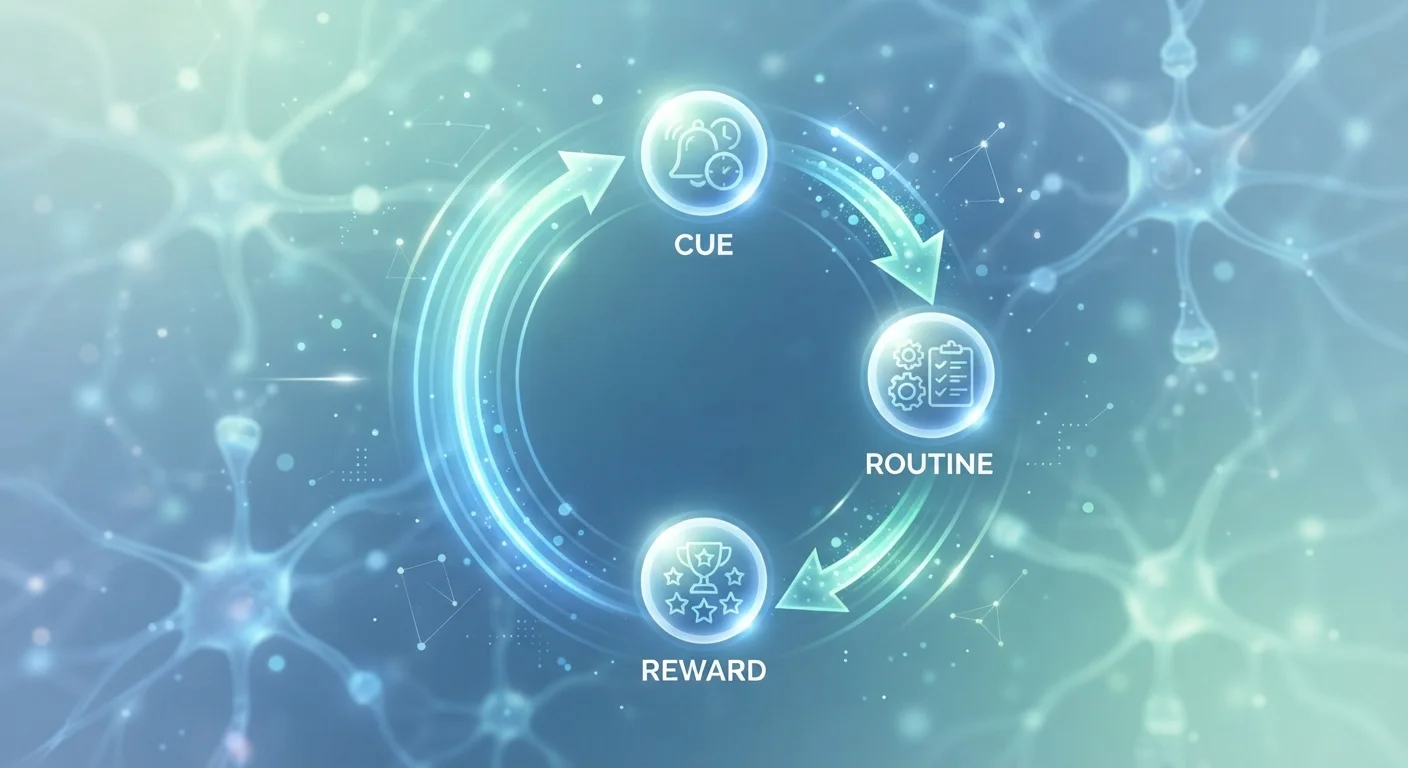
A habit loop is a three-part neurological pattern - cue, routine, and reward - that the brain uses to encode automatic behaviors. When a behavior is repeated consistently within this cycle, it eventually requires less conscious effort to perform. This is how everyday actions like brushing your teeth or reaching for a morning coffee become automatic over time.
The habit loop is associated with activity in the basal ganglia, a brain region involved in procedural learning and automaticity. As habits solidify, decision-making areas of the prefrontal cortex become less engaged, reducing cognitive load.
What the Brain Is Actually Doing
Every habit you have - from the route you drive to work to the way you wind down at night - runs on the same underlying code. Neuroscientists call it the habit loop, a three-stage sequence your brain repeats until the behavior becomes automatic.
The cycle begins with a cue: a trigger that tells your brain to initiate a specific pattern. Cues can be almost anything - a time of day, a location, an emotional state, a person, or an action that immediately precedes the behavior. The cue is the signal that a familiar routine is about to follow.
The second stage is the routine: the behavior itself, whether physical, mental, or emotional. This is the part most people focus on when they think about habits. But on its own, the routine is the least important piece of the puzzle.
The loop closes with a reward: the positive feedback that tells your brain this sequence is worth remembering and repeating. Rewards can be sensory (the taste of coffee), emotional (a sense of calm after exercise), or social (approval from others). Over time, the brain begins to anticipate the reward the moment it detects the cue - producing a craving that drives the cycle forward.
Habits vs. Decisions: A Key Distinction
Not all repeated behaviors are habits in the neurological sense. A true habit is one that initiates automatically in response to a cue, with little or no conscious deliberation. Deliberate choices - even ones you make regularly - are processed differently by the brain and require more cognitive effort. The distinction matters because strategies for changing habits differ from strategies for changing decisions.
Why Habits Are So Hard to Change
Once a habit loop is encoded in the basal ganglia - the brain region associated with procedural learning - it does not simply disappear. Even years after someone quits a habit, the neural pathway remains, ready to be reactivated by the original cue. This is one reason relapse is common in behavior change: the old loop is never truly erased, only overwritten by a competing one.
This is also why awareness is such a critical first step. Many habitual behaviors run so automatically that people are barely conscious of them in the moment. Identifying the specific cue that triggers a behavior - particularly an unwanted one - is where meaningful change begins.
Research in behavioral science consistently shows that substitution is more effective than elimination. Rather than fighting the entire loop, a more sustainable approach is to keep the cue and reward in place while changing only the routine in between. The brain still gets its anticipated payoff; it just gets there through a different path.
For a deeper look at why habits collapse even with good intentions, see why healthy habits often fall apart.
“The problem is that your brain can't tell the difference between bad and good habits, and so if you have a bad one, it's always lurking there, biding its time, waiting for the right cues and rewards.”
— Charles Duhigg, Author, 'The Power of Habit'
Applying the Habit Loop in Everyday Life
Understanding the loop's structure gives you a practical toolkit for designing new behaviors - without requiring an overhaul of your entire lifestyle.
Start with a clear, consistent cue. Habit researchers often recommend pairing a new behavior with an existing one - a technique called habit stacking. For example: after pouring your morning coffee (existing cue), you sit quietly for two minutes (new routine). The established cue does the triggering work so you do not have to rely on memory or motivation.
Make the routine small enough to be non-negotiable. Ambitious goals are inspiring but fragile. A two-minute routine performed daily is neurologically more valuable than a 45-minute routine performed occasionally, because repetition is what encodes the loop.
Design a reward that actually satisfies. The reward needs to feel meaningful in the moment - not just intellectually worthwhile. If the payoff feels distant or abstract, the brain is slower to encode the loop. Immediate, tangible rewards (a satisfying check mark, a brief moment of enjoyment, a sense of accomplishment) are more effective in early habit formation.
66 days
Average time to form a new habit
A study published in the European Journal of Social Psychology found habit automaticity typically develops after about 66 days of consistent repetition, though the range varied widely.
40-45%
Daily behaviors that are habitual
Research by Duke University psychologist David Neal and colleagues estimated that roughly 40-45% of everyday actions are performed habitually rather than as conscious decisions.
3x
More likely to exercise with a specific cue
Studies in implementation intentions - pre-decided cue-behavior plans - show people are significantly more likely to follow through on new behaviors when a specific trigger is identified in advance.
These principles apply across nearly every domain. Whether you are trying to build a morning exercise routine, improve your financial discipline, or develop a learning practice, the same three levers apply. See how these ideas extend to skill development in our guide on building a learning habit that actually sticks.
And for a comprehensive view of how daily routines add up over time, explore everyday habits and long-term health.
Use Habit Stacking to Anchor New Behaviors
Pair any new habit with something you already do reliably every day - making coffee, brushing your teeth, or sitting down at your desk. This borrows the existing cue's reliability so you do not have to generate motivation from scratch each time. The more specific and consistent the anchor behavior, the faster the new loop encodes.
This article is for general informational and educational purposes only and does not constitute medical advice. Consult a qualified healthcare professional for guidance specific to your health situation.