

Key Takeaways
- Replacing your HVAC filter every 1–3 months is the single highest-impact DIY maintenance task.
- Dirty coils reduce efficiency and can lead to system failure if neglected over multiple seasons.
- Blocked or closed vents create pressure imbalances that strain the entire system.
- Refrigerant handling, electrical work, and deep coil cleaning require a licensed HVAC technician.
- Logging your maintenance dates makes future troubleshooting — and home resale — easier.
Start here
Why HVAC Maintenance Matters for Everyday Homeowners
First task
Air Filters: The Component You Should Never Ignore
Go deeper
Evaporator and Condenser Coils: What They Do and How to Care for Them
Complete the picture
Vents and Registers: Keeping Airflow Where It Belongs
Know your limits
When to Call a Licensed HVAC Technician
Why HVAC Maintenance Matters for Everyday Homeowners
Your HVAC system works year-round to heat and cool your home, but most homeowners only think about it when something goes wrong. Routine upkeep — much of which you can handle yourself — keeps the system efficient, extends its lifespan, and helps avoid costly emergency repairs.
Neglecting HVAC maintenance is a lot like skipping oil changes on a car: small oversights accumulate into serious problems. As covered in your home's annual maintenance calendar, HVAC tasks fit naturally into a seasonal routine that protects your home all year long. This primer focuses on three components every homeowner can understand and act on: filters, coils, and vents.
MERV Rating
A standardized scale (1–16 for residential use) that measures how effectively an air filter captures airborne particles. Higher numbers capture smaller particles but can restrict airflow in systems not designed for them.
Evaporator Coil
The indoor coil that absorbs heat from room air, cooling it before it circulates back through your home. It sits inside the air handler near the furnace or fan unit.
Condenser Coil
The outdoor coil that releases heat drawn from inside your home to the outside air. It's located in the large outdoor unit of a central air conditioning system.
Static Pressure
The resistance to airflow inside your duct system. Closed vents, dirty filters, or blocked returns all raise static pressure, forcing the system to work harder.
Return Air Grille
The larger vent — usually on a wall or ceiling — that pulls room air back into the HVAC system to be filtered, heated, or cooled, and redistributed.
Fin Comb
A simple tool used to straighten bent aluminum fins on HVAC coils. Bent fins block airflow across the coil surface, reducing efficiency.
Air Filters: The Component You Should Never Ignore
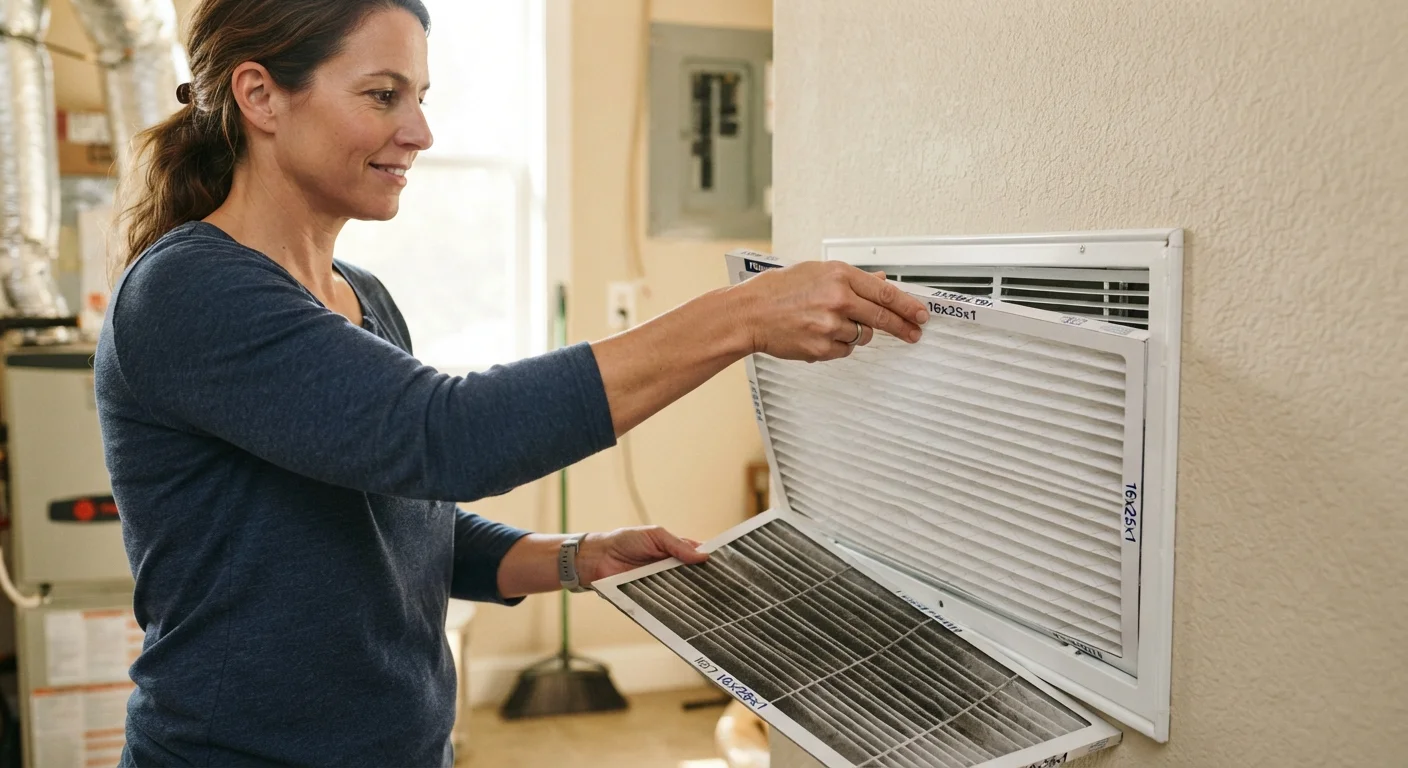
The air filter is your first line of defense. It traps dust, pet dander, pollen, and other particles before they circulate through your living space or coat sensitive internal components. A clogged filter forces the system's blower motor to work harder, driving up energy use and accelerating wear.
Choosing the Right Filter
Filters are rated by their MERV (Minimum Efficiency Reporting Value) score. Residential systems typically perform best with MERV 8–11 filters — enough to capture common allergens without restricting airflow. Very high MERV filters (13+) are designed for sensitive environments and can strain systems not built for them. Always verify your system's specifications before selecting a higher-rated filter.
How Often to Replace
- 1-inch flat filters: every 30–60 days
- 2-inch filters: every 60–90 days
- 4–5 inch media filters: every 6–12 months
Homes with pets, smokers, or allergy sufferers should lean toward the shorter end of each range. When you pull a filter out and hold it to the light, it should look gray and loaded — that means it was doing its job. A filter with visible debris buildup or one that's been in place more than three months is overdue.
Write the Date on Every New Filter
Use a marker to write the installation date directly on the cardboard frame of each new filter. This takes two seconds and eliminates guesswork about when it's due for replacement. Pair it with a phone reminder set for the appropriate interval and filter changes become automatic.
Evaporator and Condenser Coils: What They Do and How to Care for Them
Your HVAC system has two sets of coils that work together to transfer heat. The evaporator coil sits indoors (usually in the air handler) and absorbs heat from inside air. The condenser coil is located in the outdoor unit and releases that heat outside. Both need to stay clean to transfer heat efficiently.
The Outdoor Condenser Coil
The outdoor unit's fins accumulate grass clippings, cottonwood seeds, and general debris. Homeowners can safely perform basic cleaning by:
- Turning off power to the unit at the disconnect box
- Removing any visible debris from the top and sides by hand
- Gently rinsing the fins with a garden hose — spray from the inside out if possible
- Allowing the unit to dry before restoring power
Avoid using a pressure washer, which can bend the delicate aluminum fins. Bent fins restrict airflow; a tool called a fin comb can straighten minor damage.
The Indoor Evaporator Coil
The evaporator coil is harder to access and easier to damage. Dust accumulates on the coil surface over time, acting as insulation and reducing heat transfer. If the coil becomes too dirty, it can ice over and halt cooling entirely. Professional cleaning with appropriate coil cleaners is the safest approach for most homeowners. If you notice ice forming on lines near the indoor unit, turn the system to fan-only mode and call a technician.
Never Run the System with Ice on the Coil
If you spot ice forming on refrigerant lines or the indoor unit, switch the thermostat to fan-only mode immediately — do not run heating or cooling. Running a frozen system can damage the compressor, which is one of the most expensive components to replace. Call an HVAC technician to diagnose the underlying cause before resuming normal operation.
Vents and Registers: Keeping Airflow Where It Belongs
Supply vents deliver conditioned air to rooms; return air grilles pull room air back to be filtered and reconditioned. Both need to stay clear and open for the system to maintain balanced pressure throughout the duct network.
What Homeowners Can Do
- Vacuum registers regularly — dust buildup on slats restricts airflow and gets recirculated
- Keep vents unobstructed — furniture, rugs, and drapes placed directly over vents reduce airflow significantly
- Check that dampers are open — many registers have a small lever to adjust airflow; make sure they're fully open in rooms you use regularly
- Inspect for condensation or mold — moisture around vents may signal a duct leak or humidity problem that warrants professional attention
Resist the temptation to close vents in unused rooms to cut energy costs. Doing so raises static pressure in the duct system, which can stress duct seams and reduce overall system efficiency. For homes where room-by-room temperature control is a priority, a zoning system is a more effective long-term solution. For broader home efficiency context, see energy efficiency upgrades that complement HVAC performance.
When to Call a Licensed HVAC Technician
Knowing your limits is part of good maintenance. Several HVAC tasks are either regulated by law, require specialized equipment, or carry genuine safety risks if performed incorrectly.
Always Hire a Pro For
- Refrigerant handling — adding or recovering refrigerant requires EPA Section 608 certification; it is illegal for unlicensed individuals to purchase or handle refrigerants
- Electrical component work — capacitors, contactors, and control boards involve high-voltage hazards
- Duct sealing and modification — improper duct work affects whole-system balance and may require permits
- Furnace heat exchanger inspection — a cracked heat exchanger can allow carbon monoxide to enter living spaces; this is a serious safety issue
A professional tune-up twice a year — spring for cooling, fall for heating — is a practical baseline for most homes. Technicians check refrigerant charge, test electrical connections, inspect the heat exchanger, and verify safety controls that homeowners cannot safely evaluate on their own.
Keeping a log of your filter changes, coil cleanings, and service visits also pays dividends down the road. As explained in keeping a home maintenance log, documented upkeep supports warranty claims and builds confidence with future buyers. And if you want to see how HVAC fits into the full picture of routine home care, home maintenance tasks first-time owners overlook is a practical complement to this guide.
ENERGY STAR: HVAC Maintenance Tips
The EPA's ENERGY STAR program offers straightforward guidance on HVAC upkeep, energy savings, and when professional service makes sense for residential systems.
Home Maintenance Log Template
A simple tracking sheet to record filter change dates, coil cleanings, and professional service visits — useful for warranty documentation and home resale.
Air Filter MERV Rating Explainer
A reference explaining MERV ratings in plain language, helping homeowners match filter efficiency to their system's capability and household needs.