

Key Takeaways
- The debt avalanche targets the highest-interest debt first, reducing total interest costs over time.
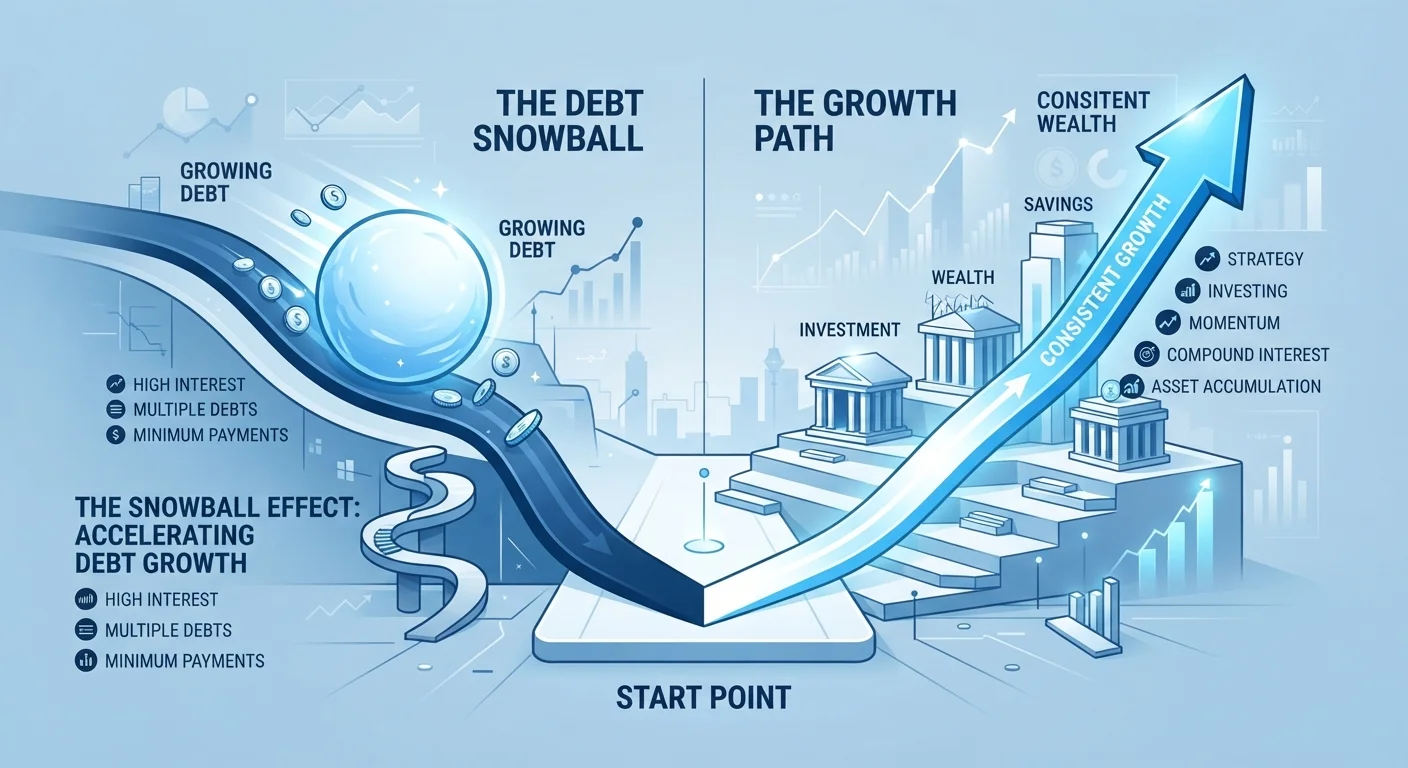
- The debt snowball targets the smallest balance first, delivering faster early wins that build momentum.
- Neither method requires extra income — both work by redirecting freed-up minimum payments to the next debt.
- Research suggests consistency matters more than which method you choose.
- Your personal motivation style is a legitimate factor when picking between the two.
Option A
Debt Avalanche
The mathematically efficient approach.
Best for: People who want to minimize total interest paid and are comfortable with a slower start.
Option B
Debt Snowball
The motivation-first approach.
Best for: People who need early wins to stay engaged and stick with their payoff plan.
If minimizing total interest paid is your top priority
Debt Avalanche
By attacking high-interest debt first, the avalanche method reduces how much you pay overall — often by a meaningful amount if you carry high-rate balances like credit cards.
If you've tried debt payoff before and lost momentum
Debt Snowball
Clearing small balances quickly creates tangible progress and has been shown in behavioral research to improve follow-through for many people.
If your debts carry similar interest rates
Debt Snowball
When rates are close, the interest savings from the avalanche are minimal — so the snowball's psychological boost may be the deciding factor.
If you carry one or two very high-rate debts alongside smaller ones
Debt Avalanche
A single high-APR balance can cost you significantly more the longer it lingers; eliminating it first limits the damage.
How Both Methods Actually Work
Both the debt avalanche and debt snowball follow the same basic structure: you make minimum payments on all your debts, then direct any extra money toward one specific target debt. When that debt is gone, you roll its former payment into the next target. The methods differ only in how they rank your debts.
Debt Avalanche: You rank debts by interest rate — highest to lowest — and focus extra payments on the highest-rate balance first, regardless of its size. Once it's gone, you move to the next highest rate. The logic is straightforward: high-interest debt grows the fastest, so eliminating it first limits what you pay overall.
Debt Snowball: You rank debts by balance — smallest to largest — and attack the smallest balance first. The interest rate is secondary. Once the smallest debt is gone, you redirect its payment toward the next smallest. Each payoff happens relatively quickly, which gives you a sense of forward momentum.
Neither method requires you to earn more money or cut expenses dramatically. They're organizational frameworks for debt you're already paying. For a broader look at how these strategies fit into your overall picture, see our budgeting basics hub.
How They Compare Head to Head
The clearest difference is financial efficiency versus psychological ease. Over a multi-debt payoff journey, those two things can pull in opposite directions.
| Criterion | Debt Avalanche | Debt Snowball |
|---|---|---|
| Payoff order | Highest interest rate first | Smallest balance first |
| Total interest paid | Generally lower | Potentially higher |
| First payoff timeline | Slower if top debt is large | Faster — smallest balance clears quickly |
| Motivation style | Numbers-driven, long-term focus | Progress-driven, near-term wins |
| Best debt mix | Wide spread of interest rates | Many small balances or similar rates |
| Complexity | Requires tracking rates carefully | Simple to follow and explain |
A hypothetical example makes this concrete: imagine you have three debts — $500 at 8% APR, $3,000 at 22% APR, and $7,000 at 14% APR. The avalanche targets the 22% debt first. The snowball targets the $500 balance first. You'll pay off that $500 in a matter of weeks under the snowball, but the 22% debt keeps accruing interest in the meantime. Over a full payoff timeline, that gap can add up to hundreds of dollars — though the exact amount depends on balances, rates, and how much extra you can pay each month.
It's also worth knowing that some people use a hybrid: they start with the snowball to clear one or two small balances for motivation, then switch to avalanche logic once they feel confident. There's nothing stopping you from adapting the approach as your circumstances change. For more on where well-intentioned plans can go sideways, see common debt payoff mistakes.
22%+
Typical APR on U.S. credit cards
The Federal Reserve has reported average credit card interest rates exceeding 20% APR in recent years, underscoring the cost of carrying high-rate balances.
$6,000+
Average U.S. credit card balance per holder
According to Federal Reserve consumer credit data, the average revolving balance carried by American households with credit card debt has remained in this range.
Choosing What Works for You
Personal finance research — including work published in journals studying consumer behavior — consistently finds that people who stick with a plan outperform those who abandon a theoretically optimal one. That means your own psychology is a real variable worth weighing, not a soft afterthought.
Ask yourself honestly: Have you started paying down debt before and stopped? If yes, the snowball's early wins may keep you engaged longer. Do you feel motivated by numbers and spreadsheets? The avalanche's measurable interest savings may be the reinforcement you need.
Also consider your debt mix. If your debts have similar interest rates, the avalanche's mathematical edge shrinks considerably — the snowball becomes more attractive simply because it offers faster feedback with little financial cost. If you carry a high-APR balance (say, a credit card above 20%), leaving that to grow while you pay off a $300 medical bill is a real cost worth calculating.
Before committing, it's also worth understanding what myths surround debt management. Our article on separating debt myths from reality covers common misconceptions that can steer people in the wrong direction. And if you're also trying to build savings at the same time, saving while carrying debt explores how to think through that balance.
Both Methods Assume Consistent Extra Payments
The avalanche and snowball only work if you can consistently pay more than the minimum each month. Before choosing a method, make sure your budget actually supports a regular extra payment — even a small one. If cash flow is tight, signs your debt may be unmanageable outlines signals worth knowing. Also consider whether debt consolidation might simplify your payments first — see our debt consolidation explainer.
This article is for general informational purposes only and does not constitute personalized financial advice. Consider speaking with a licensed financial professional about your specific situation.