

Key Takeaways
- Minimum payments are designed to keep you current, not to get you out of debt quickly.
- Daily compounding means interest accrues on your growing balance every single day.
- A $3,000 balance at 20% APR can take over a decade to repay on minimum payments alone.
- Even modest increases above the minimum can cut years and hundreds of dollars off your total cost.
- Understanding your card's APR is the first step to making a real payoff plan.
Minimum Payment
A minimum payment is the smallest amount a credit card issuer requires you to pay each billing cycle to keep your account in good standing. It is usually calculated as a small percentage of your outstanding balance — often around 1–3% — or a flat dollar amount, whichever is greater. Paying only this amount keeps you out of default but leaves the rest of your balance to accumulate interest charges.
Credit card interest is typically compounded daily using a daily periodic rate derived from the card's Annual Percentage Rate (APR). This means interest is charged on previously accrued interest, not just the original principal.
How Minimum Payments Are Structured
Credit card minimum payments are deliberately low. Issuers typically calculate them as roughly 1–3% of your current balance, plus any accrued interest and fees — or a set floor (often $25–$35), whichever is larger. When your balance is high, the minimum looks manageable. That's partly the point.
What looks like financial breathing room is actually a mechanism that keeps you carrying a balance — and accumulating interest — for a very long time. The minimum payment satisfies the issuer's requirement to keep your account current, but it does almost nothing to reduce the principal you owe.
For a grounded look at how debt myths can shape harmful habits, see common misconceptions about debt.
20%+
Average credit card APR in recent years
Federal Reserve data has shown average credit card interest rates exceeding 20% for accounts assessed interest, among the highest levels on record.
10+ years
Potential payoff timeline on minimum payments
Consumer Financial Protection Bureau resources illustrate that a moderate balance paid at minimums only can take well over a decade to clear, depending on the card's terms.
1–3%
Typical minimum payment as share of balance
Most major card issuers calculate the minimum as 1–3% of the outstanding balance or a fixed floor amount, whichever is greater, per standard card agreement terms.
The Compounding Interest Trap
Most credit cards charge interest daily, using a daily periodic rate calculated from your APR. If your card has a 20% APR, your daily rate is roughly 0.055%. That sounds tiny — until you realize it's applied to your entire remaining balance every single day, including any interest that has already built up.
Here's what that looks like in practice: If you carry a $3,000 balance at 20% APR and make only minimum payments, it can take well over 10 years to pay off, and you may pay more than $1,500 in interest on top of what you originally borrowed. The exact figures vary by card terms, but the direction is consistent: minimum payments drag out repayment and multiply your total cost significantly.
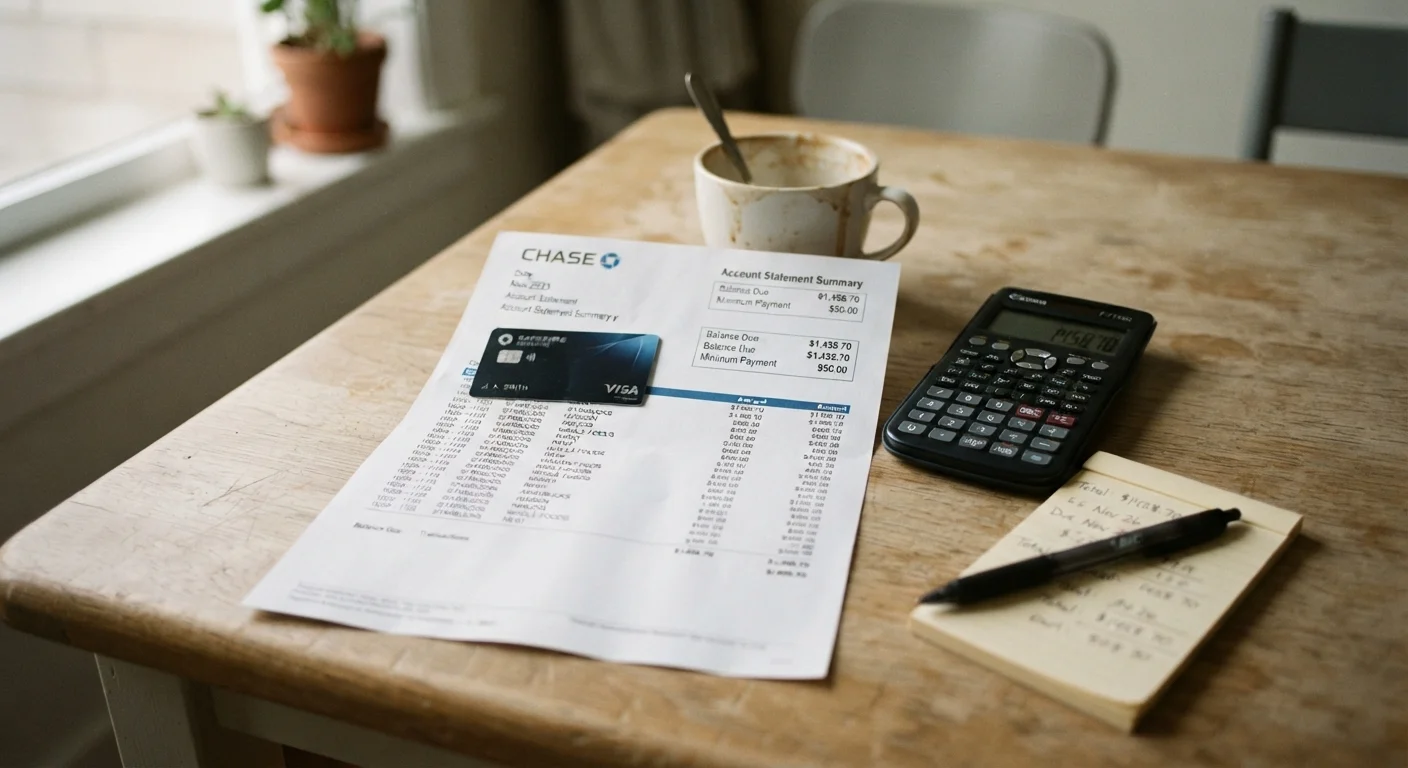
Your monthly statement is required by law (under the federal Credit CARD Act of 2009) to show you a payoff timeline based on minimum-only payments — and a comparison showing what you'd need to pay monthly to clear the balance in 36 months. That comparison alone is worth reading carefully.
APR Varies Widely by Card and Borrower
Credit card APRs can range from under 15% to over 30% depending on the card type, the issuer, and the cardholder's credit profile. The higher your rate, the more aggressively interest compounds on an unpaid balance. Always check your specific card agreement for the exact APR applied to purchases, balance transfers, and cash advances — they can differ.
What Even a Small Increase Can Do
You don't need to pay off everything at once to make a meaningful difference. Adding even $20–$50 above the minimum each month can shorten your repayment timeline by years and save a meaningful amount in interest — though the exact impact depends on your balance, APR, and payment schedule.
The math works in your favor when you consistently reduce the principal. Lower principal means less interest accrues the next day, which means more of every payment chips away at what you actually owe rather than servicing debt costs.
Use Your Statement's Built-In Math
Every credit card statement must include a minimum payment warning box that shows how long payoff takes at the minimum — and what monthly payment clears the balance in 3 years. Use that second number as a target, or get as close to it as your budget allows. You don't have to hit it perfectly; any amount above the minimum helps.
For a deeper look at how everyday spending decisions affect your financial picture over time, see how small daily habits shape your finances. And if you're weighing whether to pay down debt or build savings simultaneously, saving while carrying debt lays out the trade-offs clearly.
This article is for general informational and educational purposes only and does not constitute personalized financial advice. Consider consulting a licensed financial counselor or adviser for guidance specific to your situation.