

Key Takeaways
- EVs typically cost less to fuel per mile than gasoline vehicles, but electricity rates vary by region.
- EV maintenance costs tend to be lower due to fewer moving parts and no oil changes required.
- Higher purchase prices and potentially higher insurance premiums can offset EV running savings.
- Home charging availability significantly affects whether an EV delivers financial benefits.
- Federal and state incentives may reduce EV upfront costs, but eligibility rules apply.
- Long-term savings depend heavily on how many miles you drive and how long you own the vehicle.
Option A
Electric Vehicle (EV)
The lower-fuel-cost, higher-upfront-investment option.
Best for: Drivers with predictable daily commutes, home charging access, and plans to keep the vehicle for several years.
Option B
Gasoline Vehicle
The familiar, flexible choice with established infrastructure.
Best for: Drivers who frequently travel long distances, live in areas with limited charging access, or prefer lower purchase prices.
If you drive a high-mileage daily commute and have home charging
Electric Vehicle (EV)
Per-mile fuel savings and lower maintenance costs accumulate quickly for high-mileage drivers, and home charging eliminates dependence on public stations.
If you regularly drive long distances through areas with sparse charging infrastructure
Gasoline Vehicle
Gasoline's refueling network is far more extensive nationally, reducing range anxiety and unplanned stops on long trips.
If you want the lowest possible purchase price
Gasoline Vehicle
Comparable gasoline models typically carry a lower sticker price than EVs, making the upfront financial commitment smaller.
If you plan to own your vehicle for five or more years
Electric Vehicle (EV)
The longer you own an EV, the more time fuel and maintenance savings have to accumulate and offset the higher initial cost.
Fuel Costs: Electricity vs. Gasoline Per Mile
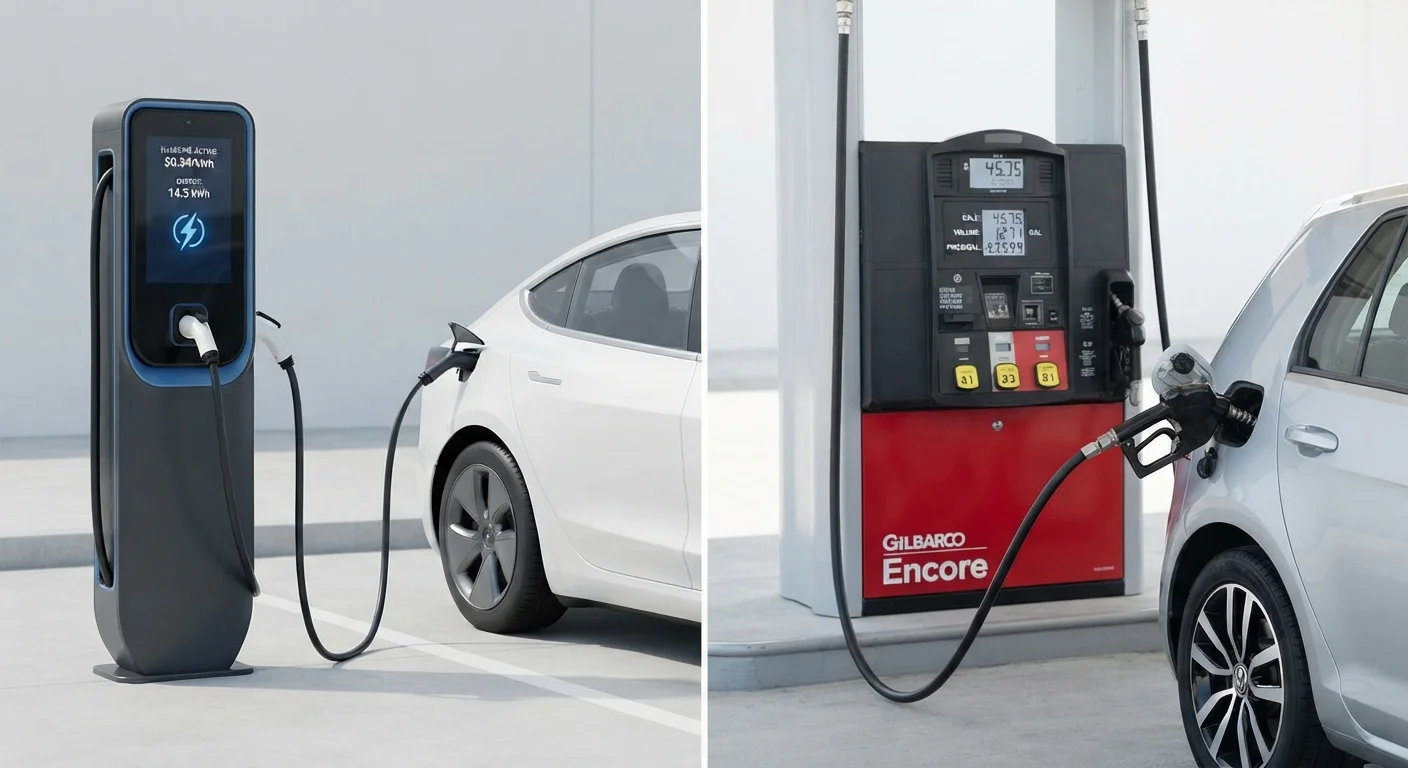
Fueling an EV costs less per mile for most American drivers than filling a gas tank - but the gap depends on where you live and how you charge. The U.S. Energy Information Administration (EIA) tracks both electricity and gasoline prices, and while both fluctuate, electricity has generally been the cheaper energy source per mile driven.
A rough comparison: at a national average of around $0.16 per kilowatt-hour (kWh) for residential electricity, a typical EV consuming roughly 3 miles per kWh costs approximately $0.05-$0.06 per mile to fuel. A gasoline vehicle averaging 30 miles per gallon at $3.50 per gallon costs roughly $0.12 per mile. That difference compounds over tens of thousands of miles. For a deeper framework on estimating those totals, see fuel costs over a vehicle's lifetime.
However, drivers who rely primarily on public DC fast-charging stations will often pay significantly more per kWh than home chargers, sometimes approaching or exceeding the per-mile cost of gasoline. Home charging access is therefore a meaningful factor in whether the fuel savings equation actually works in your favor.
~$0.05
Estimated EV cost per mile (home charging)
Based on a national average residential electricity rate near $0.16/kWh and typical EV efficiency of roughly 3 miles per kWh, per EIA data.
$0.12+
Estimated gasoline cost per mile
Calculated using an average retail gas price of $3.50/gallon for a vehicle achieving 30 MPG, a common benchmark for mid-size sedans.
~40%
Lower maintenance spending reported by EV owners
Consumer Reports surveys have found EV owners typically report significantly lower annual repair and maintenance costs than gas-vehicle owners.
Maintenance and Repair: Fewer Parts, Fewer Bills?
EVs have far fewer moving mechanical components than gasoline vehicles. They don't require oil changes, transmission fluid services, spark plug replacements, or exhaust system repairs. Consumer Reports research has indicated that EV owners generally spend less annually on maintenance and unplanned repairs than owners of comparable gas-powered vehicles - though battery replacement, if ever needed outside warranty, can be a large expense.
Gasoline vehicles involve recurring scheduled maintenance: oil changes typically every 5,000-7,500 miles, coolant flushes, air filter replacements, and more. These costs are individually modest but add up steadily. A well-documented picture of these ongoing expenses appears in our guide to the true cost of owning a car in America.
Both vehicle types still require tire rotations, brake fluid checks, and windshield wiper replacements. EVs also use regenerative braking, which recaptures energy when slowing down and reduces wear on physical brake pads - another incremental savings over time.
| Criterion | Electric Vehicle | Gasoline Vehicle |
|---|---|---|
| Avg. fuel cost per mile | ~$0.05-$0.07 (home charging) | ~$0.10-$0.14 (30 MPG avg.) |
| Oil changes required | None | Every 5,000-7,500 miles |
| Typical purchase price premium | Higher (often $5,000-$15,000 more) | Lower baseline price |
| Insurance premiums | Generally higher | Generally lower |
| Refueling infrastructure | Expanding but uneven nationally | Extensive nationwide network |
| Brake maintenance | Reduced (regenerative braking) | Standard wear schedule |
| Long-term running cost | Lower for high-mileage drivers | Higher fuel and maintenance spend |
Purchase Price, Insurance, and Hidden Costs
The upfront cost of an EV has historically been higher than a comparable gasoline model. Federal tax credits of up to $7,500 under the Inflation Reduction Act are available for qualifying new EVs, and some states add their own incentives - but income caps, vehicle price limits, and sourcing requirements mean not every buyer or vehicle qualifies. Verify current eligibility through the IRS or your state's energy office before factoring incentives into your budget.
Insurance premiums for EVs tend to run somewhat higher than for equivalent gas vehicles. This reflects the higher vehicle value, the cost of specialized battery components, and repair labor that requires EV-certified technicians. The difference isn't uniform - it varies by insurer, model, and driver profile - but it's worth obtaining quotes for both before deciding.
Depreciation is another variable worth watching. Early EV models experienced steeper depreciation than expected due to rapid technology changes, though this has moderated as the market matures. Our article on new car vs. used car total cost of ownership covers how depreciation affects long-term value for both vehicle types.
Federal EV Tax Credit: Check Eligibility Carefully
The federal EV tax credit of up to $7,500 applies only to vehicles and buyers meeting specific criteria under the Inflation Reduction Act, including income limits, vehicle MSRP caps, and battery sourcing requirements. The credit is nonrefundable, meaning it can only offset tax you already owe. Always verify current eligibility rules directly through the IRS website or a qualified tax professional before making purchase decisions based on this incentive.
Making the Decision: What to Weigh
No single answer fits every driver. Your break-even point - the mileage at which EV savings offset the higher purchase price - depends on your local electricity rates, gasoline prices, driving habits, and how long you keep the vehicle. Drivers who log 15,000+ miles per year in high-gas-price regions tend to see the strongest financial case for EVs. Lower-mileage drivers or those in low-electricity-cost regions may find the math less compelling.
Be cautious about assumptions that don't fit your situation. Many common beliefs about vehicle expenses - including fuel economy estimates and maintenance skipping - are explored in our piece on common assumptions about car costs that lead drivers astray. Applying realistic numbers to your own driving patterns will produce a far more useful comparison than industry averages alone.
For drivers already holding a paid-off gasoline vehicle, it's worth asking whether the savings from switching justify the new purchase. Keeping a personal vehicle longer carries its own financial trade-offs that deserve honest consideration alongside any EV switch.