

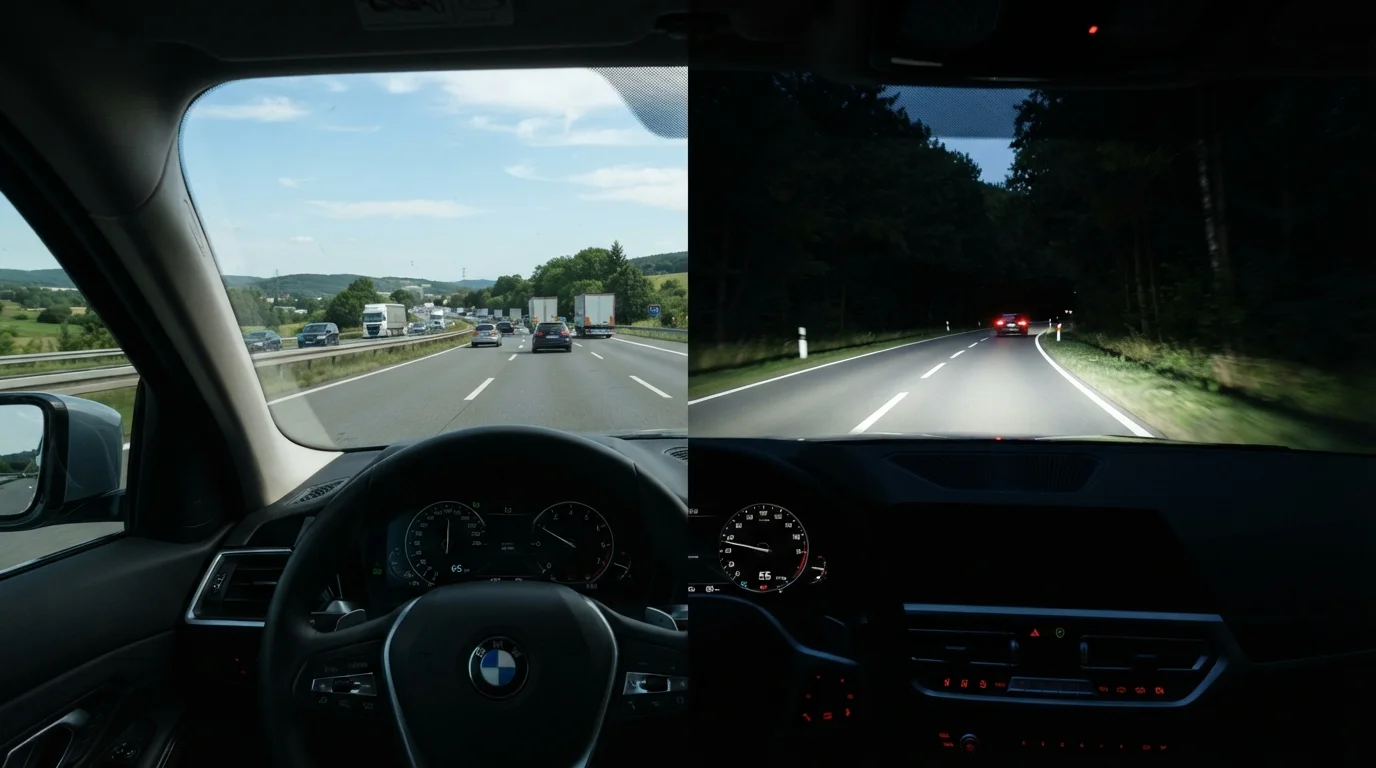
Key Takeaways
- Nighttime driving accounts for a disproportionate share of fatal crashes despite lower overall traffic volume.
- Reduced visibility at night limits hazard detection distance and compresses your available reaction time.
- Headlight aim, eye fatigue, and impaired drivers on the road all add unique risk after dark.
- Slowing down and increasing following distance are the most effective adjustments for nighttime driving.
- A brief pre-trip check of lights and mirrors pays off more at night than at any other time.
Option A
Daytime Driving
The higher-volume, lower-risk baseline.
Best for: Most routine commutes, errands, and trips where full visibility and alert conditions are available.
Option B
Nighttime Driving
The lower-volume, higher-risk window.
Best for: Essential after-dark travel requiring heightened awareness, adjusted speed, and deliberate defensive habits.
If you drive primarily during morning or afternoon commutes
Daytime Driving
Daylight provides maximum visibility and hazard detection distance. Focus on traffic density and distraction management rather than low-light techniques.
If you regularly drive after sunset or before dawn
Nighttime Driving
After-dark trips require a specific set of habits - reduced speed, increased following distance, and attention to headlight condition - that daytime routines don't demand.
If you experience drowsiness or eye strain on long drives
Daytime Driving
Fatigue compounds nighttime risk significantly. Scheduling longer drives during daylight hours when alertness is naturally higher reduces this compounding hazard.
If you cannot avoid overnight or late-evening travel
Nighttime Driving
Understanding how nighttime risk differs from daytime helps you apply the right countermeasures rather than driving after dark with a daytime mindset.
How the Numbers Break Down
Traffic volume drops significantly after dark - yet the share of fatal crashes does not drop proportionally. According to the National Safety Council, the fatal crash rate per mile driven is roughly three times higher at night than during the day. Fewer cars on the road does not translate to a safer environment when visibility, driver alertness, and the likelihood of encountering impaired road users all shift against you.
Understanding why nighttime is statistically riskier is the first step toward adjusting your behavior to close that gap. The risks are not random - they follow predictable patterns that informed drivers can address directly.
~3×
Higher fatal crash rate per mile at night
The National Safety Council estimates the nighttime fatal crash rate per mile driven is approximately three times the daytime rate.
50%
Of traffic deaths occur at night
Despite carrying a minority of total traffic volume, nighttime hours account for roughly half of all U.S. traffic fatalities, according to NHTSA data.
160-250 ft
Typical low-beam headlight range
Standard low beams illuminate approximately 160 to 250 feet ahead - a distance that closes quickly at highway speeds.
Visibility: The Core Difference
During the day, ambient light lets you read the road well ahead. At night, your usable field of vision narrows to whatever your headlights illuminate - typically 160 to 250 feet for low beams. At 55 mph, you're covering roughly 80 feet per second, which means a hazard at the edge of your low-beam range gives you only about two to three seconds to react. That margin shrinks fast if your headlights are aimed too low, fogged by oxidation, or simply underpowered for the speed you're traveling.
High beams extend that range considerably - up to 350-500 feet on a clear road - but many drivers underuse them out of habit or forget to dip them for oncoming traffic. Use high beams on unlit rural roads whenever no other vehicle is within range, and switch back promptly. This single habit meaningfully expands your hazard detection window.
| Criterion | Daytime Driving | Nighttime Driving |
|---|---|---|
| Visibility range | Full ambient light; broad field of view | Limited to headlight beam (160-500 ft) |
| Fatal crash rate per mile | Lower baseline rate | Roughly 3× higher than daytime |
| Traffic volume | Higher - peak commute hours | Lower - but hazard density rises |
| Impaired driver risk | Present but lower probability | Significantly elevated, especially weekends |
| Pedestrian/cyclist visibility | Generally easy to detect | Often poorly lit; detection delayed |
| Driver fatigue factor | Lower during peak alert hours | Higher; circadian dips compound risk |
| Recommended following distance | 3 seconds minimum | 4-5 seconds recommended |
For a systematic look at what else your mirrors and sightlines can miss - day or night - see our article on blind spot awareness.
Unique Nighttime Hazards
Three categories of hazard spike specifically after dark:
- Impaired drivers. Drunk and drug-impaired driving incidents are heavily concentrated in late-night and early-morning hours, particularly on weekends. This means other road users become less predictable at exactly the time your own visibility is lowest.
- Pedestrians and cyclists. Many are poorly lit or entirely unlit. A pedestrian in dark clothing on an unlit road can be nearly invisible until they're dangerously close.
- Wildlife and road debris. Animals are more active at dawn and dusk. Debris that would be easily spotted in daylight can appear with almost no warning in headlamp beams.
These hazards don't disappear in daytime, but they're meaningfully more frequent or more dangerous after dark. Defensive driving principles become especially valuable when hazards are harder to see and predict.
Dawn and Dusk: The Transition Zone
The hour after sunset and the hour before sunrise carry some of the highest risk of any driving period. Ambient light is low enough to impair visibility but bright enough that many drivers delay switching on their headlights. In most U.S. states, headlights are legally required from sunset to sunrise - but turning them on earlier during low-light conditions is always the safer habit. If you're using windshield wipers, your headlights should be on.
Adjustments That Actually Help
The most impactful nighttime adjustments are behavioral, not technological:
- Reduce speed below the posted limit when visibility is genuinely limited. Speed limits are set for ideal conditions. At night on an unlit road, slowing down by 5-10 mph can double your reaction window.
- Increase your following distance. The standard three-second rule is a daytime baseline. At night, extend this to four or five seconds to account for reduced visibility and longer reaction chains.
- Check your headlights before driving. Confirm both beams work, lenses are clean, and aim is correct. A pre-trip light check takes under a minute and pays dividends after dark.
- Dim your dashboard and interior screens. Bright infotainment displays can degrade your dark adaptation (your eyes' adjustment to low light), reducing how well you see beyond your headlight zone.
- Take breaks on long nighttime drives. Fatigue is a major contributor to after-dark crashes. If you feel drowsy, stopping is not optional - it's the correct safety decision.
Overconfidence is a real risk here too. Familiarity with a route can cause experienced drivers to underestimate how much night changes the hazard picture. Our article on why experienced drivers still make dangerous assumptions explores this dynamic in depth.