

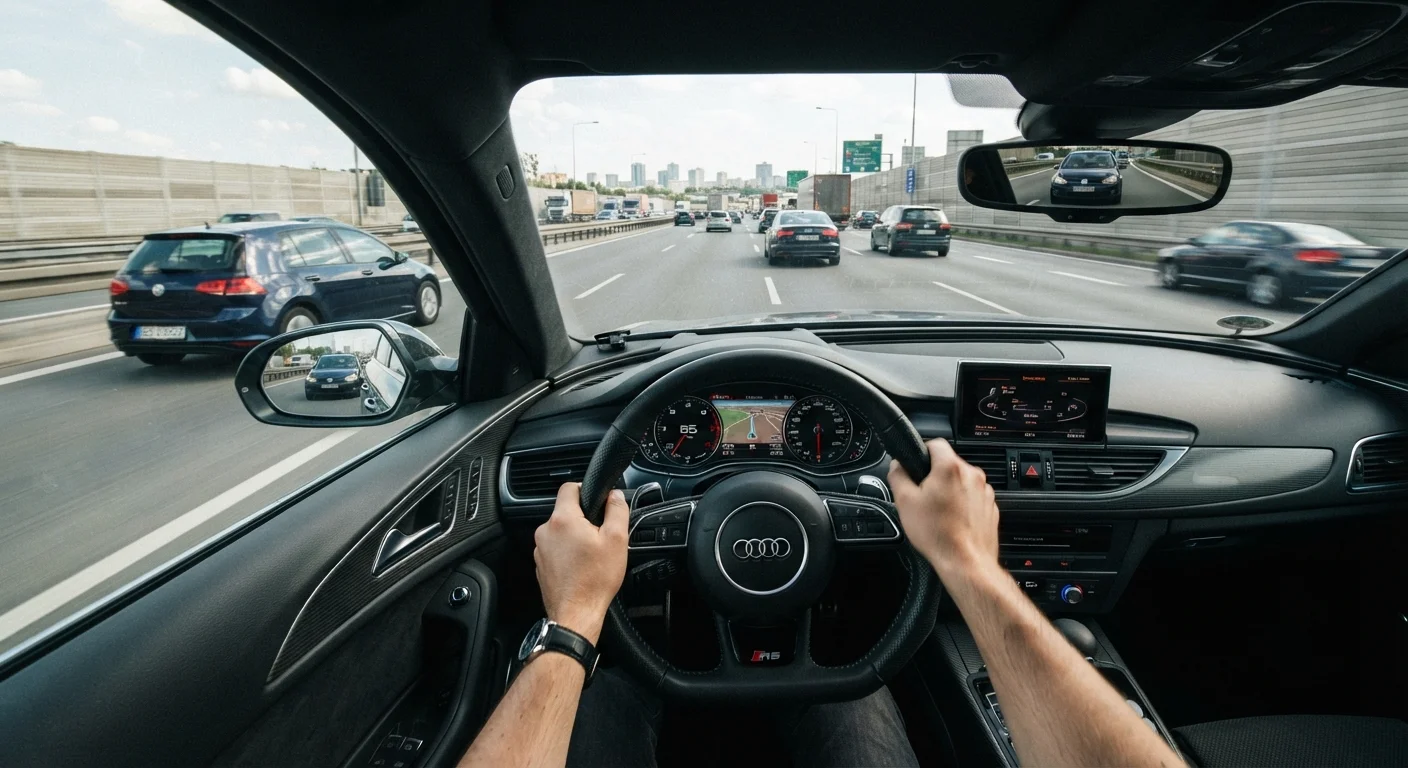
| Primary blind spot location | Rear quarters, roughly from the B-pillar back on both sides |
| Backup camera requirement (U.S.) | Federally mandated on new passenger vehicles since May 2018 (NHTSA Federal Motor Vehicle Safety Standard No. 111) |
| Vehicles with largest blind zones | Large SUVs, pickup trucks, semi-trucks, and full-size vans |
| Head check angle for lane change | Approximately 45 degrees toward the target lane |
| BSM system limitation | May not reliably detect fast-approaching motorcycles or cyclists |
| Mirror adjustment goal | Minimize vehicle self-view; maximize lateral road coverage |
Where Your Mirrors Actually Fall Short
Your mirrors cover a lot of ground - but not all of it. Every passenger vehicle has areas alongside and behind it that no mirror configuration can fully reveal. These uncovered zones, commonly called blind spots, are where lane-change crashes most often originate.
For a typical sedan, the primary blind spots sit on both rear quarters - roughly from the B-pillar (the structural post between your front and rear side windows) backward to the tail of the vehicle. Drivers of SUVs, pickup trucks, and vans face larger blind zones because their body panels are taller and wider, blocking more of the surrounding road.
The rear blind spot is also significant. When reversing out of a parking space, children, cyclists, and low-profile objects disappear entirely below the sightline of the rear window and side mirrors - one reason backup cameras became federally required on new passenger vehicles sold in the U.S. starting in 2018.
| Primary blind spot location | Rear quarters, roughly from the B-pillar back on both sides |
| Backup camera requirement (U.S.) | Federally mandated on new passenger vehicles since May 2018 (NHTSA Federal Motor Vehicle Safety Standard No. 111) |
| Vehicles with largest blind zones | Large SUVs, pickup trucks, semi-trucks, and full-size vans |
| Head check angle for lane change | Approximately 45 degrees toward the target lane |
| BSM system limitation | May not reliably detect fast-approaching motorcycles or cyclists |
| Mirror adjustment goal | Minimize vehicle self-view; maximize lateral road coverage |
Before any lane change, consider reading our pre-trip safety routine - adjusting mirrors correctly is a foundational step that starts before the engine turns over.
How to Adjust Mirrors to Minimize (Not Eliminate) Blind Spots
The most common mirror mistake is angling side mirrors so you can see the side of your own car. While that feels reassuring, it wastes coverage on metal you already know is there. A better approach:
- Driver's side mirror: Lean your head until it nearly touches the window, then adjust the mirror outward until you can just barely see your vehicle's flank at the inner edge. From your normal driving position, your car should no longer be visible.
- Passenger's side mirror: Lean toward the center console, then repeat the same process - adjust until your car's body just disappears from view.
- Rearview mirror: Set it to frame the full rear window from your normal seated posture. Tilting it slightly downward at night reduces glare from trailing headlights.
This wider outward angle narrows the gap between what your side mirrors show and what your rearview captures, reducing - but not eliminating - the rear-quarter blind zone. A physical head check (turning your head roughly 45 degrees toward the lane you're entering) remains essential before every lane change.
Blind spot
An area around your vehicle that cannot be seen through mirrors alone from the driver's normal seated position. It typically refers to the rear-quarter zones on both sides of the car.
B-pillar
The vertical structural post between the front and rear side windows of a vehicle. It often marks the forward boundary of the rear-quarter blind zone.
Blind Spot Monitoring (BSM)
An electronic driver-assistance feature that uses sensors or cameras to detect vehicles in adjacent lanes and alert the driver, typically via a warning light in or near the side mirror.
Shoulder check
A deliberate head turn of roughly 45 degrees toward the lane you intend to enter, performed immediately before changing lanes to visually confirm the blind spot is clear.
Rear-quarter blind zone
The area on either side of a vehicle, behind the driver's peripheral vision and beyond what the side mirrors capture, where another vehicle or cyclist can travel undetected.
Blind Spot Habits That Actually Reduce Risk
Technology and mirror technique both help, but driving habits close the gap further. These practices are grounded in standard defensive driving guidance:
- Signal first, check second, then move. Signaling early gives nearby drivers a chance to react before you initiate the lane change.
- Time your shoulder check. The head check should happen in the final moment before you steer - not several seconds earlier when traffic positions have already shifted.
- Avoid lingering in others' blind spots. If you can't see a truck driver's mirrors, they almost certainly can't see you. Pass quickly or drop back to a position where you're visible.
- Speed up, don't slow down, when merging. Hesitating mid-merge creates unpredictable speed differentials. Match the flow of the lane you're entering.
- Use BSM systems as a supplement, not a substitute. Electronic blind spot monitoring alerts are useful but have limits - they can miss fast-approaching motorcycles or cyclists in some conditions.
Overconfidence is a real factor here. Experienced drivers still make dangerous assumptions about familiar roads and their own reaction time - habits that erode the checks that actually keep lane changes safe.
Blind spots also interact with pedestrians and cyclists sharing the road, who may be moving at speeds or from angles that mirrors can't reliably track, especially in urban environments.
When Conditions Make Blind Spots Worse
Certain driving conditions amplify the risk already present in your vehicle's blind zones:
- Night driving reduces contrast and makes it harder to detect movement in peripheral vision. Nighttime driving shifts your risk profile in ways that go beyond simple visibility - reaction time and depth perception are also affected.
- Rain, fog, and dirty mirrors scatter light and reduce the effective range of mirror visibility. Cleaning mirrors as part of your pre-drive routine matters more than most drivers realize.
- Cargo and passengers blocking the rear window eliminate your rearview mirror's usefulness. In these situations, side mirrors and shoulder checks carry the full load.
- Distraction compounds every blind spot. Distraction takes many forms beyond phone use, and any cognitive gap between a driver and the road makes visual checks less reliable even when performed.
BSM Technology Has Real Limits
Blind Spot Monitoring systems are a useful safety layer, but they are not foolproof. Sensors can be affected by heavy rain, snow, or sensor blockage, and some systems have slower response times to motorcycles traveling at high speed. Treat any BSM alert as a prompt to perform a visual shoulder check - not as a clearance to move. Always verify with your own eyes before changing lanes.
This article is for general informational and educational purposes only. Always follow your state's traffic laws and consult a certified driving instructor for personalized guidance on safe driving techniques.