

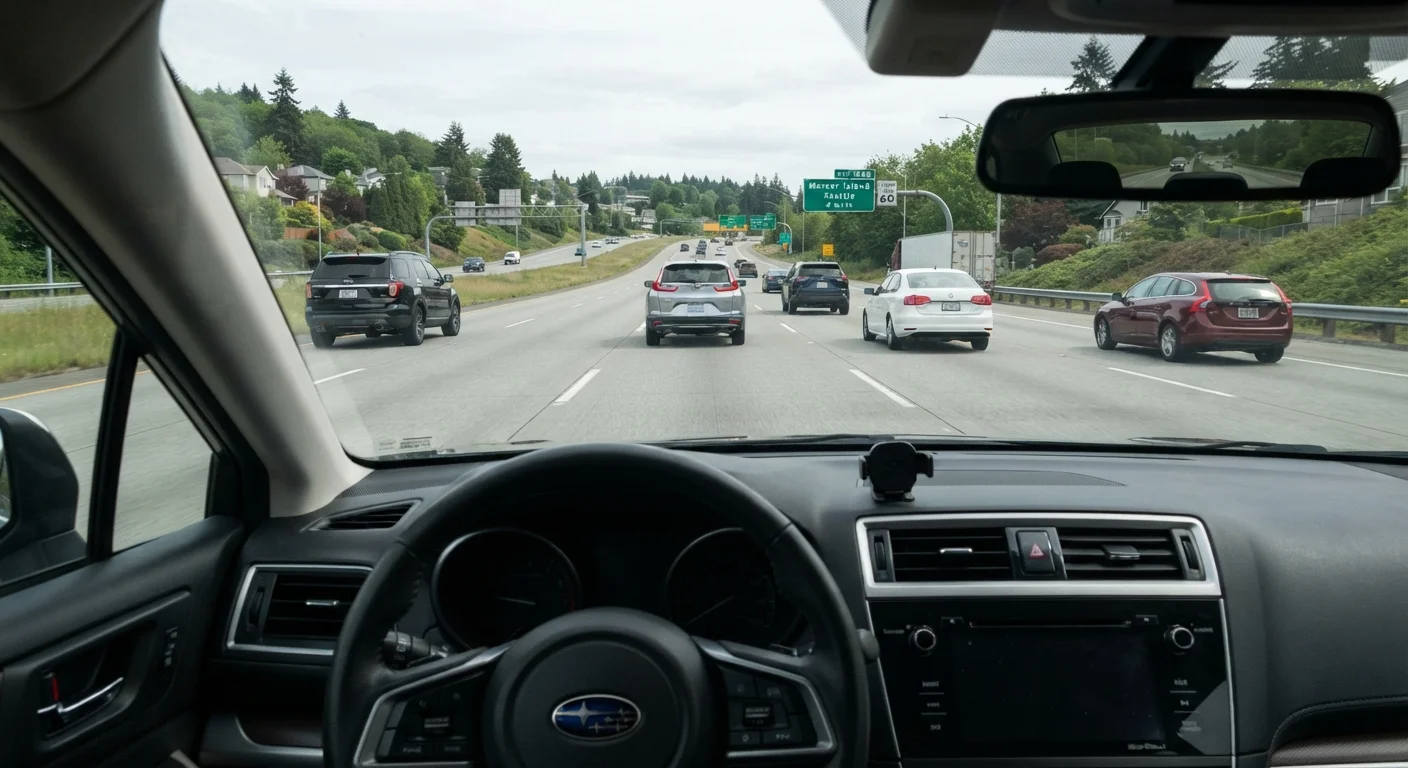
Key Takeaways
- The two-second rule gives you a minimum safe following distance, not an ideal one.
- Speed, weather, road surface, and vehicle load all require you to extend the gap.
- Reaction time alone averages 1.5 seconds - leaving almost no room for braking within a two-second gap at highway speeds.
- Trucks, motorcycles, and towing setups need significantly longer following distances.
- Adjusting your gap costs you almost no extra travel time but dramatically reduces crash risk.
The Two-Second Rule
The two-second rule is a simple guideline that recommends keeping at least two seconds of travel time between your vehicle and the one ahead. To measure it, pick a fixed point - a sign or overpass - and count how long after the car in front passes it before you reach the same point. If you get there in under two seconds, you're following too closely.
Two seconds translates to roughly one car length per 10 mph of speed, meaning at 60 mph you'd want about 176 feet of gap - though many safety engineers recommend three to four seconds as a more practical buffer under real driving conditions.
Why Two Seconds Is a Starting Point, Not a Finish Line
The two-second rule has been taught in driver's education for decades, and it works - as a floor. What it doesn't account for is the full physics of stopping a moving vehicle, the variability of human reaction time, or the many conditions that extend your braking needs well beyond that baseline gap.
Understanding why the rule exists helps you use it more intelligently. At 30 mph, two seconds gives you roughly 88 feet of space. At 60 mph, that gap doubles to about 176 feet - but your braking distance more than doubles due to kinetic energy. Speed increases stopping distance exponentially, not linearly. That's the core reason two seconds at freeway speeds often isn't enough.
Defensive driving is built on anticipating hazards before they develop, and following distance is one of the clearest expressions of that mindset.
~40%
Rear-end crashes as share of all U.S. collisions
The NHTSA estimates rear-end crashes represent roughly 40% of all crashes reported in the U.S., with following too closely consistently cited as a primary contributing factor.
1.5 sec
Average driver reaction time before braking
Research from the Transportation Research Board indicates average reaction time for an alert, unimpaired driver is approximately 1.5 seconds - which itself consumes most of a two-second gap at highway speeds.
300+ ft
Total stopping distance at 60 mph on dry pavement
Combining reaction distance and braking distance, a typical passenger car traveling at 60 mph on dry pavement requires over 300 feet to come to a complete stop - longer than the gap provided by the two-second rule at that speed.
The Math: Reaction Time, Braking Distance, and Total Stopping Distance
Total stopping distance has two components: reaction distance (how far you travel before your foot hits the brake) and braking distance (how far you travel while the brakes are actually working). At 60 mph with an average reaction time of 1.5 seconds, you've already covered 132 feet before braking even begins.
Once braking starts, a typical passenger car in good condition on dry pavement needs roughly 180 feet to stop from 60 mph. That's a total stopping distance of over 300 feet - more than the length of a football field. A two-second gap at 60 mph gives you only 176 feet. The math doesn't favor the minimum.
“Most drivers dramatically underestimate how long it takes to stop. They think they're leaving enough room, but reaction time alone often consumes the gap before the brakes do any work.”
— Traffic Safety Research Community, Broad consensus reflected in road safety literature and driver education curricula
Fatigue, distraction, and even moderate blood-alcohol content each add fractions of a second to reaction time - fractions that translate to dozens of additional feet of travel before your foot even touches the brake pedal.
When to Extend the Gap (and by How Much)
Several real-world conditions require you to add time to your baseline buffer:
- Wet or slick roads: Wet pavement roughly doubles stopping distance; ice can increase it by a factor of eight to ten. In rain, use four seconds minimum. In snow or ice, six or more seconds is a reasonable target.
- Reduced visibility: Fog, glare, or heavy rain limits how far ahead you can see - your gap needs to cover what you can't yet see, not just what you can.
- Towing or heavy load: Added weight dramatically increases stopping distance. A loaded pickup towing a trailer may need two to three times the distance of the same truck unladen.
- Older vehicles or worn brakes: Brake fade, worn pads, or aging tires all reduce stopping effectiveness. If your vehicle is overdue for brake service, compensate with extra space.
- Following large trucks: Trucks take significantly longer to stop than passenger cars. Tailgating a semi also eliminates your view of the road ahead - a serious visibility problem.
A Simple Way to Recalibrate Your Gap
If you're unsure whether you're maintaining enough space, practice the landmark count on your next drive. Choose a highway marker, bridge shadow, or painted line. Count from when the car ahead passes it until you do. Make this a weekly habit until correct spacing becomes instinctive.
The cost of adding one or two extra seconds of gap is nearly zero in terms of travel time. On a 30-minute commute, maintaining a three-second gap instead of two costs you fewer than 30 additional seconds of travel. The safety return is disproportionately large - something explored further in this look at what tailgating actually costs drivers.
Building the Habit: Practical Ways to Stay Consistent
Knowing the rule intellectually and applying it consistently while driving are two different things. Drivers frequently close gaps unconsciously, especially in heavy traffic where others fill the space ahead. A few techniques help:
- Use the landmark count actively: Don't rely on feel. Periodically test your gap using the landmark method, especially when traffic density or speed changes.
- Resist the urge to fill gaps: When you increase your following distance and another driver moves into that space, resist the impulse to close back in. Simply reclaim the gap gradually.
- Adjust for the vehicle you're driving: Rental vehicles, unfamiliar cars, trucks, and vehicles hauling weight all handle differently. Give yourself extra margin when the vehicle is less familiar.
- Treat city driving as seriously as highway driving: Low-speed urban collisions are extremely common. Pedestrian and cyclist interactions require the same gap discipline at 25 mph as highway driving does at 65.
This article provides general driving safety information for educational purposes. Always follow your state's traffic laws and consult official driver safety resources for guidance specific to your vehicle and local conditions.