

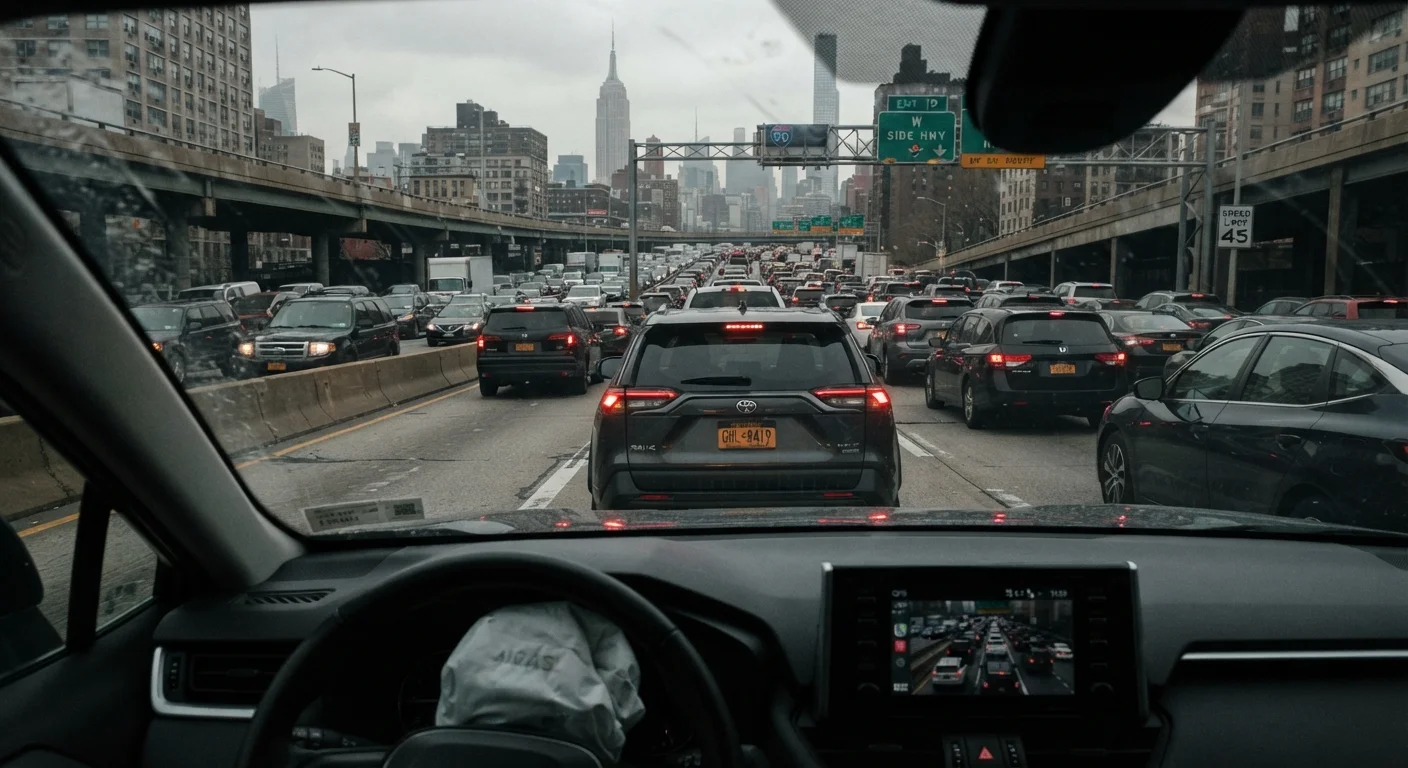
Key Takeaways
- Tailgating contributes to a significant share of rear-end crashes, the most common collision type in the U.S.
- Psychological and situational factors - not just impatience - explain why drivers follow too closely.
- Rear-end crashes caused by tailgating carry real financial consequences: repair bills, insurance rate increases, and potential liability.
- Maintaining a two-second-plus following gap costs nothing and meaningfully reduces crash risk.
- Experienced drivers are not immune - overconfidence and route familiarity often erode safe habits over time.
Tailgating
Tailgating means following the vehicle ahead of you more closely than is safe for your speed and road conditions. It reduces the time and distance available to react if traffic suddenly slows or stops. Most traffic safety guidelines recommend maintaining at least a two-second gap between your vehicle and the one ahead - more in wet, icy, or heavy traffic conditions.
Reaction time alone averages 1.5 seconds for most drivers; at 60 mph, a vehicle travels roughly 132 feet before braking even begins. A gap of less than one second offers virtually no stopping margin at highway speeds.
Why Drivers Tailgate - Even When They Know Better
Tailgating is rarely a calculated decision. In most cases it emerges from a mix of cognitive shortcuts, emotional pressure, and environmental cues that feel normal in the moment. Understanding the drivers behind the behavior is the first step toward changing it.
Overconfidence in reaction time. Many drivers believe they can stop faster than physics allows. At 65 mph, stopping distance for an average vehicle - including reaction time - exceeds 300 feet. Most people significantly underestimate that figure, leading them to feel safe at gaps they're not. This is a classic pattern explored in why experienced drivers still make dangerous assumptions.
Traffic normalization. On congested urban highways, nearly everyone is following closely. When surrounding drivers maintain the same short gap, the behavior feels acceptable - even when it objectively isn't. Social conformity is a powerful override for safety instincts.
Frustration and time pressure. Running late, stuck behind a slow-moving vehicle, or simply frustrated by traffic - these emotional states compress a driver's risk tolerance. The urge to close the gap feels like a solution, even though it creates more danger than it resolves.
Habituation on familiar routes. Drivers who commute the same road daily often operate on autopilot. Familiarity breeds a false sense of control, and safety margins quietly erode over months of repetition.
Reframe the Gap as a Safety Buffer, Not Lost Time
A three-car gap at highway speed feels like wasted space, but it represents roughly three seconds of decision time. That's the difference between a controlled stop and a collision. Remind yourself when the urge to close the gap arises: the space is doing its job.
The Real Cost: Crashes, Repairs, and Rising Premiums
Rear-end collisions are the most frequently occurring crash type in the United States, and following too closely is a leading contributing factor. The financial fallout extends well beyond the initial repair bill.
~29%
Share of all U.S. crashes that are rear-end collisions
According to the National Highway Traffic Safety Administration (NHTSA), rear-end crashes consistently represent the most common crash type on American roads.
1.5 sec
Average driver reaction time before braking begins
At 60 mph, 1.5 seconds of reaction time translates to approximately 132 feet of travel before the brakes engage - before any actual stopping occurs.
$2,000-$8,000+
Typical rear-end repair cost range
Repair costs vary by vehicle and impact severity, but modern bumper assemblies with integrated sensors significantly raise the cost of even low-speed rear-end damage.
Repair costs for rear-end damage vary widely by vehicle, but even a low-speed impact can trigger $2,000-$8,000 in repairs when sensors, bumper assemblies, cameras, and frame alignment are involved. Modern vehicles pack expensive safety technology into their rear and front fascias that older bumpers never contained.
Insurance rate increases following an at-fault rear-end crash are substantial and persistent. Surcharges typically remain on a policy for three to five years depending on the insurer and state. For drivers already paying average U.S. premiums, an at-fault crash can add hundreds of dollars per year in additional cost. These are the kinds of expenses covered in detail in our hub on car ownership costs.
Legal liability is a further exposure. In multi-vehicle pile-ups originating from a tailgating driver, liability can extend across several damaged vehicles and injury claims - well beyond what a single insurance policy covers.
Tailgating also accelerates wear on brakes and tires through more frequent hard stops. Tire health and brake pad life are directly affected by driving style, and aggressive following habits quietly raise maintenance costs over time. For a broader look at overlooked vehicle expenses, see where drivers overspend on their vehicles.
How to Build a Safer Following Habit
Changing a deeply ingrained driving behavior requires replacing instinct with a deliberate process - until the new behavior becomes the habit.
Use the two-second method consistently. Pick a fixed point on the road - a sign, a bridge, a painted line. When the vehicle ahead passes it, count: one-thousand-one, one-thousand-two. Your front bumper should not reach that point before you finish counting. At highway speeds or in poor conditions, extend to three or four seconds. The full explanation is in our guide on safe following distance.
Anticipate, don't react. Defensive drivers scan further ahead than the vehicle immediately in front of them. Watching two or three cars ahead gives earlier warning of slowdowns, making hard braking - and the tailgating that necessitates it - less likely. This is central to defensive driving on American roads.
Manage lane-change and merge habits. Drivers who follow closely are often the same ones who merge aggressively. Improving your highway merging technique reduces the situations where tailgating feels necessary.
Revisit cruise control use. On open highways, cruise control helps maintain a consistent speed and, by extension, a more stable following distance. However, using it in heavy or variable traffic can actually reduce your responsiveness - a nuance covered in our piece on cruise control in traffic.
Weather and Load Change the Equation
The two-second rule applies under normal, dry conditions. Rain, ice, fog, or carrying a heavy load all extend stopping distances significantly. In wet conditions, doubling your following gap to four seconds is a reasonable starting point. Towing a trailer or driving a larger vehicle requires even more space due to added weight and braking demands.
The extra few seconds of space that a proper following gap requires will not meaningfully change your arrival time. It will, however, meaningfully change your crash risk.