
Interleaving: The Counterintuitive Practice Schedule That Boosts Long-Term Recall

Key Takeaways
- Interleaving means switching between topics or problem types within one session, not finishing one block before starting another.
- Learners typically feel interleaving is harder than blocked practice, but that difficulty is a sign of productive struggle.
- Research suggests interleaving improves long-term recall and the ability to recognize which strategy to use in new situations.
- Interleaving works well alongside spaced repetition and active recall for a comprehensive study approach.
- Start small: even alternating between two related topics in one session delivers measurable benefits.
Interleaving
Interleaving is a study strategy in which a learner switches between different topics, problem types, or subjects within a single study session rather than finishing all of one type before moving to another. Instead of doing 30 math problems of the same kind in a row, an interleaved session might alternate between algebra, geometry, and statistics problems. This mixing feels less efficient in the moment - but research consistently shows it produces stronger long-term retention and the ability to apply knowledge flexibly.
In cognitive psychology, interleaving is thought to improve learning partly through "contextual interference" - the difficulty of switching forces the brain to reconstruct retrieval strategies repeatedly, which strengthens memory encoding.
What Interleaving Actually Means
Most students organize study sessions the intuitive way: finish everything on one topic, then move to the next. This approach - known as blocked practice - has a certain logic to it. Concentrating on one thing at a time feels focused and productive.
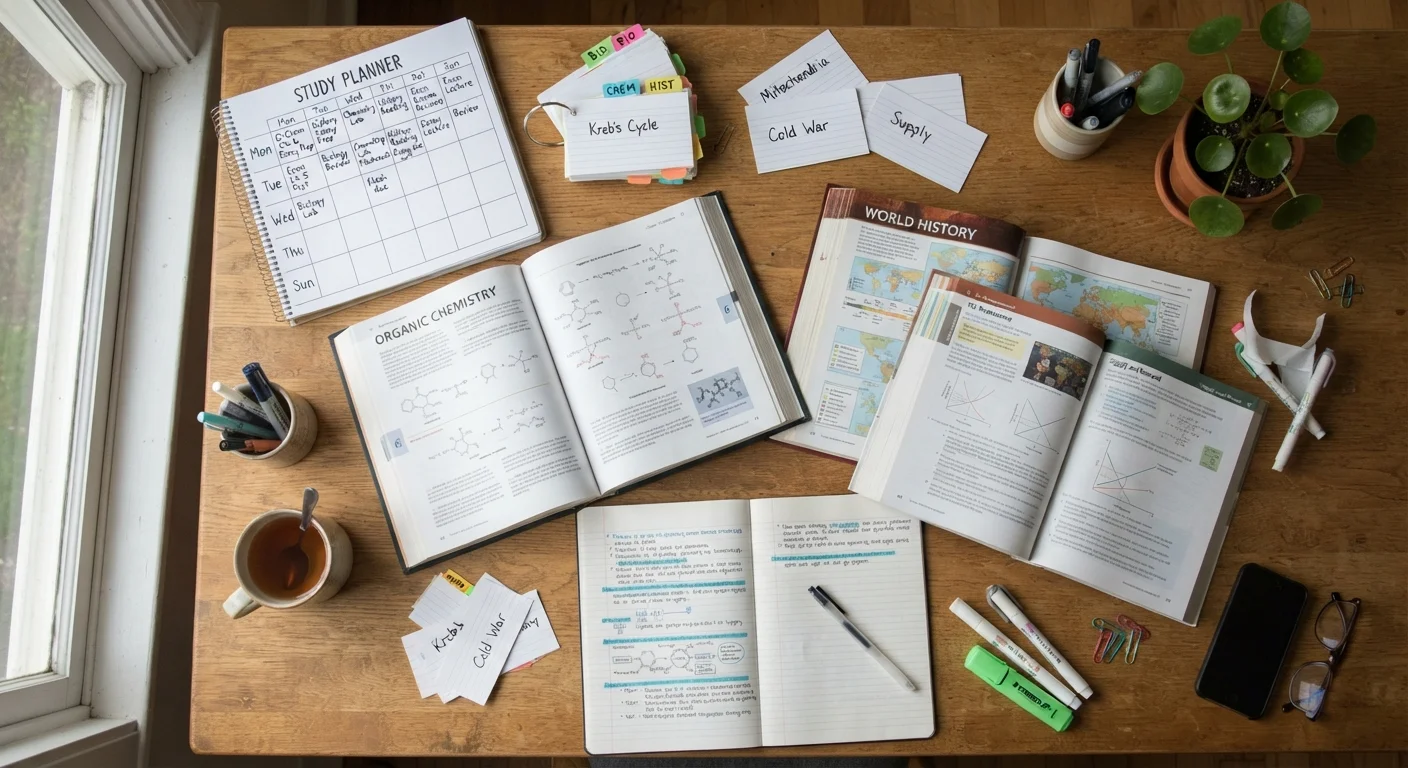
Interleaving flips that script. Rather than blocking topics together, an interleaved session deliberately mixes them. A student preparing for a math exam might rotate among algebra, geometry, and statistics problems throughout the session rather than completing each chapter's exercises in isolation. A language learner might alternate between vocabulary, grammar, and reading comprehension exercises in the same sitting.
The key distinction is not about the material itself but about the sequence in which it is practiced. Interleaving forces the learner to switch mental gears repeatedly - and that switching, though uncomfortable, is where much of the learning benefit comes from.
To understand interleaving alongside other evidence-backed concepts, see the plain-language reference to learning science terms that covers retrieval practice, cognitive load, and more.
~215%
Improvement in test scores with interleaving vs. blocking
A widely cited study by Rohrer and Taylor (2007) found that students who used interleaved practice on math problems scored substantially higher on a delayed test than those who used blocked practice.
~30%
Lower perceived performance during interleaved sessions
Research consistently shows learners rate their own performance as lower during interleaved study, illustrating the gap between feeling of learning and actual learning - a core insight in cognitive psychology.
Why the Difficulty Is the Point
Interleaving often produces what researchers call desirable difficulty - a term for challenges during learning that feel frustrating in the short term but enhance retention over time. When you switch from one topic to another, you cannot simply continue a pattern you just established. You have to stop, mentally reorient, and retrieve the relevant strategy or knowledge from scratch.
This process of repeated retrieval and reorientation is cognitively demanding. It also happens to be one of the most powerful things you can do for memory consolidation. Each time your brain has to reconstruct an approach rather than continue a familiar one, it encodes that approach more durably.
There is also a transfer benefit. Because interleaving exposes you to varied problem types in unpredictable order, you develop the ability to recognize which strategy a new problem calls for - not just how to execute a known strategy. That skill, known as discrimination learning, is precisely what tests and real-world applications demand.
“The order in which material is studied can be just as important as the amount of time devoted to study. Interleaving material leads to better long-term learning, even though it often feels less effective to the learner.”
— Robert Bjork, Distinguished Professor of Psychology, University of California, Los Angeles, known for foundational research on memory and desirable difficulties
This connects naturally to active recall. If you want to deepen the benefit of interleaving, combine it with self-testing - for a closer look at how that works, see why active recall outperforms rereading notes.
How to Apply Interleaving in Practice
Applying interleaving does not require a complex system. The core principle is straightforward: within a study session, rotate among two or more distinct topics or problem types at regular intervals.
- Choose related but distinct material. Interleaving works best when the topics share a domain but require different approaches - math problem types, biology concepts, historical periods, or foreign language skill areas.
- Set a switching interval. A common starting point is rotating every 10-20 minutes. As you grow comfortable, you can switch more frequently or even problem-by-problem in subjects like math.
- Resist the urge to re-block. When a topic feels shaky, the instinct is to stay on it longer. Notice that urge - it is normal - and switch anyway. The struggle with retrieval is productive.
- Pair it with spacing. Interleaving and spaced repetition are complementary strategies. For a detailed comparison of cramming versus spreading sessions, see how spaced repetition compares to massed practice.
Start With Just Two Topics
If rotating among three or more subjects feels overwhelming at first, begin by alternating between just two related topics - for example, two math concepts or two language skill areas. Even a two-topic interleave produces meaningful benefit over straight blocking, and you can expand the rotation as you grow comfortable with the method.
For guidance on structuring a full study session around these principles, building a study session that actually sticks walks through warm-up to wind-down using evidence-backed sequencing.
Common Misconceptions and Practical Limits
Interleaving is sometimes misread as simply studying multiple things in random order. The randomness is not the goal - the meaningful variation is. Switching between completely unrelated subjects (calculus and art history, for instance) does not carry the same research-backed benefit as switching among related problem types within a domain.
It is also worth noting that learners brand new to a subject may benefit from some initial blocked practice to establish basic schemas before interleaving. Think of it as needing a foundation before you start mixing the bricks. Once you have a working grasp of the core ideas, interleaving accelerates what comes next.
Finally, interleaving is not a replacement for sufficient total study time. It improves the quality of practice, not a shortcut around the quantity needed to genuinely understand material. If you are also working on reading comprehension alongside your other subjects, reading for retention approaches offers active strategies that pair well with an interleaved schedule.