
Digital Overload and Mental Health: What the Evidence Says About Screen Time and Stress

Key Takeaways
- Research links heavy social media use and constant notifications to elevated stress and anxiety symptoms.
- Not all screen time is equal - passive scrolling and active communication affect mood differently.
- The relationship between screens and stress is bidirectional: stressed people also tend to reach for devices more.
- Small, consistent boundaries around device use may support wellbeing more than total digital abstinence.
- Individual factors like sleep, social connection, and existing stress levels shape how much digital use affects someone.
- Always consult a qualified mental health professional if digital stress is significantly affecting daily functioning.
Digital Overload
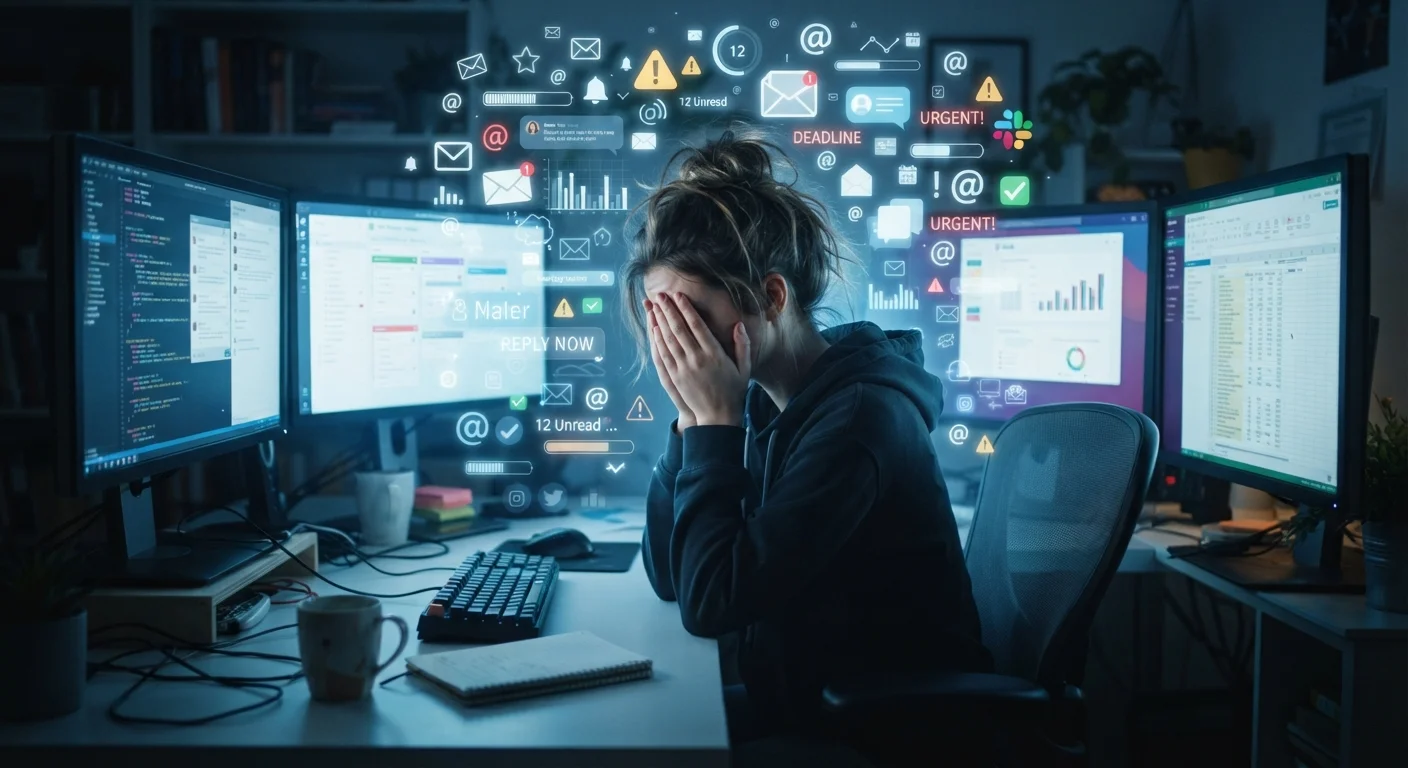
Digital overload - sometimes called technostress - refers to the mental and emotional strain that results from excessive or poorly managed exposure to digital devices, apps, and information streams. It occurs when the volume of incoming digital demands exceeds a person's comfortable capacity to process and respond. The experience can include feelings of anxiety, irritability, difficulty concentrating, and a persistent sense of being "behind."
Researchers distinguish between quantitative overload (too much information) and qualitative overload (content that is emotionally or cognitively demanding), both of which appear to activate stress-response pathways independently.
What Research Actually Links to Digital Stress
The evidence connecting heavy digital device use to psychological stress is real - but more qualified than headlines often suggest. Multiple peer-reviewed studies have found associations between high social media use and elevated rates of anxiety and depressive symptoms, particularly in young adults. However, most of this research is observational, meaning it cannot reliably establish that screens cause poor mental health rather than reflecting it.
What the data does suggest with reasonable consistency is that certain patterns of use carry more risk than others. Passive scrolling - consuming content without meaningful interaction - is more reliably linked to negative mood states than active communication with others. Similarly, exposure to negative or conflict-heavy content, social comparison triggers, and the unpredictable reward structure of notification alerts appear to be the mechanisms most tied to stress responses.
~4.8 hrs
Average daily smartphone use among US adults
Estimates from app-usage data aggregators suggest American adults spend close to five hours per day on their smartphones, not counting other screens.
2x
Anxiety risk with very high social media use
Some observational studies have found that individuals reporting the highest social media use have roughly twice the odds of reporting anxiety symptoms compared to low users, though causality remains uncertain.
70%+
Adults who check phones within an hour of waking
Survey research consistently finds a large majority of US adults reach for their device within the first hour of the morning, a pattern associated with elevated daily stress in self-report data.
Understanding the difference between acute and chronic stress matters here: brief digital frustrations may be trivial, but the relentless low-grade vigilance of constant connectivity can accumulate into something more significant over time.
The Bidirectional Problem: Stress Drives Screen Use Too
One of the most important - and often overlooked - findings in this area is that the relationship between screens and stress runs in both directions. People who are already stressed, lonely, or anxious frequently turn to devices for distraction or relief. This means that heavier use is partly a symptom of existing stress, not just a cause of it.
This bidirectionality complicates both the research and personal self-assessment. If you notice you're reaching for your phone more during difficult periods, that behavior may be a signal about your overall stress state as much as a driver of it. The habits that quietly drain mental energy are often invisible precisely because they feel like coping.
“The question is not whether technology is bad for us, but which uses, in which contexts, for which people, produce harmful versus beneficial outcomes. Broad generalizations in either direction outpace what the evidence actually supports.”
— Amy Orben, Research Fellow in psychology, University of Cambridge, known for large-scale analyses of technology and adolescent wellbeing
Recognizing this loop - stress leads to more scrolling, scrolling amplifies stress - is the first practical step toward interrupting it, without requiring dramatic lifestyle changes.
Sleep, Social Connection, and the Wider Picture
Digital overload rarely operates in isolation. Two of its most well-documented downstream effects involve sleep and real-world social connection - both of which are independently linked to stress resilience.
Evening screen use is associated with delayed sleep onset and reduced sleep quality, partly through light exposure and partly through cognitive and emotional arousal from content. What sleep researchers have found about evening device use is more nuanced than a simple ban suggests, but the general pattern of late-night stimulating content disrupting rest is well-supported.
Separately, heavy device use can crowd out the face-to-face interaction that research consistently identifies as a stress buffer. Spending time on a feed is a structurally different experience from meaningful conversation - and those differences appear to matter for mood. Social connection as a stress buffer represents one of the clearest, most consistent findings in wellbeing research.
Start With Notifications, Not Abstinence
Rather than attempting a full digital detox, consider auditing your notification settings first. Turning off non-essential alerts - especially from social and news apps - reduces the frequency of attention interruptions without requiring behavioral willpower throughout the day. Even modest reductions in notification volume can meaningfully lower the ambient cognitive load many people associate with digital stress.
For a broader view of how daily patterns accumulate into health outcomes, everyday habits and long-term health offers helpful context on how small behaviors compound over time.
Practical Approaches Worth Considering
The evidence does not support the conclusion that all digital use is harmful or that complete abstinence is necessary or realistic. What research does point toward is the value of intentional, bounded engagement rather than default, reactive use.
Strategies researchers and clinicians commonly discuss include: batching notification checks to specific times rather than responding to every alert; removing apps that consistently generate negative social comparison; establishing device-free periods around meals or the first hour after waking; and prioritizing active over passive use - messaging a friend rather than scrolling a feed.
These adjustments work best when they reflect personal values rather than fear or guilt. If you notice that digital stress is significantly affecting your mood, concentration, relationships, or sleep on an ongoing basis, that is worth discussing with a qualified mental health professional. General strategies are not a substitute for individualized care. Understanding why stress feels physical can also help contextualize why digital overload sometimes produces real, bodily symptoms.
This article is for general informational purposes only and does not constitute medical or mental health advice. If you are experiencing significant distress, please consult a qualified healthcare or mental health professional.