

Key Takeaways
- An emergency fund is reserved for true financial emergencies, not planned purchases or goals.
- Monthly savings are intentional contributions toward defined future objectives.
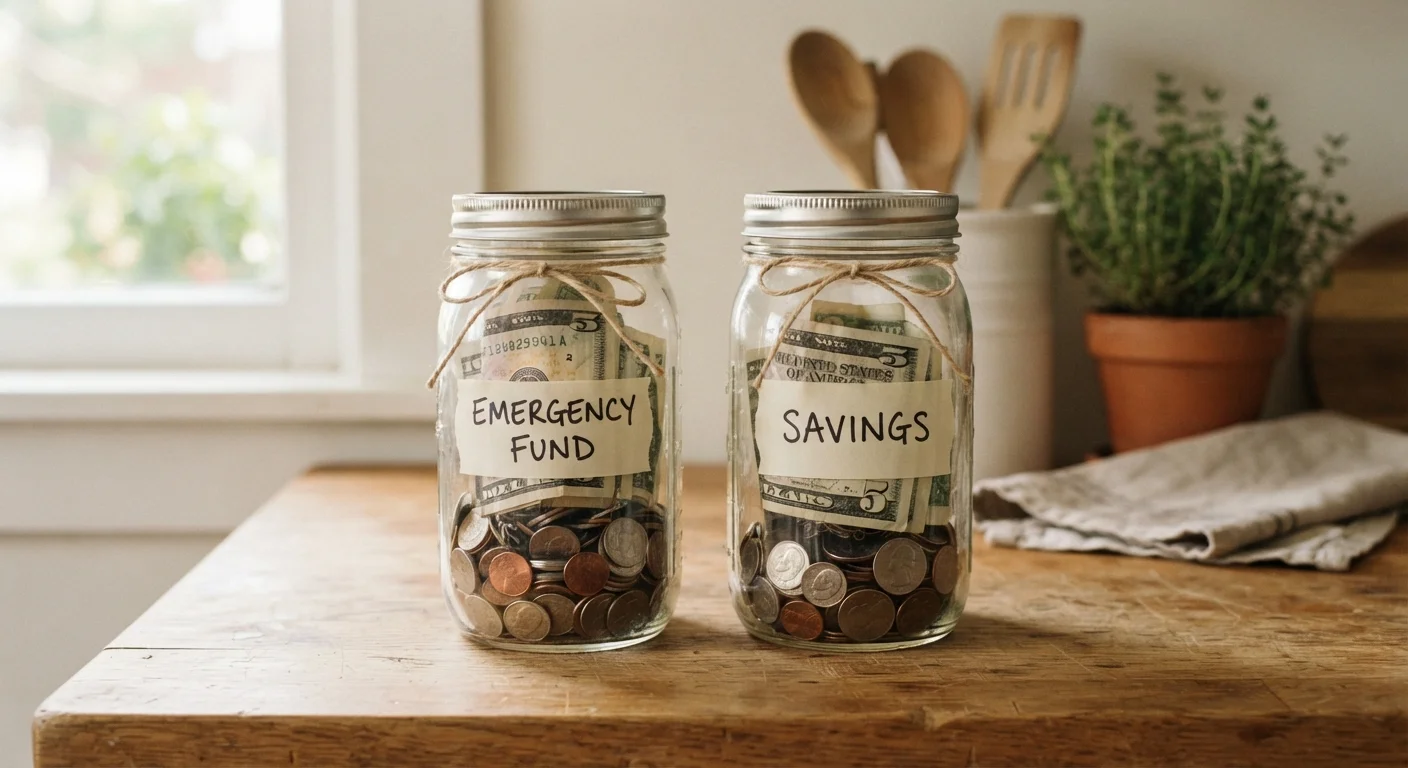
- Mixing the two in one account often leads to raiding goal-based savings during a crisis.
- Most financial educators suggest three to six months of essential expenses as an emergency fund target.
- Both belong in a healthy budget — they serve different purposes and should ideally be kept separate.
Option A
Emergency Fund
Your financial firewall against the unexpected.
Best for: Anyone who needs a dedicated cushion to cover sudden, unavoidable expenses without going into debt.
Option B
Monthly Savings
The steady engine behind your financial goals.
Best for: Anyone building toward a specific target — a vacation, a down payment, or a retirement contribution — on a regular schedule.
If you have no financial cushion and live paycheck to paycheck
Emergency Fund
Building even a small emergency reserve first protects you from high-interest debt when an unexpected expense hits. Start with a modest target like $500–$1,000 before splitting focus.
If you already have three to six months of expenses saved
Monthly Savings
Once your emergency fund is funded, redirecting regular contributions toward defined goals — retirement, a home, education — makes the most of your budget capacity.
If you're rebuilding after a financial setback
Emergency Fund
Replenishing a depleted emergency fund before resuming goal-based saving prevents the cycle of borrowing every time life surprises you.
If you want to save for a predictable future expense
Monthly Savings
A goal-based savings account — or a sinking fund — is better suited for planned costs like a car repair fund or a holiday trip, keeping that money separate from your true safety net.
What Each One Is Actually For
The terms "emergency fund" and "savings" get used interchangeably, but they describe two fundamentally different buckets. Conflating them is one of the most common reasons people find themselves raiding their savings account during a crisis — and then feeling like they've failed.
An emergency fund is money set aside exclusively for genuine financial emergencies: a sudden job loss, an unexpected medical bill, a major car repair you couldn't have planned for, or a broken furnace in January. It is not for a vacation, a new phone, or anything you could have anticipated. Its only job is to keep you out of debt when life doesn't go as planned.
Monthly savings, by contrast, are contributions toward goals you've chosen and planned for — a down payment, a retirement account, a college fund, or a six-month travel budget. These funds have a destination and a timeline. You're building toward something specific, not stockpiling against the unknown.
For a deeper look at how emergency funds are structured and sized, see how emergency funds work. And if you're also thinking about planned large purchases, sinking funds are worth understanding as a third, distinct category.
| Criterion | Emergency Fund | Monthly Savings |
|---|---|---|
| Primary purpose | Cover unexpected financial crises | Build toward specific goals |
| When to use it | Job loss, medical bill, urgent repair | Planned milestone (vacation, down payment) |
| Typical target amount | 3–6 months of essential expenses | Defined by your specific goal |
| Access frequency | Rarely — only in a true emergency | When the savings goal is reached |
| Impact on debt risk | Directly reduces need for emergency borrowing | Indirect — depends on goal type |
| Priority in a budget | Build first if starting from zero | Expand after emergency fund is funded |
Why Keeping Them Separate Matters
When emergency savings and goal-based savings share one account, the boundaries blur fast. A weekend trip feels justified when the balance looks healthy. A sudden car repair feels less painful when you tell yourself you'll "pay it back." In practice, most people don't pay it back — they just adjust their mental accounting.
Separate accounts create a visible, concrete boundary. When you can see your emergency fund balance distinct from your travel savings or investment contributions, the decision to spend is clearer. You either have an emergency or you don't.
~57%
Americans unable to cover a $1,000 emergency from savings
According to Bankrate's annual emergency savings report, a majority of U.S. adults would need to borrow or use credit to handle a sudden $1,000 expense.
3–6 months
Widely recommended emergency fund coverage
Financial educators broadly recommend holding three to six months of essential living expenses in a dedicated, liquid account.
This separation also helps during budget reviews. If your emergency fund drops, you know exactly what to replenish. If your vacation fund is growing slowly, you know what to adjust. Mixing the two obscures both pictures.
Automating contributions to each account makes this easier to sustain. Automating savings transfers can remove the temptation to skip a month — but it's worth setting up each account's auto-transfer separately so you maintain that mental distinction.
How to Fit Both Into a Monthly Budget
Most personal finance educators recommend building your emergency fund before aggressively pursuing other savings goals, particularly if you have no existing financial cushion. A common guideline is to work toward three to six months of essential living expenses — think rent or mortgage, utilities, groceries, and minimum debt payments — not your full lifestyle budget.
Once that fund is in place, monthly savings contributions can expand. At that stage, you're no longer just protecting against collapse — you're actually building toward something. Many people find it useful to label savings accounts by goal ("car fund," "home down payment," "vacation") so the purpose stays visible.
If your emergency fund is a work in progress, a practical split might look like directing the majority of discretionary saving toward the emergency fund until it reaches a baseline target, then pivoting to goal-based saving once that floor is established.
Understanding how your fixed and variable expenses are structured also helps clarify how much is genuinely available to allocate. And for those exploring where to keep either type of funds, high-yield vs. traditional savings accounts is worth reviewing — the account type can matter for growth, especially for longer-term goal savings.
One Account or Two?
There's no rule that says you need separate financial institutions for each bucket — just separate accounts with clear labels. Many banks and credit unions allow you to open multiple savings accounts under one login. Naming them by purpose ("Emergency Only," "Home Fund") is a simple way to preserve that mental separation without extra complexity.
This article provides general financial information for educational purposes only and is not personalized financial advice. Consult a qualified financial professional for guidance specific to your situation.