

Key Takeaways
- Fixed expenses don't change month to month; variable expenses do — and that difference drives how you budget for each.
- Variable costs are where most households have the most control over their spending.
- Knowing your total fixed expenses tells you the minimum income you need to stay afloat.
- Irregular but predictable costs — like car registration — benefit from a dedicated savings plan.
- Both categories need a place in your budget for it to reflect reality.
Fixed vs. Variable Expenses
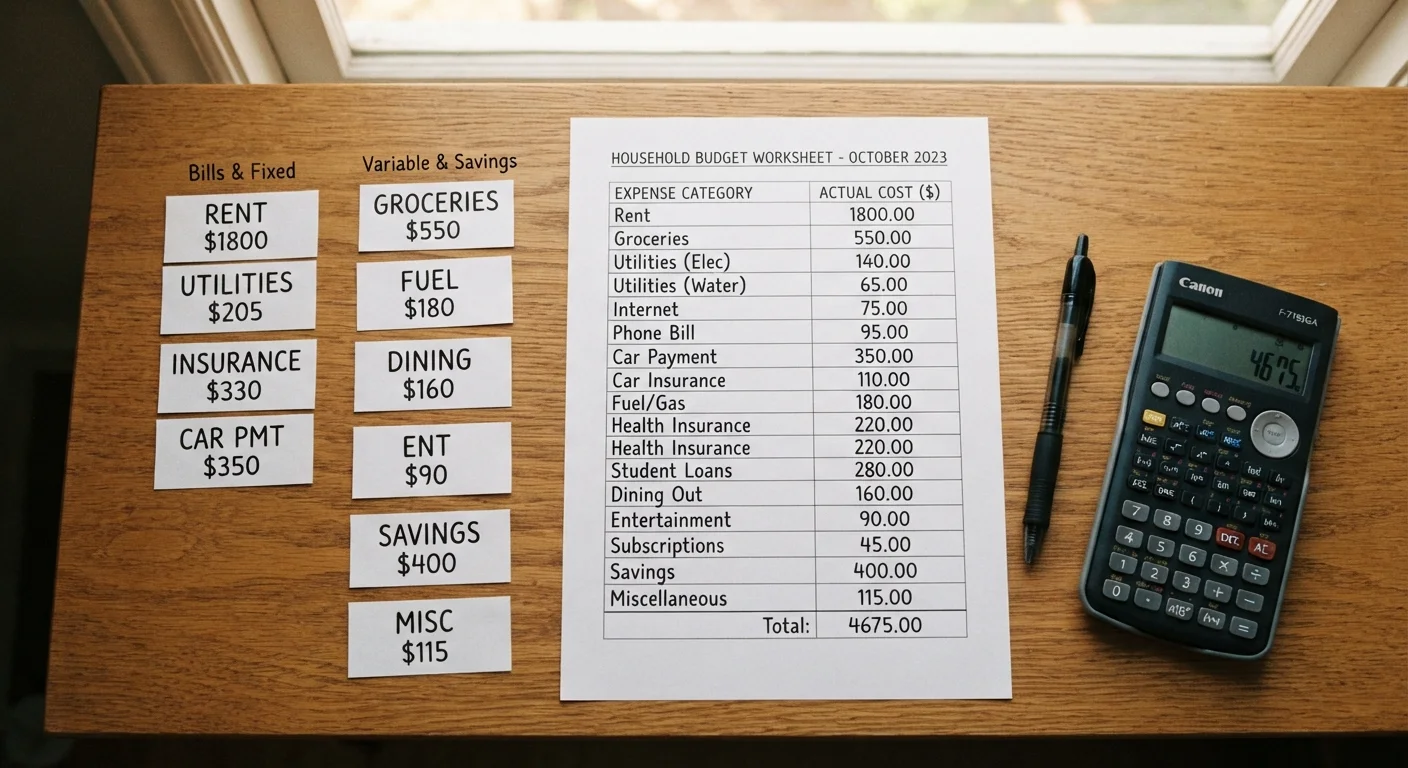
Fixed expenses are costs that stay the same amount every month, like your rent or car payment. Variable expenses change from month to month, such as groceries, gas, or utility bills. Knowing which category each cost falls into helps you predict what you'll spend and where you have room to adjust.
Some expenses are called 'periodic' or 'irregular fixed' — they're predictable in amount but don't recur every month (e.g., annual insurance premiums). These are worth treating as a separate sub-category when building a detailed budget.
The Core Difference — and Why It Matters
Every expense in your life falls into one of two buckets: it either stays constant month after month, or it shifts based on your habits, usage, and circumstances. That's the whole distinction — but its impact on how you build a budget is significant.
Fixed expenses are predictable by nature. You know exactly what's due, when it's due, and how much it will be. Your mortgage, your car payment, your renter's insurance premium — these don't budge unless you make a deliberate change like refinancing or canceling a contract.
Variable expenses move. Your grocery bill depends on what you buy and how often you cook at home. Your gas spending tracks your driving. Your electric bill climbs in summer when the AC runs all day. These costs respond directly to your behavior.
Why does this matter? Because the strategy for managing each type is completely different. Fixed expenses require planning and commitment; variable expenses require ongoing attention and self-awareness. A budget that treats both the same way tends to fall apart.
Fixed Doesn't Always Mean Unchangeable
Fixed expenses feel permanent, but many can be renegotiated or eliminated over time. Refinancing a mortgage, switching insurance carriers, or canceling unused subscriptions are all ways to lower your fixed cost floor. Review your fixed expenses at least once a year to see if any adjustments make sense for your situation.
Fixed Expenses: Your Non-Negotiable Baseline
Add up every fixed expense you carry — rent, car payment, loan minimums, subscriptions, insurance premiums — and you've found your budget floor. That's the amount of money you must bring in each month just to keep your commitments. Everything else has to fit around that number.
This floor is useful in two ways. First, it tells you whether your income is structurally sound. If your fixed costs eat up 70% or more of your take-home pay, you have very little room to absorb an unexpected expense or redirect money toward savings. Second, it highlights which financial moves actually change your situation — renegotiating your rent, refinancing a loan, or eliminating a recurring subscription are all ways to lower the floor and create breathing room.
33%
Share of income spent on housing by average US household
According to the U.S. Bureau of Labor Statistics Consumer Expenditure Survey, housing is typically the largest single fixed expense American households carry.
~$6,000
Average annual US household food spending
The BLS Consumer Expenditure Survey consistently shows food as one of the largest variable expense categories for American families.
For help thinking through how different budgeting frameworks handle fixed costs, see Zero-Based Budgeting vs. Envelope Budgeting.
Variable Expenses: Where Your Real Spending Choices Live
Variable expenses are where most households actually have leverage. Groceries, dining out, clothing, personal care, entertainment, gas — these categories shift based on decisions you make every day. That's a challenge when you're trying to stay on budget, but it's also an opportunity.
The key is to set a realistic monthly target for each variable category based on your actual spending history, not a wishful number. Pull three months of bank or credit card statements, average out what you've genuinely spent in each category, and use that as your starting point.
Use Real Numbers, Not Estimates
When setting variable expense targets, review at least two to three months of actual spending before deciding on a budget figure. Guessing low is one of the most common reasons budgets fail in the first month. Accurate baselines make your plan far more likely to hold.
Once you have realistic baselines, you can make conscious choices about where to trim. Variable categories also interact with your savings goals — putting money toward an emergency fund or monthly savings is easier when you have an honest picture of what's already going out the door on variable costs.
If your income isn't consistent month to month, variable expenses become even harder to manage. Budgeting with irregular income requires an extra layer of planning, but the fixed-vs.-variable framework still applies.
The Category in Between: Irregular but Predictable Costs
There's a third type of expense worth knowing about, even though it doesn't fit neatly into either bucket: costs that are predictable in amount but don't hit every month. Annual car registration, semi-annual insurance premiums, back-to-school shopping, holiday spending — these are known costs that can blindside you if they're not in your plan.
The practical solution is a sinking fund: setting aside a fixed amount each month toward a specific future expense so that when it arrives, the money is already there. If your car registration runs $180 a year, putting $15 aside each month means you're never caught off guard. Sinking funds are one of the most underused tools in everyday budgeting.
For a broader look at how to organize your budget around all three expense types, the Everyday Money Tips hub covers practical frameworks worth exploring. You can also compare budgeting methods to find an approach that matches how you actually spend.
This article is for general informational purposes only and does not constitute personalized financial advice. Consider consulting a qualified financial professional for guidance specific to your situation.