

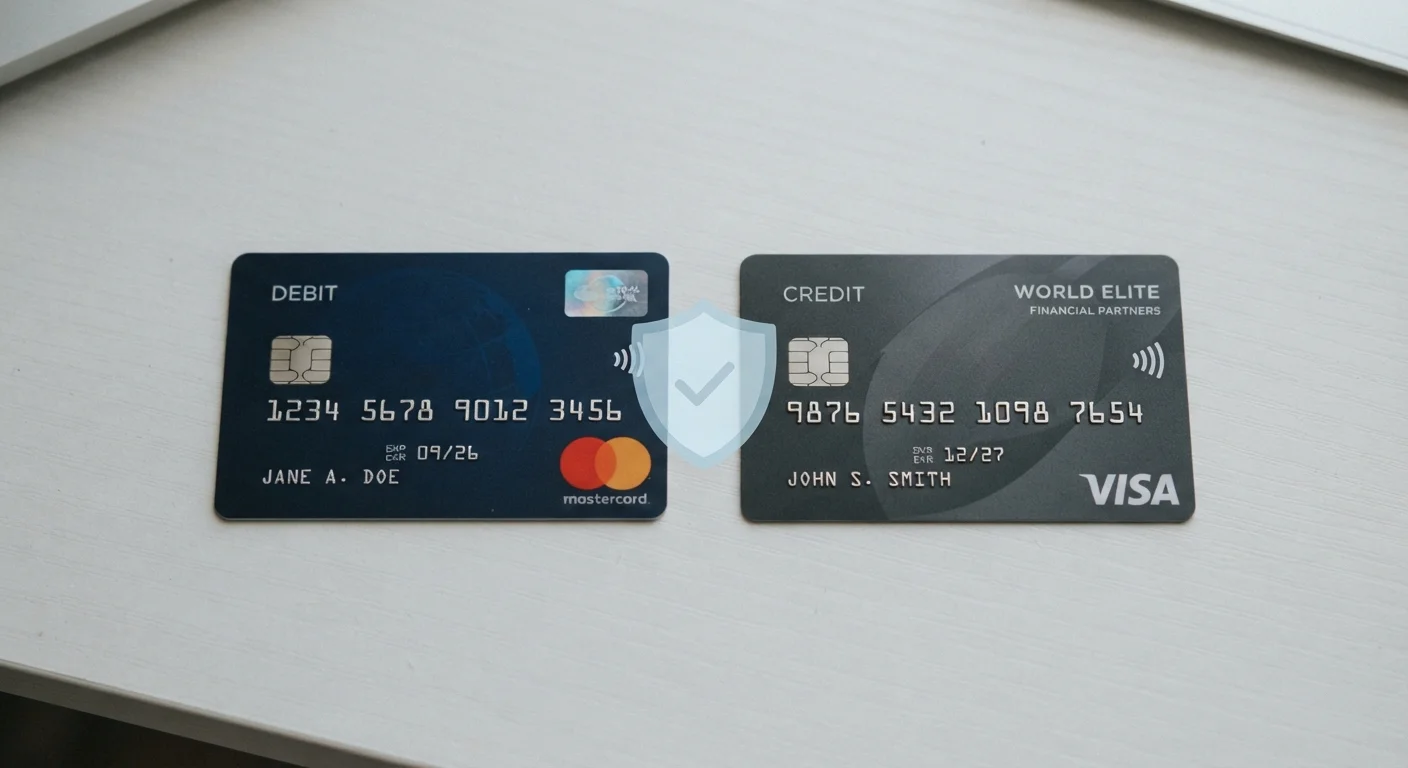
Key Takeaways
- Credit cards cap your fraud liability at $50 under federal law; debit cards can expose you to much more if you delay reporting.
- With debit card fraud, real money leaves your checking account immediately — recovery takes time and isn't always guaranteed.
- Credit card disputes let you withhold payment while an investigation is underway; debit card disputes do not.
- Both card types offer zero-liability policies from major networks, but those are voluntary — not a legal requirement.
- For large purchases or travel, credit cards generally offer stronger built-in consumer protections.
Our Verdict
Credit cards carry stronger federally mandated consumer protections than debit cards, particularly for fraud liability and purchase disputes. Debit cards are useful for everyday discipline and direct-access spending, but they leave your checking account funds exposed in a way credit cards do not. Understanding these differences helps you choose the right card for each situation.
| Best for | Recommended |
|---|---|
| Fraud protection and purchase disputes | Credit Card |
| Avoiding debt and spending only what you have | Debit Card |
| Travel, large purchases, and online shopping | Credit Card |
| Daily low-stakes spending with a tight budget | Debit Card |
The Law Behind the Cards
Two separate federal laws govern how your card issuer must respond when things go wrong. For credit cards, the Fair Credit Billing Act (FCBA) sets the rules. For debit cards, it's the Electronic Fund Transfer Act (EFTA). These aren't minor procedural differences — they create meaningfully different experiences if you're ever a fraud victim or need to dispute a charge.
The FCBA limits your maximum liability for unauthorized credit card charges to $50, regardless of when you report the fraud. The EFTA applies a sliding scale to debit cards that depends heavily on how quickly you act. Report within two business days of discovering the fraud and your liability is capped at $50. Wait up to 60 days after your statement is sent and that cap rises to $500. Miss the 60-day window entirely and you could be responsible for all losses in your account during that period.
These are the legal minimums. Many card networks go further with voluntary zero-liability policies, but those policies are not required by law and can be modified by the issuer. The federal protections are the floor.
What Happens to Your Money During a Dispute
This is where the practical difference becomes most visible. When you dispute a fraudulent charge on a credit card, the charge is typically suspended while the issuer investigates. You don't pay for something while the question of whether you owe it is still open. Your credit limit is also affected, not your checking account balance.
With a debit card, the money is already gone. A fraudulent charge hits your checking account in real time. If that depletes your balance, you may face overdraft fees, bounced payments, or disrupted automatic transfers before the bank completes its investigation. Provisional credits are sometimes issued quickly, but banks generally have up to 10 business days to investigate — and longer in some circumstances — before they must provisionally restore the funds.
Report Debit Card Fraud Fast
Because debit card liability limits tighten quickly, get in the habit of checking your bank account every few days rather than waiting for a monthly statement. If you spot something unfamiliar, contact your bank immediately — even a one-day delay can matter. Setting up real-time transaction alerts through your bank's app is one of the simplest ways to catch fraud early.
For purchase protection beyond fraud, the FCBA also gives credit card holders the right to dispute charges for goods or services not delivered as promised, a protection that has no direct equivalent for debit cards under the EFTA. See our breakdown of everyday payment trade-offs for more context on how each method affects your financial record-keeping.
Side-by-Side: Key Protection Differences
The table below summarizes the core consumer protection distinctions between debit and credit cards under federal law.
| Protection Feature | Credit Card (FCBA) | Debit Card (EFTA) | |
|---|---|---|---|
| Max fraud liability | $50, regardless of timing | Up to $500+ depending on delay | |
| Reporting deadline matters | No — liability capped at $50 always | Yes — delays increase your exposure | |
| Money at risk during dispute | No — credit line affected only | Yes — real funds already withdrawn | |
| Dispute for undelivered goods | Yes — FCBA chargeback rights | No direct federal equivalent | |
| Zero-liability policy | Voluntary network policy | Voluntary network policy | |
| Investigation timeline (provisional credit) | Charge suspended during review | Up to 10+ business days for credit |
Keep in mind that actual policies vary by issuer and network. Always review your cardholder agreement for the specific terms that apply to your account.
Practical Guidance for Everyday Use
These protections don't mean you should abandon one card type entirely. They do mean you should be deliberate about which card you reach for in different situations.
- Online shopping and unfamiliar retailers: Credit cards are generally the lower-risk choice because your real money isn't on the line during a dispute.
- Travel and hotels: Hotels often place holds on cards. A hold against a debit card freezes actual cash in your checking account; a credit card hold affects only available credit.
- Recurring bills and trusted vendors: Either card can work well — just monitor statements regularly.
- ATM withdrawals and cash needs: Debit cards are the natural fit; credit card cash advances typically carry high fees and interest from the moment of withdrawal.
If you carry a credit card balance, the interest cost can easily outweigh any protection benefit. Understanding how minimum payments compound over time is essential before deciding how heavily to lean on credit. You might also find it useful to explore common myths around debt management to make sure your card strategy is grounded in evidence, not assumptions.
This article provides general financial information for educational purposes and is not personalized financial or legal advice. Consult a qualified financial professional for guidance specific to your situation.