

Key Takeaways
- Leash pulling is driven by instinct and environmental rewards, not stubbornness or defiance.
- Dogs experience the world primarily through scent, making forward movement feel deeply compelling.
- Every successful pull teaches your dog that pulling works — consistency in your response matters.
- Understanding the root cause of pulling is the first step toward building calmer, more enjoyable walks.
- Training approaches that work with a dog's instincts tend to be more effective than those that fight them.
Leash Pulling
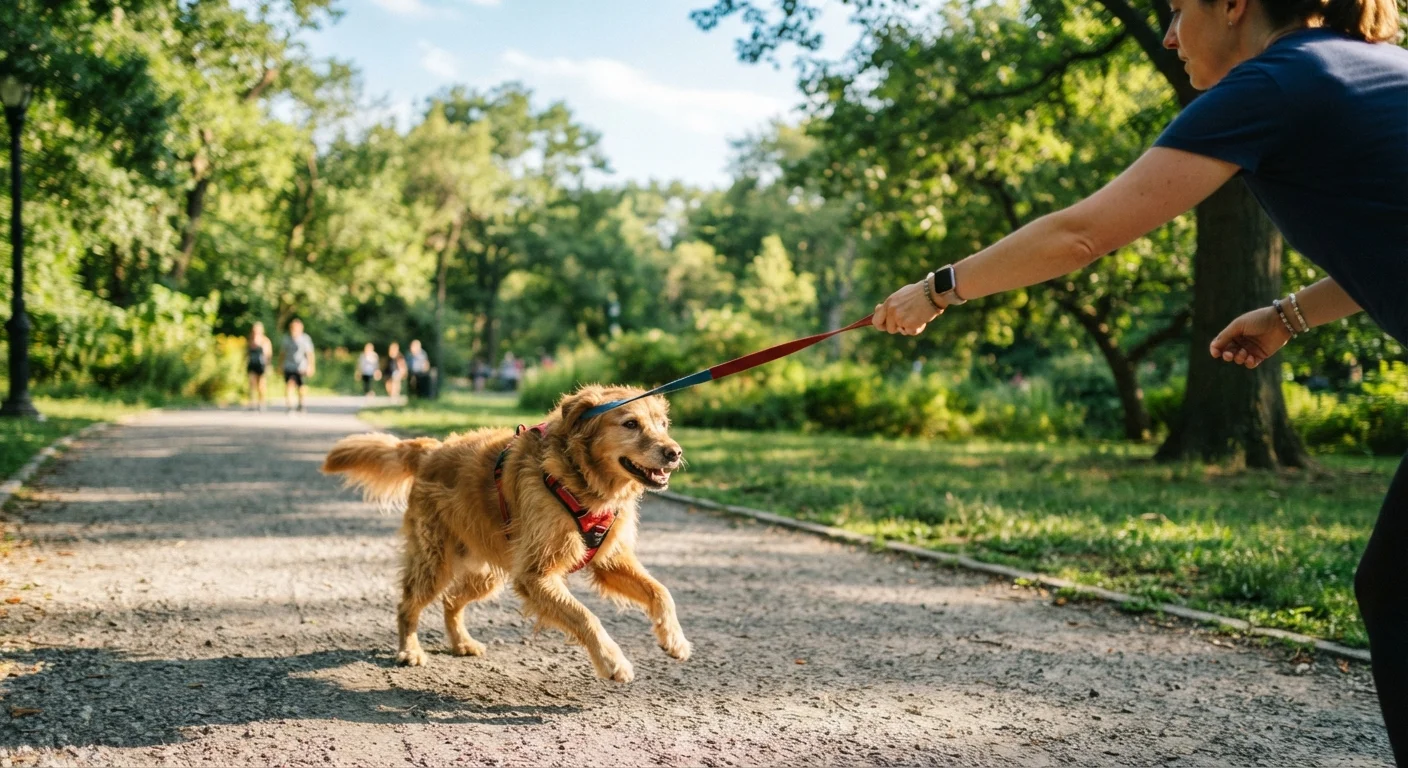
Leash pulling is when a dog consistently moves ahead of or away from its owner during a walk, creating tension in the leash. It isn't a sign of dominance or bad character — it's a natural behavior rooted in how dogs process the world around them. Dogs are wired to explore, and walking at a human pace can feel frustratingly slow for an animal built to cover ground.
In behavioral science, leash pulling is often explained through negative reinforcement: the dog pulls, moves forward, and the environment rewards it with new smells, sights, and stimulation — reinforcing the pulling behavior over time.
The Instinct Behind the Pull
When your dog lunges toward a fire hydrant or drags you across the sidewalk to sniff a patch of grass, it isn't being defiant. It's being a dog. Canine brains are wired for exploration, and their primary tool for experiencing the world is their nose — which is estimated to be tens of thousands of times more sensitive than a human's. Every lamppost, curb, and passing stranger represents a rich stream of information your dog is desperate to process.
Walking at a measured human pace, staying on a straight path, is genuinely unnatural for most dogs. Their instinct is to range, investigate, and follow scent trails wherever they lead. The leash doesn't change that drive — it just creates conflict with it.
Pulling Is Rewarded by the World, Not Just You
One reason leash pulling is so persistent is that the reward comes from the environment itself, not from the owner. A dog that reaches a smelly patch of ground has already received its payoff before you've had a chance to respond. This is why management and proactive redirection — not just withholding treats — are central to changing the behavior.
This exploratory behavior is reinforced the moment a dog discovers that pulling gets results. From the dog's perspective, the logic is airtight: pull forward, reach the interesting thing, get the reward. No malice, no power play — just effective problem-solving from an animal doing what animals do.
How Pulling Becomes a Habit
Behavioral science offers a clear explanation for why leash pulling persists: it is self-reinforcing. Every time a dog pulls and reaches its target — the bush, the other dog, the interesting smell — the environment delivers a reward. The dog didn't need you to hand it a treat. The world did the reinforcing automatically.
This is why well-meaning owners who occasionally give in to pulling — letting the dog reach what it wants just to stop the chaos — often find the behavior getting stronger, not weaker. In learning theory, this pattern is called intermittent reinforcement, and it's one of the most powerful forces in shaping persistent behavior.
The flip side is equally important: consistent, calm redirection — stopping when the leash goes taut, changing direction, rewarding loose-leash moments — gradually shifts what the dog learns about how walks work. For a broader foundation on how dogs learn, the first-time owner training guide covers learning theory in plain terms.
What's Going On Emotionally
It's worth considering the emotional dimension of pulling, not just the mechanical one. Dogs that pull with urgency, panting heavily, or fixating intensely on targets may be experiencing high arousal — a state of excitement that can spill into frustration when blocked. High arousal makes calm behavior harder, not easier, which is why simply tightening your grip rarely solves anything.
In some cases, a dog that pulls frantically and appears distressed may be dealing with anxiety rather than pure excitement. Dogs experiencing separation anxiety or generalized fear, for example, can behave very differently on leash depending on context. If walks feel like a source of stress rather than joy for your dog, understanding anxiety-driven behavior may be relevant background.
Rule Out Physical Discomfort First
If your dog's pulling behavior changes suddenly, or if they seem reluctant to walk at all, a veterinary check-up is a smart first step. Pain in the hips, joints, or paws can alter how a dog moves and behaves on leash in ways that look behavioral on the surface. Addressing physical health before training keeps your approach grounded in the full picture.
Physical health is also worth keeping in mind. A dog that suddenly starts pulling more, or resists walking altogether, may be responding to discomfort. Reviewing the signs your dog may be in pain can help you rule out an underlying physical issue before assuming the cause is purely behavioral.
Building Better Walks Through Understanding
Knowing why dogs pull reframes how you approach the problem. Rather than a battle of wills, leash training becomes a process of teaching your dog that a loose leash is actually the more efficient path to what it wants. Structured sniff breaks — deliberately allowing your dog to investigate an area on cue — can reduce the urgency that drives frantic pulling.
Patience and predictability are the real tools. Dogs don't generalize well, meaning leash manners learned on one street may need reinforcement on a new one. Short, frequent sessions tend to outperform long, exhausting ones. And owners who understand that their dog isn't acting out of spite are far more likely to stay consistent through the process.
This article is for general informational purposes only and does not constitute veterinary or behavioral health advice. Consult a qualified veterinary professional or certified animal behaviorist for guidance specific to your dog's needs.