

Key Takeaways
- Correct tire pressure is listed on your door jamb sticker, not on the tire sidewall.
- Underinflated tires increase fuel consumption and raise blowout risk.
- Overinflated tires reduce traction and cause uneven center tread wear.
- Tire pressure drops roughly 1 PSI for every 10°F decrease in outside temperature.
- Checking pressure monthly - and before long trips - is a simple, cost-free habit.
Tire Pressure (PSI)
Tire pressure refers to the amount of air inside a tire, measured in pounds per square inch (PSI). Every vehicle has a recommended PSI range, determined by the manufacturer based on the vehicle's weight, handling, and tire size. Maintaining the correct pressure keeps the tire's contact patch - the portion touching the road - at its intended shape and size.
PSI stands for pounds per square inch, a standard unit of pressure. A tire's maximum PSI (printed on the sidewall) is not the same as the recommended operating PSI, which is listed on the driver's door jamb sticker.
Why Tire Pressure Is Easy to Overlook
Tires rarely demand attention the way a dashboard warning light or strange noise does. Because pressure loss is gradual - often just a few PSI over weeks - most drivers don't notice it until a tire looks visibly flat. By that point, the damage to fuel economy, tread life, and potentially safety has already accumulated.
The good news: tire pressure is one of the simplest and least expensive aspects of vehicle ownership to manage. A quality gauge costs only a few dollars, and most gas stations still offer air for free or for minimal cost. The challenge is simply building the habit. See our guide to routinely skipped maintenance tasks for context on how small oversights compound into larger repair bills.
~1 PSI
Pressure lost per 10°F temperature drop
A widely cited guideline from tire industry and automotive safety sources on seasonal pressure changes.
25%+
Below recommended PSI before TPMS activates
Per NHTSA standards, the Tire Pressure Monitoring System warning light triggers at this threshold - meaning significant underinflation can exist before any alert appears.
Up to 0.5%
Fuel economy improvement per properly inflated tire
The U.S. Department of Energy has cited this figure as the potential per-PSI improvement in fuel economy when maintaining correct pressure.
What Happens When Tires Are Underinflated
An underinflated tire flexes more than it's designed to. More flexing generates more heat, and heat is one of the primary contributors to tire failure, including blowouts at highway speeds. The tire's sidewalls also experience greater stress, accelerating their breakdown over time.
Beyond safety, underinflation directly affects your wallet. A tire running low on pressure has more of its surface in contact with the road than intended, which increases rolling resistance - the force your engine must overcome to move the vehicle. The U.S. Department of Energy has estimated that properly inflated tires can improve gas mileage. Even modest savings per tank add up across a full year of driving.
Tread wear is another casualty. Underinflated tires wear faster on both outer edges while leaving the center relatively intact. If you're seeing that pattern, reading your tire wear patterns can help you diagnose what's happening before it worsens.
Check Pressure When Tires Are Cold
Driving heats the air inside your tires and temporarily raises pressure readings by several PSI, which can mask underinflation. For the most accurate reading, check your tires before driving - or after the vehicle has been parked for at least three hours. This one habit makes every pressure check more reliable.
What Happens When Tires Are Overinflated
Overinflation is less common but carries its own real risks. An overinflated tire becomes rigid and round, reducing the amount of rubber that actually contacts the pavement. This smaller contact patch means less grip - a meaningful concern on wet or slippery roads where stopping distances matter most.
The handling consequences are also noticeable. An overly stiff tire transmits more road vibration into the cabin and makes the vehicle feel harsher over bumps. More practically, the center of the tread bears a disproportionate load and wears down faster than the edges - the opposite pattern from underinflation. Both extremes shorten tire life unnecessarily.
For drivers who want to connect tire condition to the broader picture of vehicle safety, our pre-trip vehicle safety checklist walks through tire condition alongside other key checks before a long drive.
Temperature Changes and Seasonal Pressure Drops
Air pressure inside a tire responds to temperature. As a general rule, tires lose approximately 1 PSI for every 10°F drop in ambient temperature. For drivers in climates with distinct seasons, this means a tire that was properly inflated in summer may register 5-8 PSI low by mid-winter - without any leak present.
This is why a monthly pressure check is especially important heading into fall and winter. It's also why the TPMS (Tire Pressure Monitoring System) warning light - required on all US passenger vehicles made after 2008 - tends to illuminate more frequently in cold weather. The TPMS is a useful alert, but it typically triggers only when a tire is 25% or more below the recommended PSI, which already represents a significant shortfall. Relying solely on the TPMS as a pressure monitor isn't a substitute for regular manual checks.
TPMS Is a Backup, Not a Substitute
The Tire Pressure Monitoring System is a helpful safety net, but it's designed to catch significant underinflation - typically 25% or more below the recommended PSI. A tire can be meaningfully underperforming in terms of fuel economy and tread wear long before the warning light appears. Monthly manual checks fill that gap.
How to Check and Adjust Tire Pressure Correctly
Start by finding your vehicle's recommended PSI. It's printed on a sticker on the inside edge of the driver's door - not on the tire sidewall. Front and rear tires sometimes have different recommended pressures, so check both.
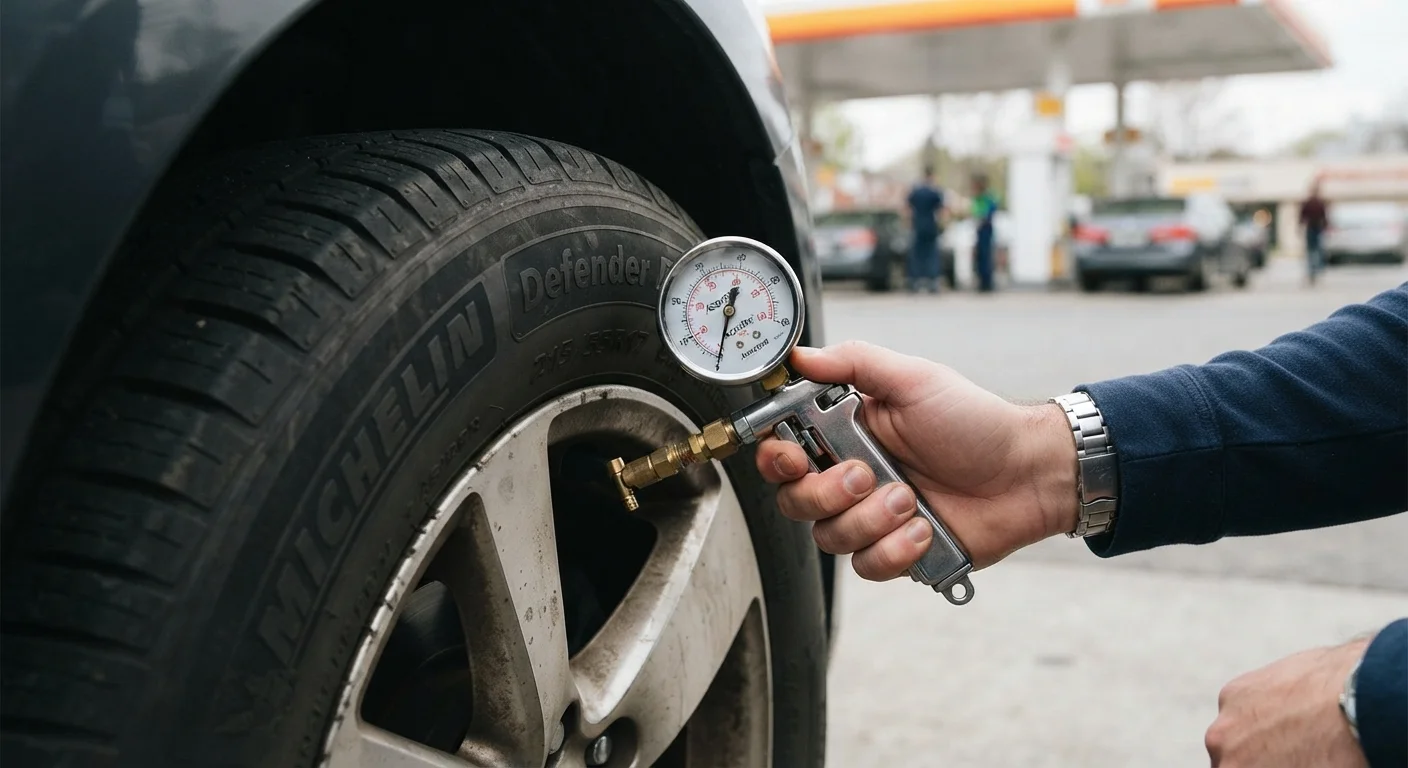
Check pressure when tires are cold (the car parked for at least three hours). Remove the valve cap, press a tire gauge firmly onto the valve stem, and read the result. Add air if below the recommended PSI, or release air using the small pin inside the valve stem if above it. Recheck after any adjustment. Keeping a simple gauge in your glove box makes this a two-minute task anywhere you park.
Proper inflation is also one of the most cost-effective ways to extend tire life and avoid unplanned expenses. Combining this habit with attention to wheel alignment signs gives you a more complete picture of tire health.