

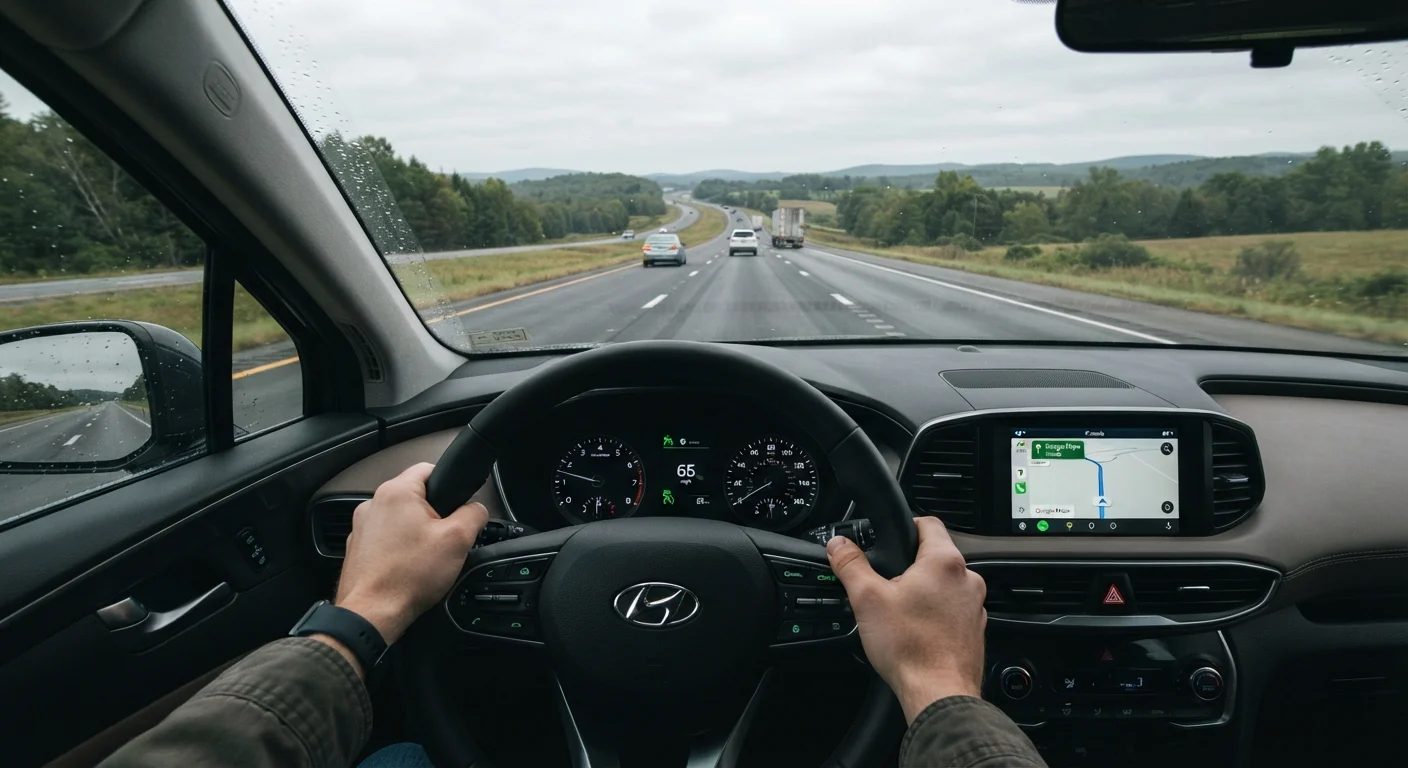
Key Takeaways
- Cruise control is most effective on open, dry highways with steady traffic flow.
- Using it in heavy traffic, rain, or hilly terrain can reduce your reaction time and control.
- Adaptive cruise control improves safety but still requires constant driver attention.
- Turning it off on wet roads helps prevent hydroplaning by restoring manual throttle control.
- Smart use means knowing when to engage it - and when to leave it off.
Improves fuel efficiency on long highway drives
Holding a steady speed avoids the fuel cost of repeated acceleration and deceleration, which is especially noticeable on trips over 50 miles.
Reduces driver fatigue over long distances
Removing constant throttle management lets drivers conserve physical effort, which can help maintain alertness on multi-hour road trips.
Helps prevent unintentional speeding
On flat, open highways where speed creep is easy to miss, locking in a speed keeps you within legal limits without constant glances at the speedometer.
Adaptive versions automatically manage following distance
ACC systems adjust vehicle speed in response to traffic ahead, reducing the need for constant brake-and-accelerate cycles in moderate highway traffic.
Increases reaction time in sudden traffic changes
When the throttle is controlled automatically and your foot isn't near the brake, response time to sudden stops or hazards is measurably longer.
Dangerous on wet, icy, or slippery roads
Cruise control maintains engine throttle to hold speed, which can prevent the natural speed reduction that helps avoid hydroplaning or skidding on low-traction surfaces.
Encourages cognitive disengagement
Studies on driver behavior have found that automation encourages drivers to shift attention away from the road - reducing the situational awareness needed to respond to hazards.
Poorly suited for hilly or winding terrain
On grades and curves, cruise control can accelerate on downhills or carry too much speed into bends, taking control away from the driver at moments requiring manual adjustment.
Adaptive systems have notable sensor limitations
Rain, snow, and low-visibility conditions can impair radar and camera sensors, causing ACC to behave unpredictably - including failing to detect stationary objects.
Our Verdict
Cruise control is a genuinely useful feature when conditions are right - open roads, dry pavement, and predictable traffic flow. In stop-and-go commutes, wet weather, or winding terrain, it shifts control away from the driver at exactly the moments when attentiveness matters most. Used with awareness, it's a convenience and a fuel-saver; used on autopilot, it becomes a safety liability.
Drivers who regularly cover long stretches of interstate highway in good weather conditions and want to reduce fatigue and improve fuel efficiency.
What Cruise Control Actually Does
Cruise control is a system that maintains a driver-set vehicle speed without requiring continuous pressure on the accelerator pedal. Standard cruise control holds a fixed speed; adaptive cruise control (ACC) goes further by using radar or cameras to automatically adjust speed based on the vehicle ahead, maintaining a preset following distance.
Both systems are designed for highway use. They reduce the physical demand of long-distance driving and, by smoothing out speed fluctuations, can modestly improve fuel economy. The National Highway Traffic Safety Administration (NHTSA) notes that maintaining steady speeds is more fuel-efficient than repeated acceleration and braking.
What cruise control does not do is replace judgment. It cannot anticipate road hazards, respond to sudden braking by vehicles two cars ahead, or adjust for ice. That responsibility stays entirely with the driver.
The Advantages: Where Cruise Control Earns Its Place
On the right road, cruise control earns its spot as a standard feature. Here's where it genuinely helps:
Improves fuel efficiency on long highway drives
Holding a steady speed avoids the fuel cost of repeated acceleration and deceleration, which is especially noticeable on trips over 50 miles.
Reduces driver fatigue over long distances
Removing constant throttle management lets drivers conserve physical effort, which can help maintain alertness on multi-hour road trips.
Helps prevent unintentional speeding
On flat, open highways where speed creep is easy to miss, locking in a speed keeps you within legal limits without constant glances at the speedometer.
Adaptive versions automatically manage following distance
ACC systems adjust vehicle speed in response to traffic ahead, reducing the need for constant brake-and-accelerate cycles in moderate highway traffic.
For long highway drives - think stretches of I-80 or I-40 - the ability to lock in a legal speed and relax your right foot is a real comfort benefit. It also reduces the risk of unconscious speed creep, which is easy to miss on flat, open roads. See our guide to confident highway driving for more on managing speed transitions during merges.
The Disadvantages: When It Works Against You
The same automation that makes cruise control restful on open roads makes it dangerous in conditions that demand active driver input.
Increases reaction time in sudden traffic changes
When the throttle is controlled automatically and your foot isn't near the brake, response time to sudden stops or hazards is measurably longer.
Dangerous on wet, icy, or slippery roads
Cruise control maintains engine throttle to hold speed, which can prevent the natural speed reduction that helps avoid hydroplaning or skidding on low-traction surfaces.
Encourages cognitive disengagement
Studies on driver behavior have found that automation encourages drivers to shift attention away from the road - reducing the situational awareness needed to respond to hazards.
Poorly suited for hilly or winding terrain
On grades and curves, cruise control can accelerate on downhills or carry too much speed into bends, taking control away from the driver at moments requiring manual adjustment.
Adaptive systems have notable sensor limitations
Rain, snow, and low-visibility conditions can impair radar and camera sensors, causing ACC to behave unpredictably - including failing to detect stationary objects.
One underappreciated risk is reduced situational urgency - when your foot isn't near the brake, your brain subtly disengages. Research on driver monitoring has found that drivers using cruise control show increased eye-wandering and reduced engagement with the driving task. This overlaps directly with the risks covered in the distracted driver's blind spots.
On wet roads, the risks are compounded. Because cruise control maintains throttle to hold speed, it can prevent a driver from naturally easing off the gas when traction drops - a key trigger for hydroplaning. Wet roads and hydroplaning explains exactly why speed management in rain is non-negotiable.
Adaptive Cruise Control: Better, But Not a Hands-Off System
Adaptive cruise control addresses some traditional limitations by automatically slowing when traffic ahead slows. However, it still carries meaningful caveats.
Adaptive Cruise Control Is Not Self-Driving
Many drivers conflate adaptive cruise control with autonomous driving, but there is a significant difference. ACC automates speed and following distance only - it does not steer, respond to pedestrians, or reliably handle complex intersections. Manufacturer guidelines consistently state that drivers must keep hands on the wheel and eyes on the road at all times while ACC is active. Treating it as anything more than a convenience feature creates a genuine safety risk.
Even the most advanced ACC systems are rated as Level 2 driver assistance under SAE classifications - meaning the driver must remain alert and ready to take over at any moment. Several high-profile crashes have involved drivers who treated these systems as fully autonomous when they are not.
ACC also struggles in specific conditions: heavy rain or snow can blind sensors, and construction zones with shifting lane markings can confuse camera-based systems. Treating ACC as a convenience rather than a substitute for attention is the baseline rule.
For drivers also tracking spacing habits, understanding following distance is a useful companion to using ACC well - the gap settings on most systems are adjustable and worth customizing to your typical driving environment.
A Practical Decision Guide: When to Use It, When to Skip It
Developing a habit around when to engage cruise control - rather than defaulting to it - is the core of smart use.
~3-5%
Fuel economy improvement from steady-speed driving
The U.S. Department of Energy estimates that avoiding aggressive acceleration and maintaining consistent speeds can improve fuel economy by roughly 3-5% on the highway.
Level 2
Automation level of most adaptive cruise control
SAE International classifies standard ACC as Level 2 automation, meaning the driver must remain fully engaged and ready to take control at any time.
- Use it: Open interstate, dry pavement, light traffic, daylight, long constant-speed stretches.
- Skip it: Rain, snow, ice, fog, heavy or stop-and-go traffic, winding mountain roads, night driving in unfamiliar territory.
- With ACC: Still requires active attention - check sensor coverage in your owner's manual and never assume it will stop for stationary objects, pedestrians, or emergency vehicles.
Before longer trips, a pre-trip vehicle safety check is a good opportunity to confirm your cruise control system engages and disengages cleanly - a sticky cancel button is a hazard worth addressing before highway speeds.
This article is for general informational purposes only. Always follow your vehicle manufacturer's guidelines for cruise control use and consult a qualified mechanic if your vehicle's systems are not functioning as expected.