

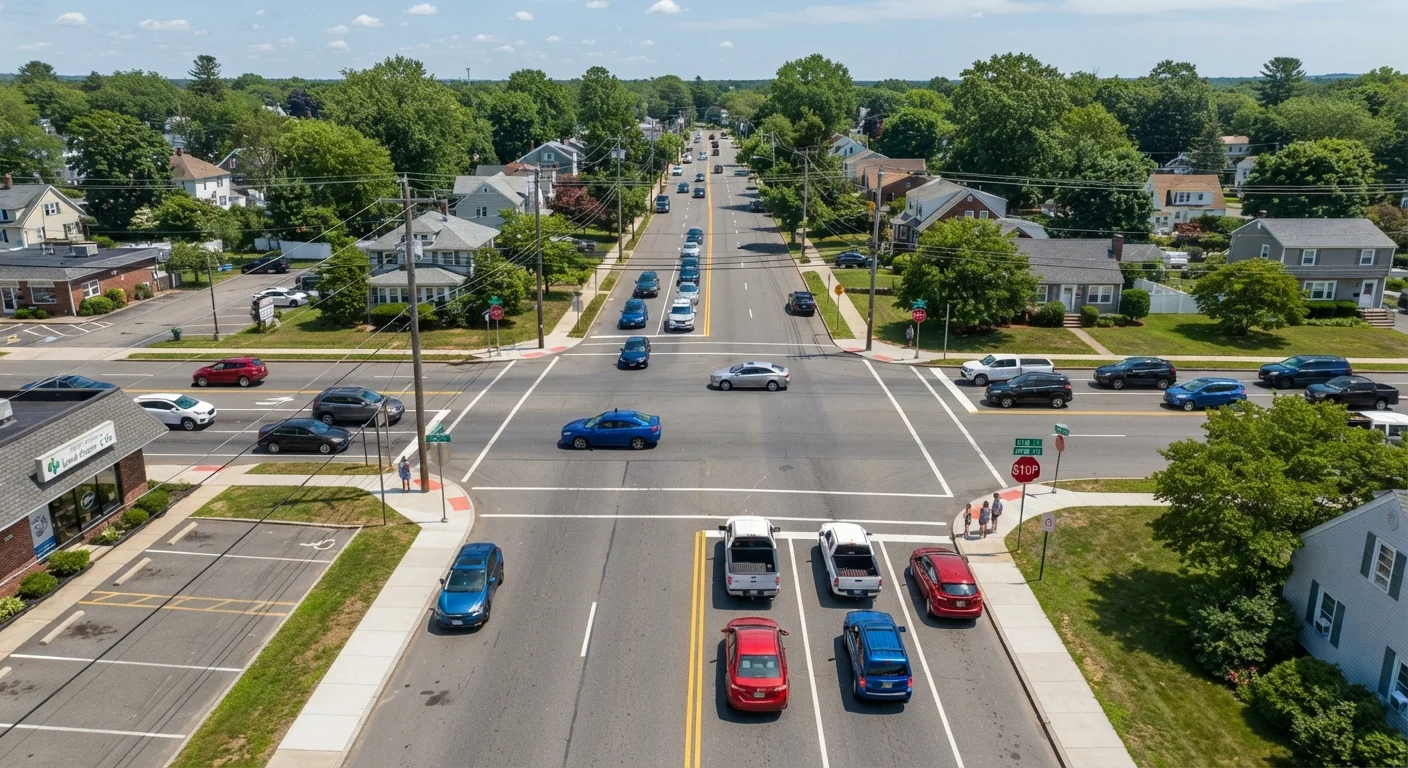
Key Takeaways
- Having the right of way does not legally or safely excuse you from preventing a collision.
- At four-way stops, arrival order - not vehicle size or road width - determines who goes first.
- Pedestrians in a marked crosswalk almost always have right of way, even mid-block in many states.
- Highway merge lanes end: the merging driver must yield, not the driver already in the travel lane.
- Turning left across oncoming traffic requires yielding even when you have a green light - not a green arrow.
Why Right-of-Way Confusion Causes Real Crashes
Right-of-way is one of the most consistently misunderstood concepts in everyday driving - and the consequences go well beyond minor inconvenience. The Federal Highway Administration has identified failure to yield as a leading contributing factor in intersection crashes, which account for a significant share of all traffic fatalities in the United States each year.
Part of the problem is that most drivers learn the rules once for their licensing exam and rarely revisit them. Habits form, myths harden, and confident assumptions replace accurate knowledge. The myth-and-fact pairs below address the most common errors - the ones that lead to close calls, collisions, and legal liability.
For a deeper look at how years of experience can breed overconfidence, see why experienced drivers still make dangerous assumptions.
Myth
If I have the right of way, I can proceed without worrying about what other drivers do.
Fact
Having the right of way creates a legal priority, not an obligation to proceed regardless of safety. You are still required to take reasonable action to avoid a collision.
Every state's traffic code includes language to the effect that drivers must exercise due care to avoid collisions, even when they have the right of way. In practice, courts and insurance adjusters can assign partial fault to a driver who could have avoided a crash but chose to "stand on" their right of way instead. Defensive driving means treating your legal priority as a starting point, not a shield.
Myth
At a four-way stop, the larger vehicle - or the driver on the wider road - goes first.
Fact
At an all-way stop, the driver who arrived first goes first. When two vehicles arrive simultaneously, the driver on the left yields to the driver on the right.
Vehicle size, road width, and the driver's perceived importance have no bearing on four-way stop priority. The arrival-order rule is straightforward, but simultaneous arrivals require the left-yields-to-right convention. When three or four vehicles arrive together, the same principle cascades: each driver yields to any vehicle on their immediate right. Confusion arises most often when drivers misjudge arrival timing or assume the busier road grants automatic priority.
Myth
Pedestrians only have the right of way at marked crosswalks with a walk signal.
Fact
In most U.S. states, pedestrians have the right of way at any marked crosswalk - signal or not - and at many unmarked crosswalks at intersections as well.
The Uniform Vehicle Code, on which most state laws are modeled, requires drivers to yield to pedestrians in crosswalks regardless of signalization. Many states extend this protection to the unmarked crosswalk that legally exists at the intersection of any two public streets, even without painted lines. Mid-block crossings vary more by jurisdiction, but marked mid-block crosswalks typically carry full pedestrian right-of-way protection. Assuming a pedestrian must wait for a signal before you need to yield is a common and dangerous error.
Myth
When merging onto a highway, cars already in the travel lane must make room for you.
Fact
The merging driver is responsible for yielding to traffic already in the travel lane. The on-ramp and acceleration lane exist to help you match speed, not to claim space.
Highway on-ramps are acceleration zones - they allow merging drivers to reach travel-lane speed before entering traffic. Once the merge lane ends, the merging driver must yield. While courteous drivers in the travel lane often shift left or adjust speed to assist a merge, they are not legally required to do so. Treating the merge lane as a right-of-way zone causes rear-end collisions and sudden braking that ripples through traffic.
Myth
A green light means you can turn left freely - oncoming traffic has to stop.
Fact
A green light permits a left turn, but only after yielding to oncoming traffic and any pedestrians in the crosswalk. A green arrow is the only signal that grants unobstructed left-turn priority.
A standard green light (circular, not an arrow) means you may enter the intersection and wait for a gap in oncoming traffic before completing your left turn. Oncoming traffic does not stop for you; they also have a green light. A protected green arrow is a separate signal phase during which oncoming traffic is held - that is the only situation where a left-turning driver has clear priority. Confusing these two is a consistent factor in left-turn collision reports.
How These Misunderstandings Play Out on the Road
Understanding right-of-way rules in theory is one thing; applying them under time pressure is another. The myths above share a common thread: drivers substitute a simpler, intuitive rule for the actual legal standard. "I got there first" feels obvious at a four-way stop, but arrival order only applies when vehicles arrive simultaneously - and judging that precisely while moving at speed is harder than it sounds.
Highway merges are another high-stakes scenario. Merge lanes are designed to allow drivers to match travel lane speed before joining traffic - they are not a second travel lane with equal claim to space. Merging on the highway without creating a hazard walks through the mechanics of a clean merge in detail.
~40%
Of all U.S. traffic crashes occur at intersections
According to Federal Highway Administration data, intersection-related crashes account for roughly 40 percent of all reported collisions, with failure to yield among the most cited contributing factors.
#1
Failure to yield - leading cause of pedestrian crashes
The National Highway Traffic Safety Administration consistently identifies failure to yield the right of way as the top driver-related factor in pedestrian fatality crashes.
Pedestrian and cyclist interactions deserve special mention. Urban road design increasingly places walkers and riders in proximity to faster-moving vehicles, often without clear physical separation. Knowing when a pedestrian has the legal right of way - and anticipating when they may step out before you yield - are two different skills. Drivers who rely only on their right-of-way knowledge, without also reading pedestrian behavior, are still operating dangerously. See pedestrians and cyclists: sharing the road without guesswork for practical guidance.
Right of Way Is a Legal Concept, Not a Safety Guarantee
No right-of-way rule eliminates your responsibility to drive safely. If another driver, pedestrian, or cyclist violates your right of way, you may be legally in the clear - but you can still be involved in a serious crash. Always scan for conflicts and be prepared to brake or adjust, regardless of who technically has priority.
Right-of-way rules vary modestly by state - crosswalk laws in particular differ in how broadly they define a pedestrian's protected zone. When in doubt, check your state's driver's manual or the relevant traffic code directly. The goal isn't to win a legal argument after a crash; it's to avoid the crash entirely.