

Key Takeaways
- Serving size is the foundation of every number on a nutrition label — always check it first.
- Daily Values (%DV) help you gauge whether a food is high or low in a given nutrient.
- Added sugars and sodium are two of the most useful nutrients to monitor on packaged foods.
- The ingredients list is listed by weight — the first few ingredients make up most of the product.
- Nutrition labels are a tool for comparison and context, not a rigid rulebook for every meal.
What you will need
Why Nutrition Label Literacy Matters
Packaged foods make up a substantial portion of what most American households eat. The Nutrition Facts label — standardized and regulated by the U.S. Food and Drug Administration (FDA) — exists to give shoppers consistent, comparable information across every product on the shelf. But knowing where to look and what the numbers actually mean are two different things.
Many shoppers glance at calories and move on, missing the more nuanced signals the label provides. Understanding the full panel — from serving sizes to added sugars to micronutrient %DVs — gives you a practical advantage when navigating grocery aisles, regardless of your dietary goals.
This is general nutritional education. It is not medical or dietary advice, and it does not replace guidance from a qualified healthcare provider or registered dietitian.
Labels Are a Guide, Not a Prescription
Nutrition labels provide general population-level reference values, not personalized dietary targets. Individual needs vary significantly based on age, activity level, health status, and other factors. If you have a chronic health condition, are pregnant, or are managing a specific dietary concern, consult a registered dietitian or your healthcare provider for guidance tailored to your situation.
To see how these label-reading skills connect to building balanced everyday meals, see building a nutritious meal without overthinking it. And if you're curious about the broader landscape of processed versus minimally processed foods, our guide on whole vs. processed foods provides useful context.
Tools You'll Need
Reading a nutrition label requires no special equipment — just the product in hand and a working understanding of what each section means. The following components are present on nearly every regulated packaged food in the US:
Nutrition Facts Panel
The standardized label on most packaged foods regulated by the FDA, containing calorie, nutrient, and ingredient information.
Ingredients List
Lists every ingredient in the product in descending order by weight, helping you understand what the food is primarily made of.
USDA Dietary Guidelines (general reference)
A publicly available framework providing population-level daily nutrient reference values used to calculate %DV figures on labels.
What you will need
How to Read a Nutrition Label Step by Step
Work through the label systematically rather than jumping to a single number. Each section builds on the one before it, and the full picture is more informative than any single data point.
Use %DV as a Quick Comparison Tool
When comparing two products on the shelf, the % Daily Value column lets you evaluate them side by side without doing math. As a general rule, 5% DV or less is considered low for a nutrient, and 20% DV or more is considered high. This works whether you're looking at sodium, fiber, or vitamin D.
Start with the serving size
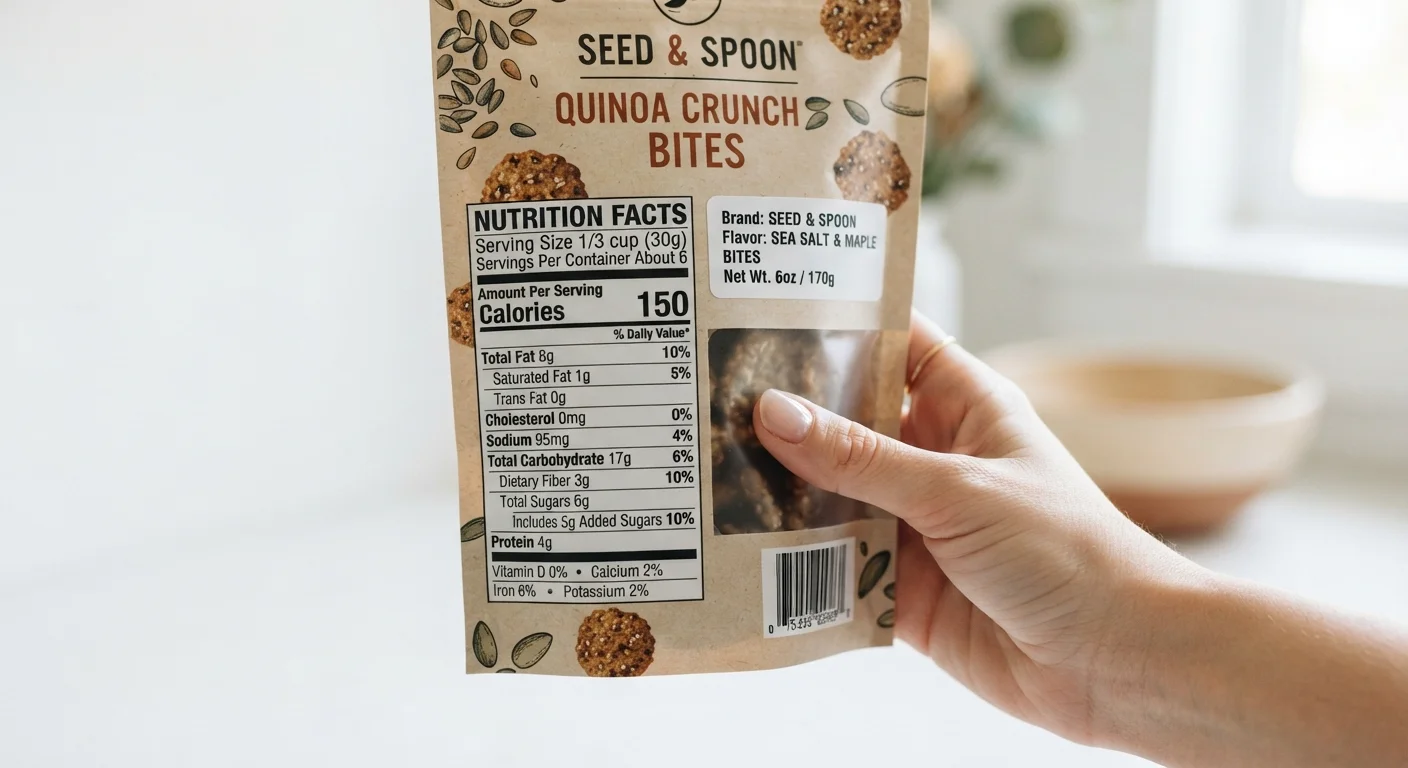
The serving size is listed at the very top of the Nutrition Facts panel, and it anchors every other number on the label. All calorie and nutrient figures apply to one serving, not the entire package.
Check the number of servings per container. A bag of chips might list 1 oz as a serving, but contain 3.5 servings total — meaning the full bag has 3.5 times the listed calories. Get in the habit of estimating how much of a package you actually consume in one sitting.
Check the calorie count in context
Calories measure the energy a food provides. The calorie figure shown on the label corresponds to one serving as defined above. Rather than treating this number as a strict limit, use it as a relative benchmark — is this food energy-dense for its portion size, or does it provide substantial volume?
Calorie needs differ widely among people, so the label's reference point of 2,000 calories per day is a general population estimate used to standardize %DV calculations, not a target for every individual.
Read the macronutrient breakdown
Below calories, the label lists three core macronutrients — fat, carbohydrates, and protein — along with sub-categories for each:
- Total Fat is broken down into saturated fat and trans fat. Most health guidance suggests limiting saturated fat and avoiding trans fat where possible.
- Total Carbohydrates include dietary fiber and total sugars, with added sugars listed separately underneath. Added sugars are those introduced during processing, distinct from naturally occurring sugars in fruit or dairy.
- Protein does not have a %DV listed, but the gram amount can help you gauge whether a food contributes meaningfully to your intake.
For more context on how fiber fits into your overall diet, see why fiber deserves more attention.
Understand % Daily Value (%DV)
The % Daily Value column shows how much of each nutrient one serving contributes toward a general daily reference amount. These reference values are established for a 2,000-calorie diet and are useful for comparison — not as precise personal targets.
Use %DV to quickly identify whether a food is a significant source of a nutrient you want more of (fiber, vitamin D, calcium, iron) or one you might want to moderate (sodium, saturated fat, added sugars).
Scan for key micronutrients
The lower portion of the Nutrition Facts panel lists several vitamins and minerals that are commonly under-consumed in the American diet: vitamin D, calcium, iron, and potassium. A higher %DV for these nutrients generally indicates a more nutrient-dense food for those particular compounds.
For a broader understanding of what these nutrients do in the body, our plain-language micronutrients reference covers each one without the biochemistry jargon.
Read the ingredients list
The ingredients list appears below the Nutrition Facts panel and is ordered by weight — the ingredient present in the largest amount is listed first. This means the first three to five ingredients give you the clearest picture of what a food is primarily made from.
Look for whole food ingredients near the top (whole grain oats, water, tomatoes) and take note if added sugars appear in multiple forms (corn syrup, dextrose, cane sugar, maltose) — each counts separately, which can distribute sugar throughout the list and obscure its total contribution.
Front-of-Package Claims Can Be Misleading
Words like 'natural,' 'light,' 'multigrain,' or 'low-fat' on the front of a package are marketing terms, not regulated nutrition guarantees. A product labeled 'low-fat' may still be high in added sugars or sodium. Always flip to the nutrition facts panel and ingredients list to form an accurate picture of what a food actually contains.
Putting It Into Practice
Label reading becomes faster and more intuitive with repetition. Start by comparing two versions of a product you regularly buy — a standard and a reduced-sodium version, for example — and walk through the %DV column on both. This kind of side-by-side comparison is often more informative than reading a label in isolation.
Keep in mind that no single food defines a diet. A food with a high sodium %DV isn't off-limits — it's context that matters. What 'eating balanced' actually means in practice offers a grounded look at how individual food choices fit into the larger picture of everyday nutrition.
This article is for general informational purposes only and does not constitute medical or dietary advice. Consult a qualified healthcare professional or registered dietitian for guidance specific to your health needs.