

Key Takeaways
- Processing exists on a spectrum — canned beans and packaged cookies are not nutritionally equivalent.
- Whole foods generally retain more fiber, vitamins, and minerals than heavily processed alternatives.
- Ultra-processed foods, not minimally processed ones, are most consistently linked to poor dietary patterns.
- Understanding food labels helps distinguish minimally processed from heavily reformulated products.
- Overall eating patterns matter more than any single food choice in isolation.
Option A
Whole Foods
Minimally altered foods close to their natural state.
Best for: People looking to maximize nutrient density and fiber intake from their everyday meals.
Option B
Processed Foods
Foods altered from their original form through industrial or culinary methods.
Best for: Consumers balancing convenience, shelf life, and cost alongside nutritional goals.
If you want to maximize nutritional density with every meal
Whole Foods
Whole foods deliver fiber, vitamins, and minerals in their most intact form, with minimal additives or reformulation affecting nutrient profiles.
If convenience, affordability, or shelf life are practical priorities
Processed Foods
Minimally processed options like canned tomatoes, frozen vegetables, or plain yogurt offer genuine nutritional value while fitting real-life schedules and budgets.
If you're trying to reduce added sugar, sodium, or artificial additives
Whole Foods
Whole and minimally processed foods typically contain far less added sodium, sugar, and artificial preservatives than ultra-processed packaged alternatives.
What Do We Actually Mean by 'Processed'?
The word "processed" covers an enormous range. Technically, cutting an apple or pasteurizing milk is a form of processing — yet neither belongs in the same category as a shelf-stable snack cake engineered for maximum palatability. Nutrition researchers have developed classification frameworks to draw clearer lines. The NOVA system, widely cited in public health literature, groups foods into four categories ranging from minimally processed (frozen peas, plain rolled oats) to ultra-processed (packaged chips, sugary beverages, reconstituted meat products).
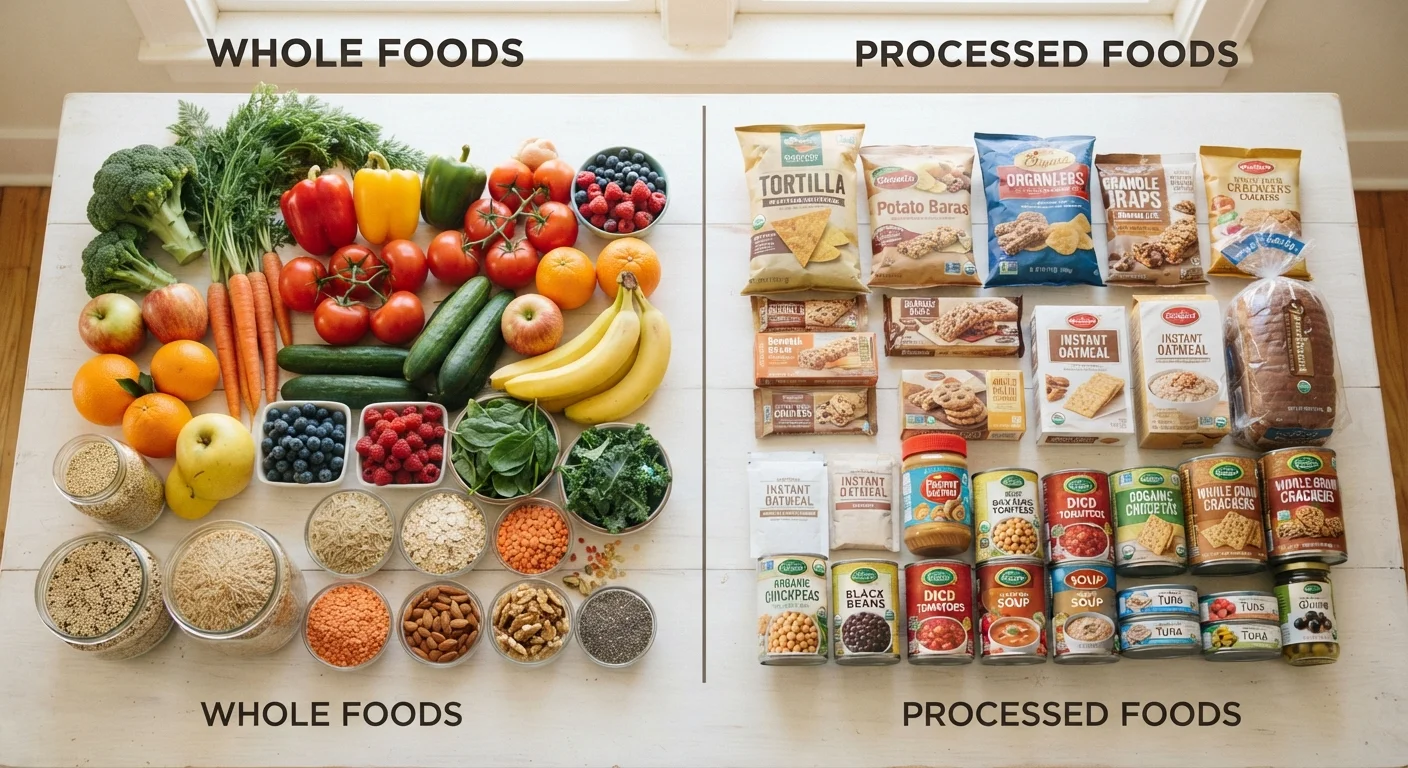
A whole food is one that has undergone little or no processing — think fresh produce, dried legumes, whole grains, eggs, or plain nuts. A minimally processed food has been altered for preservation or convenience but retains most of its original nutritional character. Ultra-processed foods are industrially formulated products where original food structures are largely broken down and replaced with additives, refined starches, flavors, and emulsifiers.
Understanding this spectrum is more useful than a binary "whole vs. processed" judgment. For practical label-reading skills, see our guide to reading nutrition labels.
| Criterion | Whole Foods | Processed Foods |
|---|---|---|
| Definition | Unaltered or minimally altered from natural state | Industrially or culinarily modified from original form |
| Fiber retention | Generally high | Often reduced, especially in ultra-processed items |
| Added sugar/sodium | Typically absent or minimal | Commonly elevated in ultra-processed products |
| Shelf life | Generally shorter | Often extended via additives or packaging |
| Convenience | Requires more preparation time | Ready-to-eat or quick to prepare |
| Cost | Varies; fresh produce can be costly | Often lower unit cost per serving |
| Nutrient density | Generally higher per calorie | Varies widely by processing degree |
How Nutritional Value Shifts Along the Spectrum
Whole foods tend to retain their natural matrix — the physical structure of a food that influences how fiber, phytonutrients, and macronutrients interact during digestion. When grains are refined, for example, the bran and germ are removed, stripping out fiber, B vitamins, and minerals. Manufacturers sometimes add some nutrients back through fortification, but the reconstituted profile rarely mirrors the original.
Heavy processing also commonly introduces what researchers call "energy-dense, nutrient-poor" characteristics: high levels of added sugars, refined starches, and sodium paired with low fiber and micronutrient content. Several large-scale observational studies have associated regular consumption of ultra-processed foods with less favorable dietary patterns and health outcomes, though diet research is complex and dietary context always matters.
~58%
Share of US calorie intake from ultra-processed foods
Research published in the BMJ estimated that ultra-processed foods account for roughly 57–58% of daily caloric intake in the average American diet.
4x
More fiber in whole grains vs. refined grains
Whole grains such as oats and brown rice can contain up to four times more dietary fiber than their refined white-flour equivalents, according to USDA nutrient data.
Minimally processed foods occupy important middle ground. Canned fish, frozen vegetables, plain Greek yogurt, and low-sodium canned beans all offer solid nutritional value with the convenience of longer shelf life. These are not nutritional equivalents of ultra-processed snacks, and lumping them together misrepresents the evidence. The bigger picture of overall eating patterns is consistently a more reliable guide than evaluating individual foods in isolation.
Making This Practical in Everyday Eating
A useful everyday approach is to ask: How far is this food from its original form, and what has been added or removed? A short ingredient list where you recognize each item is generally a reliable signal of minimal processing. Ingredient lists heavy with refined grains listed first, multiple added sugars under different names, or lengthy additive sequences suggest a more heavily reformulated product.
Frozen and Canned Foods Can Be Nutritious
Frozen vegetables are typically harvested and frozen at peak ripeness, which preserves many vitamins effectively. Similarly, canned legumes and fish can be nutritionally comparable to their fresh counterparts. Rinsing canned items can reduce added sodium significantly. These minimally processed options are worth keeping in your rotation — they are not in the same nutritional category as ultra-processed packaged snacks.
None of this means avoiding all packaged food. Convenience foods serve real needs — time, budget, accessibility, and preference all shape how Americans eat. The goal is awareness, not perfection. Leaning toward minimally processed options where practical, and reserving ultra-processed foods for occasional rather than routine consumption, aligns with most major nutrition guidance.
If you're also thinking about dietary protein sources alongside these food quality principles, our comparison of animal and plant protein options explores those trade-offs in practical terms. And for readers considering broader dietary shifts, what changes when you reduce meat intake covers the key nutritional adjustments to keep in mind.
This article is for general informational and educational purposes only and is not a substitute for professional medical or nutritional advice. Consult a qualified healthcare professional or registered dietitian for guidance specific to your health needs.