

Key Takeaways
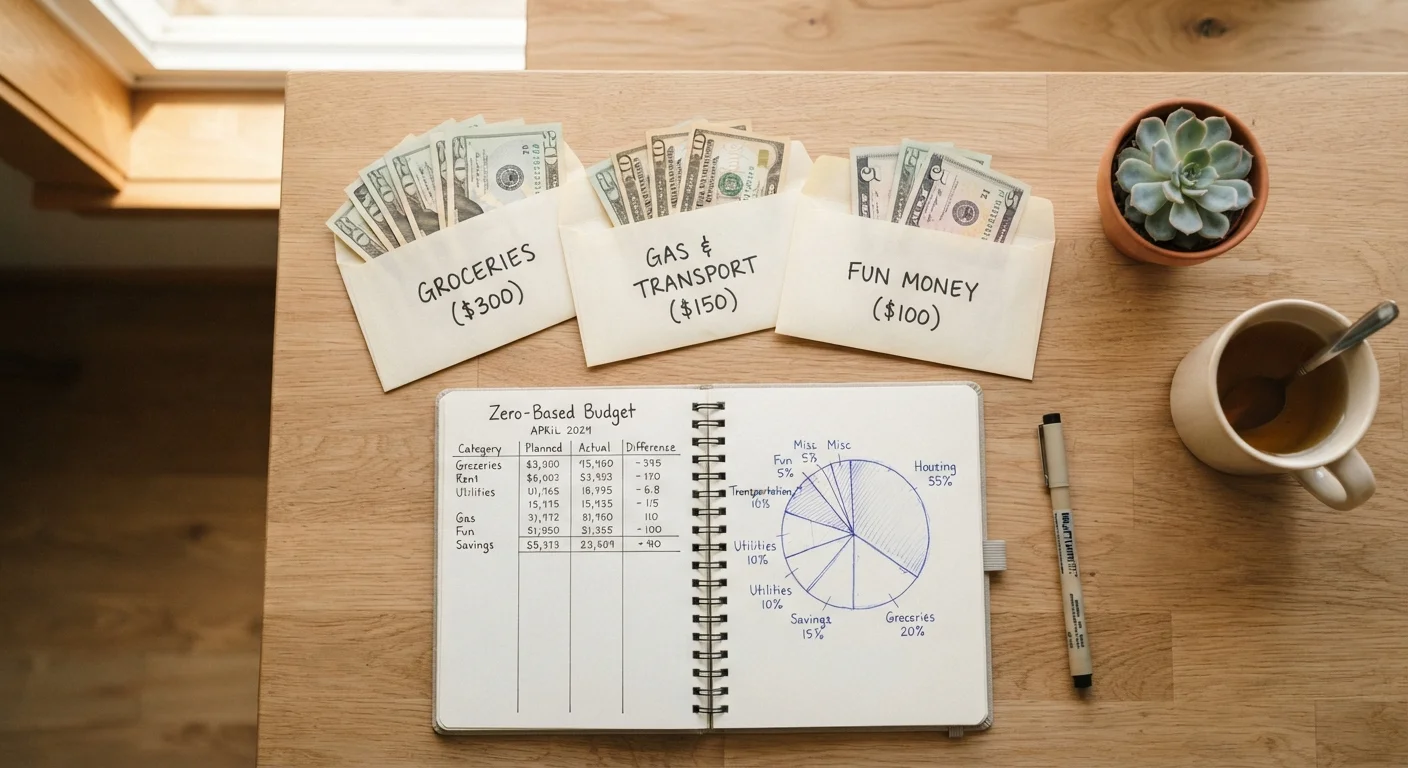
- Envelope budgeting uses physical or digital cash envelopes to cap spending in each category.
- Zero-based budgeting assigns every dollar of income a specific job before the month begins.
- Percentage-based methods like 50/30/20 offer flexibility without requiring granular tracking.
- No single method is universally superior — the right fit depends on your habits and goals.
- Switching methods is always an option; the best budget is one you'll actually use.
Our Verdict
Envelope budgeting works best for people who overspend in specific categories and need a hard stop. Zero-based budgeting suits those who want complete control and don't mind the setup time. Percentage approaches are the easiest entry point for anyone who finds detailed tracking unsustainable. The most effective method is the one that matches how you actually think about money.
| Best for | Recommended |
|---|---|
| Those who struggle with overspending in specific categories | Envelope Budgeting |
| People who want full control over every dollar | Zero-Based Budgeting |
| Anyone who wants a simple, low-maintenance framework | Percentage-Based (50/30/20) |
| Variable-income earners needing monthly flexibility | Zero-Based Budgeting |
Why Budgeting Method Matters
Most people know they should have a budget. Fewer stick with one long enough to see results. Often the problem isn't discipline — it's a mismatch between the method and the person using it. A system that feels like constant bookkeeping will get abandoned. One that's too loose won't change behavior.
This article walks through three widely used approaches — envelope budgeting, zero-based budgeting, and percentage-based budgeting — so you can evaluate which structure fits your income, habits, and goals. For a deeper look at how tracking tools affect your results, see paper vs. spreadsheet vs. app budgeting.
This article is for general informational purposes only and does not constitute personalized financial advice. Consider consulting a qualified financial professional for guidance specific to your situation.
Envelope Budgeting: Cash in, Category Out
The envelope method divides your take-home pay into spending categories — groceries, gas, dining out, entertainment — and allocates a set cash amount to each. Historically, this meant literal envelopes of cash. Today, many people replicate it digitally using budgeting apps that simulate the same hard limit.
The core rule: when an envelope is empty, spending in that category stops for the month. No borrowing from next month, no mental accounting. This makes overspending visible in a way that debit cards rarely do.
Who it suits: People who overspend in predictable categories and want a physical or visual stop mechanism. It's particularly effective for discretionary spending like dining, clothing, and entertainment. It's less practical for bill-heavy budgets with many fixed expenses that can't easily be cashed out.
Try One Method for a Full Month
Before deciding a budgeting method doesn't work for you, give it at least 30 days. Most people abandon a new system before the habits form. Pick one approach, track it consistently for a month, then evaluate. Switching too quickly means you never learn what the system can actually do.
For couples coordinating shared spending, the envelope method can also clarify who controls which category. See budgeting as a household for approaches that reduce friction.
Zero-Based Budgeting: Every Dollar Has a Job
Zero-based budgeting (ZBB) starts with your monthly income and subtracts expenses, savings, and debt payments until you reach zero. The goal isn't to spend everything — it's to intentionally assign every dollar before the month starts, so nothing is left unaccounted for.
If you earn $4,500 a month, every dollar of that $4,500 gets a label: rent, groceries, emergency fund, student loan, fun money. At the end of the planning session, the math hits zero. Surplus dollars get assigned too — to savings, debt payoff, or a specific goal.
Who it suits: People with relatively predictable income who want granular control. It's also useful for variable-income earners willing to redo the budget each month based on what actually came in. The setup takes time, but the clarity it provides is hard to match. For a side-by-side look at ZBB versus envelopes, this comparison goes deeper.
| Envelope Budgeting | Zero-Based Budgeting | Percentage-Based (50/30/20) | |
|---|---|---|---|
| Core Concept | Cash allocated per category | Every dollar assigned a job | Income split by percentages |
| Setup Time | Low to moderate | High — monthly rebuild | Low |
| Tracking Intensity | High — per-category limits | High — line-item detail | Low — broad buckets |
| Best For | Overspenders in specific areas | Control-focused budgeters | Beginners or busy households |
| Flexibility | Low — hard category caps | Moderate — resets monthly | High — broad guidelines |
| Works With Variable Income | Somewhat | Yes — rebuild each month | Yes — percentages scale |
| Main Weakness | Cash use declining | Time-consuming setup | Less visibility into overspend |
Percentage-Based Budgeting: Simple Splits, Less Tracking
Percentage approaches divide income into broad buckets by percentage rather than dollar-specific line items. The most recognized version is the 50/30/20 guideline: roughly 50% of after-tax income toward needs, 30% toward wants, and 20% toward savings and debt repayment.
The appeal is simplicity. You don't need to track every grocery receipt. You check whether your spending categories are landing within their assigned percentages, then adjust as needed. It's a framework, not a rigid rulebook.
Who it suits: People who find detailed tracking unsustainable, higher earners whose fixed costs are well below 50%, or anyone just starting out with budgeting. The tradeoff is less granularity — if overspending happens, the percentage model won't always reveal exactly where. For a thorough explanation of how the 50/30/20 rule works in practice, see The 50/30/20 Budget Framework, Unpacked.
Choosing the Right Fit — and Staying Flexible
None of these methods is objectively better. The envelope system demands the most behavioral friction, which is its strength and its weakness. Zero-based budgeting offers precision but requires time investment each month. Percentage budgeting is low-maintenance but sacrifices detail.
A few practical questions to guide your choice:
- Do you overspend in specific categories? Envelope method addresses this directly.
- Do you want to see where every dollar goes? Zero-based budgeting is built for that.
- Does detailed tracking feel unsustainable? Percentage-based approaches reduce that burden.
You can also blend approaches — many people use percentage splits as a starting framework, then apply envelope-style limits to the categories where they historically overspend. If you're budgeting for a specific goal like travel, the same logic applies: a practical travel budget framework can layer on top of whichever method you use daily.
Explore all foundational strategies in the Budgeting Basics hub, or pair your budgeting method with stronger savings habits through the Saving & Debt hub.