

Key Takeaways
- Match your bag type and size to your trip length and transportation mode before packing anything.
- A versatile capsule wardrobe built around neutral, layerable pieces eliminates most over-packing.
- Packing cubes and compression pouches dramatically improve organization and maximize bag space.
- Climate and activities — not trip length — should drive what actually goes into your bag.
- Leaving space in your bag for souvenirs or unexpected purchases prevents bag-overflow stress.
- Verifying airline carry-on size rules before departure can save time, fees, and frustration.
Choosing the Right Bag for Your Trip
Before a single shirt gets folded, the most consequential packing decision is already in front of you: which bag are you bringing? The wrong vessel — too big, too rigid, wrong shape for overhead bins — creates downstream problems for the entire trip.
For trips of one to five days, a 20–35 liter daypack or compact carry-on is usually sufficient. Weekend warriors who check luggage often over-pack simply because the extra space invites it. For trips lasting one to three weeks, a 40–50 liter backpack-style carry-on or a spinner suitcase strikes a workable balance. Longer trips rarely require more volume — they require better systems.
Consider your transportation mix carefully. Train travel in Europe rewards soft-sided bags you can squeeze into overhead racks. Domestic US road trips forgive larger roller bags. Hiking-heavy itineraries call for purpose-built packs with hip-belt support. Check the full trip planning framework to match your bag choice to your itinerary before you commit.
Check Airline Size Rules Before You Fly
Carry-on allowances vary significantly between airlines, fare classes, and even routes. A bag that fits on one carrier may be gate-checked on another. Measure your bag loaded — not empty — and compare those dimensions against the specific airline's published limits before departure.
Always verify carry-on size limits with your specific airline and fare class before your trip. Budget carriers in particular enforce linear inch limits strictly, and checked bag fees can add up quickly.
The Packing Light Mindset
Experienced travelers tend to share one counterintuitive belief: bringing less makes a trip better. Lighter bags mean faster airport security, no checked luggage fees, more flexibility to switch hotels, and far less physical fatigue on cobblestone streets or train platforms.
The shift starts with questioning every item at the door. Ask: Will I use this more than twice? If the honest answer is no, leave it. Clothes take up the most space and add the most weight, so building a small capsule wardrobe of neutral, mix-and-match pieces is where most travelers save the most room. Three to five tops, two bottoms, and one versatile layer can cover a week of varied activities when chosen strategically.
Before packing, lay every item you plan to bring on your bed — then put half of it back. Most travelers are shocked how little they actually need once they see everything together.
Visualizing the full volume of packed items at once makes it far easier to make objective cuts than packing piece-by-piece directly into a bag.
Choose one color palette for your entire wardrobe on any trip — every piece should pair with every other piece. This strategy multiplies outfit combinations without adding a single extra item.
A cohesive color palette means you're never stuck with a top that only matches one bottom, dramatically increasing the utility of each item you carry.
For a deeper look at how seasoned travelers apply this logic, see the carry-on only mindset guide — it challenges assumptions most first-timers don't even know they're making.
Building Your Packing List by Climate
Trip length is a poor guide for what to pack. Climate and planned activities are far better inputs. A four-day trip to northern Minnesota in January demands a fundamentally different kit than four days in Miami — even though the duration is identical.
- Cold destinations: Prioritize thermal base layers and a packable insulated jacket over bulky sweaters. Merino wool is compact, odor-resistant, and temperature-regulating.
- Hot and humid destinations: Lightweight, moisture-wicking fabrics in lighter colors. Fewer pieces, more frequent washing.
- Variable or four-season climates: Layering is the strategy. A lightweight rain shell, a mid-layer fleece, and a base layer handle almost any weather combination.
- Beach or water-focused trips: Quick-dry fabrics double as swimwear cover-ups, reducing total item count significantly.
New to minimalist packing for extended trips? The packing light for a two-week trip guide offers a practical foundation without the intimidation factor.
50%
Clothes travelers typically don't wear on trips
Travel industry surveys consistently find that roughly half the clothes packed go unworn, according to consumer travel research.
~$35
Average US domestic checked bag fee (one way)
Major US carriers charge between $30 and $40 for a first checked bag on most domestic fares, making carry-on travel a meaningful cost consideration.
7 lbs
Average weight added by over-packing
Travel packing studies suggest most travelers carry 5–10 pounds more than they need, increasing fatigue and mobility challenges.
Organizing What's Inside Your Bag
A well-packed bag isn't just about volume — it's about retrievability. Digging through a disorganized suitcase at 6 a.m. is a preventable misery. A few simple systems change the experience entirely.
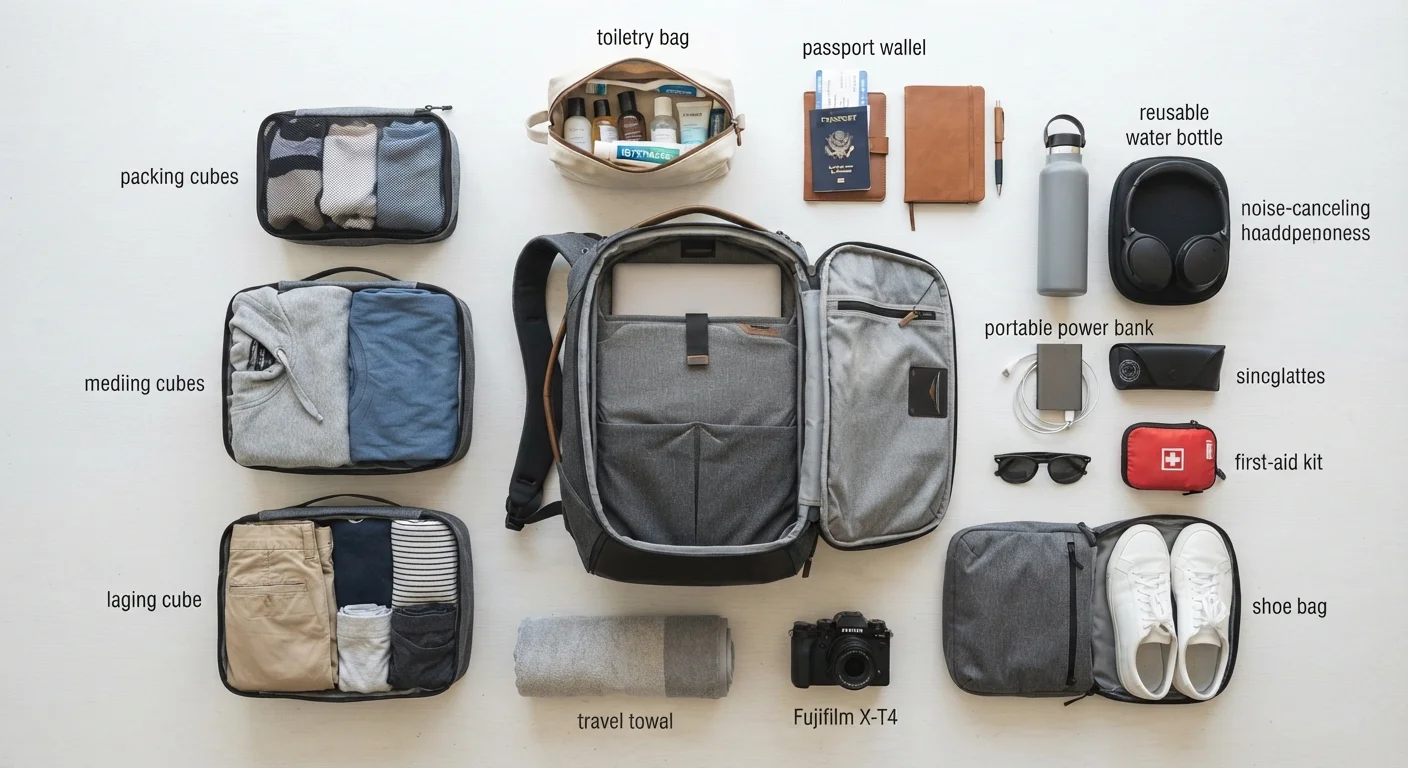
Packing cubes are the most widely recommended organizational tool among frequent travelers. Assign one cube per category — tops, bottoms, undergarments — and you can find anything in seconds. Compression cubes go a step further, physically reducing soft items like sweaters to half their normal footprint.
Rolling vs. folding: Rolling clothes generally reduces wrinkles and saves space compared to flat folding. Structured items like blazers fare better folded flat. A hybrid approach works well for mixed packing.
Keep items you'll need at security or during transit — laptop, documents, travel wallet — accessible in an exterior pocket or the top layer of your pack. Toiletries in a clear, zip-close bag belong near the top for quick extraction at TSA checkpoints.
Use the 'One In, One Out' Rule Mid-Trip
If you buy a souvenir or piece of clothing on the road, consider mailing something home or donating a worn item locally to keep your bag manageable. Many post offices in popular tourist destinations are accustomed to travelers shipping packages home — it's often more affordable than an overweight bag fee.
Essential Travel Gear Worth Carrying
Beyond clothing, a small set of multi-purpose gear makes almost every trip smoother. The goal is items that solve multiple problems without adding meaningful weight.
- Universal power adapter
- Essential for international travel; a compact multi-region adapter handles outlets in most countries.
- Packable day bag
- A lightweight tote or stuff-sack daypack collapses to almost nothing but gives you a carry option for day excursions without dragging your main bag.
- Microfiber travel towel
- Dries fast, packs small, and saves you from hostel towel rental fees or beach resort charges.
- Reusable water bottle with filter
- Reduces plastic waste and is especially useful in destinations where tap water quality is uncertain.
- Portable battery pack
- Long travel days drain phones quickly. A mid-capacity battery keeps navigation and communication available when you need them most.
Building your travel gear list is one component of comprehensive trip planning — the other pieces involve logistics, budgeting, and destination research.
TSA What Can I Bring? Tool
The official TSA search tool lets you check whether any specific item is allowed in carry-on or checked luggage before you pack it — saves surprises at the security checkpoint.
Packing List Template
A reusable, categorized packing checklist organized by clothing, toiletries, documents, and gear — customize it once and reuse it for every future trip.
Trip Planning Hub
Practical strategies covering every stage of planning a trip, from early research through final packing — a useful companion resource to this packing guide.
Common Packing Mistakes to Avoid
Even organized travelers fall into familiar traps. Knowing them in advance removes the trial-and-error from the equation.
- Packing for worst-case scenarios: Most travelers never use the emergency outfit, the formal dinner jacket, or the third pair of shoes. Pack for what you'll actually do.
- Ignoring laundry options: Most destinations have laundry services or coin laundromats. Planning one mid-trip wash cuts your clothing needs in half.
- Liquid overload: Full-size toiletries are heavy and often confiscated at security. Travel-size containers or solid alternatives — shampoo bars, solid sunscreen — save both weight and hassle.
- No buffer space: Leaving your bag completely full before departure means no room for purchases, gifts, or anything you pick up along the way.
- Forgetting to test the bag loaded: Pack your bag fully and carry it for 15 minutes before your trip. You'll quickly discover whether it fits comfortably or needs reorganization.
If you're newer to self-directed travel, the travel planning guide for first-timers covers the full scope of preparation — packing is just one piece of the puzzle.
Verify Entry and Customs Rules Independently
Packing prohibited items — certain food products, liquids over TSA limits, restricted electronics — can result in confiscation, fines, or entry delays. Always check the TSA's official guidelines for domestic flights and your destination country's customs authority for international travel. Rules change and vary by destination.
This article provides general packing guidance for informational purposes. Airline policies, customs regulations, and local entry requirements vary and can change — always verify current rules with your carrier and relevant official government sources before traveling.