

Key Takeaways
- Carry-on travel eliminates checked bag fees and baggage claim wait times.
- The mindset shift matters more than any specific packing technique.
- Versatile clothing and travel-size toiletries are the two biggest space wins.
- Most items you pack "just in case" never get used on the road.
- Carry-on packing works for trips of many lengths when planned deliberately.
Carry-On Only Mindset
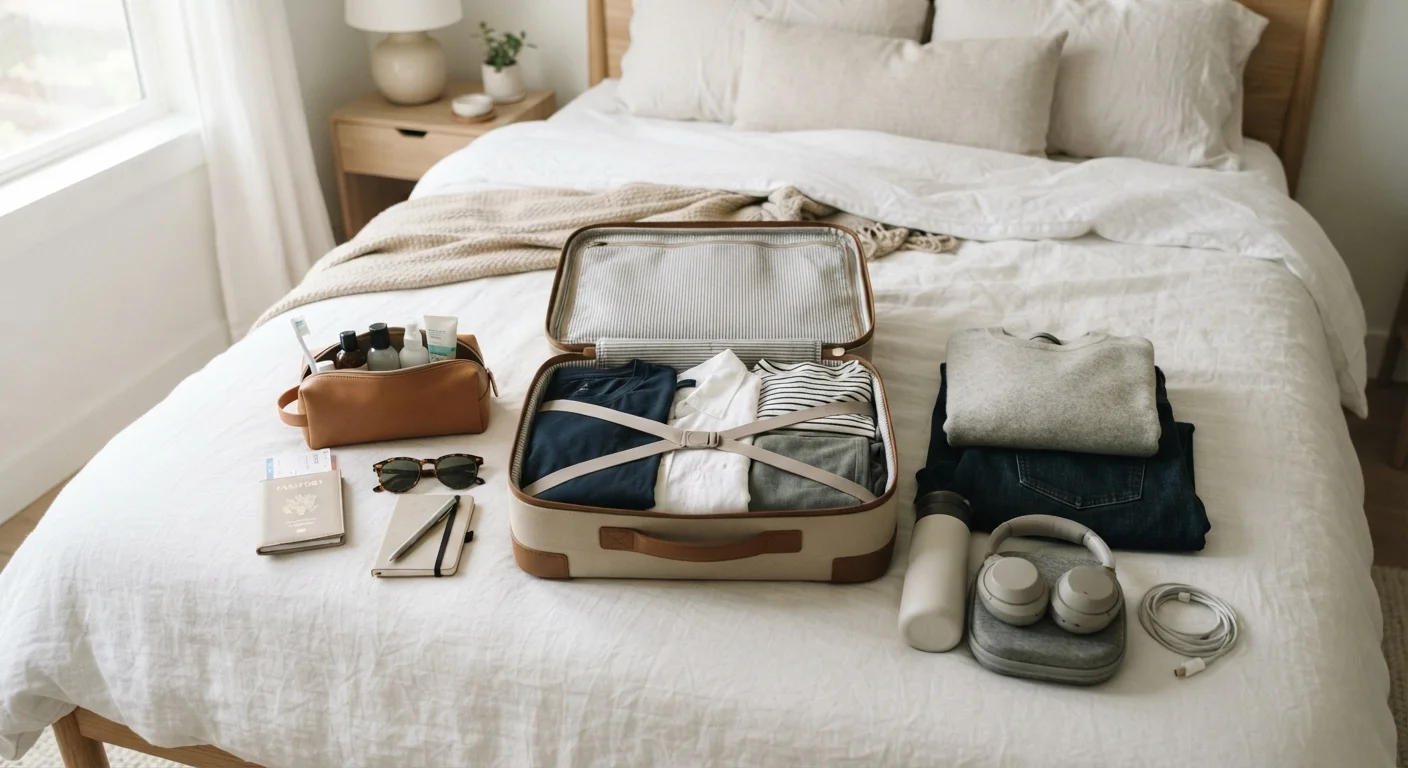
The carry-on only mindset is a travel philosophy centered on fitting everything you need for a trip into a single bag small enough to bring aboard the plane. It challenges travelers to question each item before packing it, prioritizing versatility and necessity over comfort and "just in case" thinking. The result is a lighter load that moves faster, costs less, and adapts more easily to unexpected changes.
Most major US carriers allow one carry-on bag (typically up to 22 x 14 x 9 inches) plus one personal item; always verify current size and weight limits with your specific airline before travel.
Why "Just in Case" Is the Enemy of Light Packing
Every overpacked bag tells the same story: a steady accumulation of items that seemed reasonable one by one. A backup outfit. An extra pair of shoes. Three charger cables instead of one. None of these decisions feel reckless in isolation — but together, they transform a manageable bag into a physical burden you'll lug through airports, up hotel stairs, and across cobblestones for the entire trip.
The carry-on only mindset starts by recognizing that "just in case" thinking is the root cause of most overpacking. When you pack for worst-case scenarios rather than likely ones, you're essentially hauling around insurance you'll rarely redeem. The honest truth: most of those backup items never leave the bag.
Overpacking rarely happens all at once — it creeps in through specific habits that feel entirely rational in the moment. Naming those habits is the first step to breaking them.
Try a Test Pack Before You Commit
A week before your trip, pack everything you think you need — then leave the bag untouched for 24 hours. When you return to it, remove anything you didn't think about during that time. Most travelers find they can cut 20–30% of their original list this way without any sense of loss on the actual trip.
The Core Shift: From "What Might I Need?" to "What Will I Actually Use?"
Experienced light packers don't use a different packing list — they use a different question. Instead of asking what might I need?, they ask what will I actually use? That single reframe cuts most packing lists by 30 to 40 percent before a single item hits the bag.
Practically, this means auditing items against three filters:
- Frequency: Will I use this every day, or just possibly once?
- Replaceability: Could I buy or borrow this at the destination if I truly needed it?
- Versatility: Does this item serve more than one purpose or outfit?
Clothing is where most travelers find the biggest gains. A neutral-toned capsule wardrobe — pieces that mix and match freely — stretches a small number of items across a full trip. Practical packing approaches like the capsule method are worth understanding before you start layering items into your bag.
$30–$40
Typical one-way checked bag fee on US domestic flights
Fees vary by airline and route; budget for both directions when calculating total travel costs.
20–30 min
Average baggage claim wait time avoided per flight
Carry-on travelers can exit the airport immediately after landing, which compounds across multi-leg itineraries.
3.4 oz
TSA liquid container limit per item in carry-on
All liquids must fit in a single quart-sized clear bag; solid toiletry alternatives bypass this rule entirely.
What Carry-On Only Actually Looks Like in Practice
The mechanics of fitting a week or more into one bag become straightforward once the mindset clicks. Here's what experienced carry-on travelers typically settle on:
- Clothing: 5–7 tops, 2–3 bottoms, 1–2 layering pieces, and no more than 2 pairs of shoes (worn on the travel day to save space).
- Toiletries: Travel-size or solid-format products that meet TSA liquid guidelines. A well-organized toiletry kit clears security faster and takes up far less room than full-size products.
- Tech: One universal charging cable where possible, a compact power bank, and only the devices the trip genuinely requires.
Organization tools like packing cubes can help maintain structure inside the bag — though they're not required. What packing cubes genuinely do well is worth understanding before adding them to your kit.
It's also worth knowing when a carry-on isn't the right call. Some trips — multi-climate itineraries, formal-event travel, or journeys with specialized gear — may call for checked luggage. Weighing the real trade-offs helps you choose the right approach for each specific trip rather than defaulting to habit.
The Unexpected Benefits Beyond a Lighter Bag
Travelers who commit to carry-on packing often report benefits they didn't anticipate. The financial savings are real — checked bag fees on domestic US flights typically run between $30 and $40 each way, adding up quickly on multi-leg or round trips. But the less obvious payoffs may matter even more.
A small bag means you move faster. You board earlier, skip the baggage claim carousel entirely, and pivot without friction when plans change — a missed connection, a spontaneous extra night somewhere, a last-minute mode shift from flight to train. The bag that fits in the overhead bin is the bag that gives you options.
There's also a psychological dimension. Many travelers describe carry-on-only trips as simply feeling lighter — less mental overhead, less anxiety about lost luggage, less time spent managing stuff and more time experiencing the destination. For those ready to take the concept further, packing light for longer trips is an achievable next step with the right foundation in place.
“The traveler who packs light doesn't arrive with less — they arrive with exactly what they need, and nothing they have to manage.”
— Travel & Trips Editorial Team, Editors covering practical travel strategy for everyday American travelers