

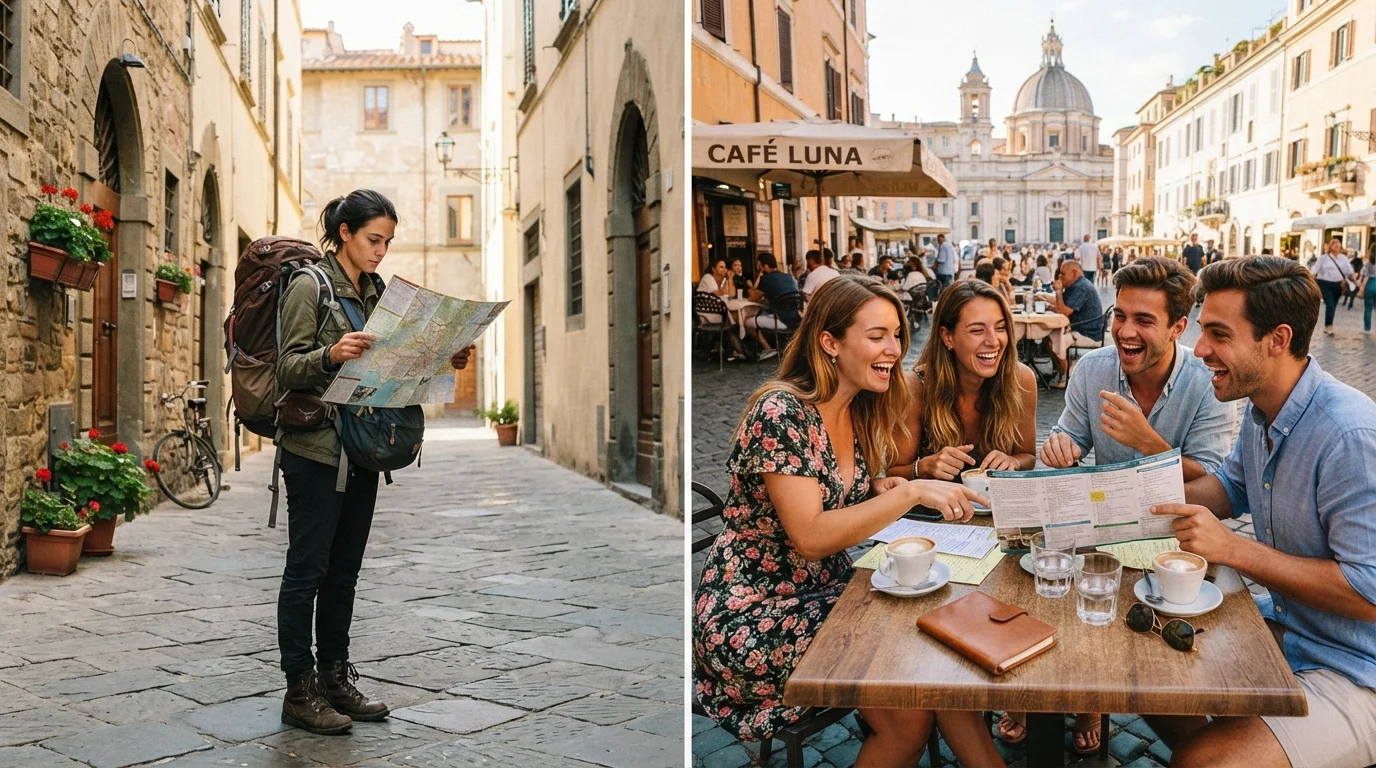
Key Takeaways
- Solo travelers bear all planning responsibility but gain total scheduling freedom.
- Group trips require early consensus on budget, style, and must-do activities to avoid friction later.
- Accommodation costs per person are often lower in groups; solo travelers may pay single-room supplements.
- Decision fatigue is a solo challenge; group trips shift that into coordination overhead.
- Both approaches benefit from a documented shared itinerary — even solo travelers should leave one with someone at home.
Option A
Solo Travel
The fully self-directed, maximum-flexibility approach.
Best for: Independent travelers who want to set their own pace, pivot on a whim, and manage decisions without group consensus.
Option B
Group Travel
The shared-experience, cost-splitting option.
Best for: Travelers who value companionship, shared costs, and collective decision-making — and are willing to compromise on the itinerary.
If you want complete control over every day's schedule
Solo Travel
You decide when to wake up, where to eat, and when to move on — no negotiation required. That autonomy is solo travel's defining advantage.
If splitting costs is a priority for your budget
Group Travel
Shared accommodation, car rentals, and group dining often reduce the per-person cost significantly compared to traveling alone.
If you're heading to an unfamiliar or complex destination for the first time
Group Travel
Having companions to navigate logistics with can reduce anxiety and provide a safety net when plans go sideways.
If you thrive on spontaneous detours and last-minute changes
Solo Travel
Pivoting your plans mid-trip is effortless alone — with a group, even small changes require buy-in from everyone involved.
If you want to build shared memories with friends or family
Group Travel
Shared experiences — even the challenging ones — create lasting bonds that solo adventures simply can't replicate.
How the Planning Mindset Shifts
Before you book a single flight, the most important question isn't where — it's who. Whether you're traveling solo or with a group fundamentally reshapes your entire planning approach, from the first brainstorm to the morning of departure.
Solo travel is planning in singular. Every choice — destination, pace, budget ceiling — is yours alone. That freedom is exhilarating, but it also means every research task, booking confirmation, and contingency plan rests on you. If you're newer to this, our guide for first-time trip planners walks through the full process step by step.
Group travel replaces that personal accountability with collective decision-making. You gain partners, shared costs, and companionship — but you also inherit the need for early alignment. The biggest planning mistake groups make is skipping the upfront conversation about travel style: one person's idea of a relaxing vacation might be another's definition of boring. Locking in shared expectations before you open a booking tab saves significant friction later.
Always Share Your Itinerary
Whether you're traveling solo or in a group, leaving a copy of your itinerary — including accommodation addresses and key contact numbers — with someone at home is a simple safety habit worth making non-negotiable. For solo travelers especially, this creates an external check-in system if communication goes dark. Many travel apps let you share live itinerary access with a trusted contact.
Logistics: Where the Differences Are Most Visible
Logistics is where solo and group planning diverge most dramatically. Here's a side-by-side look at the key variables:
| Criterion | Solo Travel | Group Travel |
|---|---|---|
| Decision-making | Fast, fully personal | Consensus required |
| Accommodation cost | Often higher per person | Lower when split |
| Itinerary flexibility | Maximum — change anytime | Limited by group agreement |
| Planning workload | Falls entirely on you | Distributed, but coordination-heavy |
| Safety net | Self-reliant | Built-in peer support |
| Social experience | Meet locals and other travelers | Shared memories with companions |
| Packing decisions | Entirely personal | Can share gear and supplies |
Accommodation is a clear example. Solo travelers frequently encounter single-room supplements — a surcharge for occupying a double room alone — that can add 20–30% to nightly costs. Groups can split a suite or multi-room rental, often arriving at a lower per-person rate. That math makes group travel genuinely more cost-efficient in many lodging scenarios.
Transportation works differently too. A rental car shared among four people costs a fraction of what one solo traveler pays per day. But coordinating airport arrival times across multiple flights, or agreeing on how many hours to drive each day, introduces logistical overhead that solo travelers never face.
For a deeper look at building a financial plan around either approach, see our practical trip budgeting framework.
Flexibility, Safety, and Decision Fatigue
Solo travel offers a level of agility that groups simply can't match. Stumble across a charming village you want to spend an extra day in? Done. Change your mind about that museum at 8 a.m.? No problem. That real-time flexibility is one of the most-cited reasons solo travelers keep choosing independent trips — including to destinations like Portugal, which draws independent travelers back again and again for exactly this kind of unhurried self-direction.
But flexibility has a shadow side: decision fatigue. When every meal, route, and activity choice falls to one person, the cognitive load accumulates. Experienced solo travelers often counter this by pre-deciding a loose daily framework — morning activity locked in, afternoon open — rather than leaving everything to be figured out in the moment.
Group travel distributes that mental load but introduces coordination overhead. Someone needs to play logistics lead: tracking reservations, communicating changes, keeping the group on schedule. Rotating that role — or designating it clearly to one willing volunteer — prevents the thankless burden from landing on one person by default.
Safety dynamics also shift. Solo travelers carry full personal responsibility for their awareness and decision-making in unfamiliar places. Groups provide built-in accountability and a network if something goes wrong. Both approaches can be safe with the right preparation — the key is acknowledging how the risk profile changes and planning accordingly. For a related comparison of how travel structure affects decision-making, see all-inclusive vs. independent travel.
~25%
Solo travelers as share of all leisure trips
Industry research consistently suggests solo travel accounts for roughly a quarter of all leisure trips taken globally, a share that has grown steadily over the past decade.
4–6 people
Typical group size for cost-efficiency
Travel planners generally find that groups of four to six people hit the sweet spot for cost-sharing without the coordination complexity of larger parties.