

Key Takeaways
- Most modern vehicles need oil changes every 5,000 to 10,000 miles, not every 3,000.
- Full synthetic oil lasts significantly longer than conventional oil and suits most newer engines.
- Your owner's manual-not quick-lube shop recommendations-is the authoritative source for your car's interval.
- Driving conditions like short trips, extreme heat, and towing can shorten the appropriate interval.
- Oil life monitoring systems calculate remaining oil life more accurately than mileage alone.
Where the 3,000-Mile Rule Came From
The 3,000-mile oil change recommendation made genuine sense decades ago. Engines in the 1960s and 1970s ran on conventional mineral oil, which broke down relatively quickly under heat and friction. Manufacturing tolerances were looser, meaning more contaminants entered the oil faster. Quick-lube businesses adopted the figure as a universal guideline, and it stuck in the American driver's mind for generations.
The problem is that both engine technology and oil chemistry have changed dramatically. Today's engines are built to tighter tolerances, and full synthetic oils - which use chemically engineered molecules rather than refined crude - resist thermal breakdown far longer than their predecessors. Recommending a 3,000-mile interval for a modern vehicle is roughly equivalent to suggesting dial-up internet speeds are fast enough for streaming video. The baseline has simply shifted.
See our guide to reading your manufacturer maintenance schedule to understand how your automaker actually defines service milestones.
Common Myths - and What the Facts Actually Show
Outdated advice circulates in conversations at gas stations, in waiting rooms, and even from some service centers. Below, we address the most persistent misconceptions directly.
Myth
All cars need an oil change every 3,000 miles, regardless of make or model.
Fact
Most modern vehicles are engineered for intervals of 5,000 to 10,000 miles or more, depending on oil type and driving conditions.
Automakers publish specific intervals in the owner's manual based on extensive testing. Many vehicles running full synthetic oil are rated for 7,500 to 10,000 miles between changes; some turbocharged European models specify even longer. The 3,000-mile figure is a legacy marketing benchmark, not a universal engineering standard.
Myth
Changing your oil more often than recommended gives your engine extra protection.
Fact
Exceeding the manufacturer's recommended frequency provides no measurable engine benefit and wastes money.
Engine oil doesn't improve with more-frequent swaps if it hasn't degraded. Modern full synthetic oil maintains its protective properties well within rated intervals. Over-servicing primarily increases your annual maintenance costs - potentially by hundreds of dollars - without any corresponding gain in engine longevity.
Myth
Dark-colored oil means it has gone bad and must be changed immediately.
Fact
Oil darkens naturally as it suspends combustion byproducts - that discoloration is a sign it's working, not necessarily that it's exhausted.
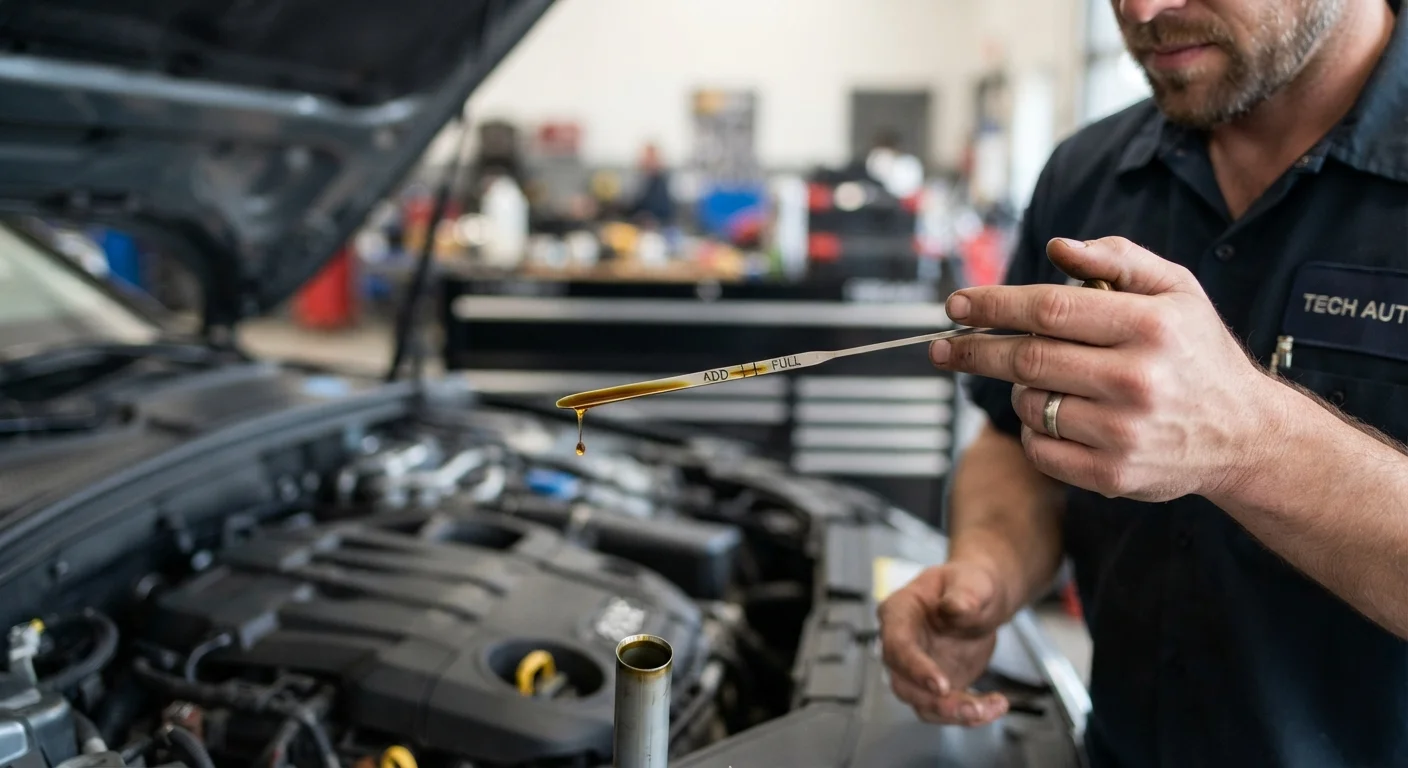
Fresh oil starts amber-gold; within a few hundred miles it typically turns dark brown. This happens because oil is designed to hold contaminants in suspension and carry them away from engine surfaces. Darkness alone is not a reliable indicator that an oil change is overdue. Milky or grayish oil, on the other hand, may indicate coolant contamination - a separate mechanical concern worth having a qualified mechanic investigate promptly.
Myth
Conventional and synthetic oil can never be mixed.
Fact
Conventional and synthetic oils are chemically compatible and can be mixed safely, though the resulting blend performs closer to the lower-grade oil.
All engine oils share similar base chemistry and use compatible additive packages. Mixing them in an emergency won't damage your engine. That said, topping up a synthetic-filled engine with conventional oil dilutes the synthetic's performance advantages. As a practical matter, use the grade and type your owner's manual specifies whenever possible, and get back to the correct full-synthetic fill at your next scheduled change.
Myth
If oil is still at the correct level on the dipstick, it doesn't need changing.
Fact
Oil level and oil condition are separate qualities; oil can be at the right level but still chemically degraded.
Over time, heat cycles break down oil's additive package - the components that prevent corrosion, reduce friction, and neutralize acids from combustion. An oil that measures full on the dipstick may have depleted additives and reduced viscosity stability, offering less engine protection than fresh oil at the same level. Monitoring both level and interval is the right approach.
5,000-10,000 mi
Typical modern oil change interval
Most major automakers specify intervals in this range for vehicles using full synthetic oil under normal driving conditions.
~$25-$75
Average cost per oil change
Costs vary widely by oil type, vehicle, and service location; synthetic changes typically cost more upfront but are needed less frequently.
When Shorter Intervals Still Make Sense
Dismissing the 3,000-mile rule entirely would be its own mistake. Certain driving patterns genuinely stress engine oil faster than normal, and manufacturers account for this with what they call "severe duty" or "severe service" conditions. These typically include:
- Frequent short trips under five miles - the engine never fully warms up, allowing moisture and fuel vapors to contaminate the oil
- Extended idling - common for commercial drivers or those in heavy stop-and-go traffic
- Towing or hauling heavy loads regularly - adds thermal stress to the engine
- Driving in dusty, sandy, or extremely hot environments
- Very cold climates where cold starts are frequent
If several of these conditions describe your regular driving, your owner's manual will typically specify a shorter "severe service" interval alongside the standard one. Use that figure - not the marketing claims on the oil jug or the reminder sticker from your last oil change shop.
Neglecting oil when these conditions apply is among the maintenance mistakes that lead to expensive engine repairs down the road.
Don't Rely Solely on the Reminder Sticker
Quick-lube shops often place a windshield sticker recommending your next change at 3,000 miles regardless of your vehicle's actual specification. This is a service interval set by the shop, not your automaker. Always cross-reference your owner's manual or built-in oil life monitor before scheduling your next appointment.
How to Find Your Vehicle's Actual Interval
The single most reliable source for your oil change interval is the owner's manual that came with your vehicle. Automakers invest significant engineering resources in determining the optimal service schedule for each engine and oil type. That figure already accounts for the engine's design, the recommended oil grade, and typical operating conditions.
Many vehicles produced in the last decade also include an oil life monitoring system (OLMS) - an algorithm that tracks driving patterns, engine temperature, rpm, and other variables to estimate remaining oil life as a percentage. When it drops to a threshold (often 15%), a dashboard alert prompts you to schedule a change. These systems tend to be more accurate than fixed mileage triggers for everyday driving.
If your vehicle uses synthetic oil and your manual specifies a 7,500- or 10,000-mile interval, following that schedule is both safe and cost-effective. Changing oil more frequently than necessary doesn't protect your engine - it just costs you more money and generates unnecessary waste oil.
For a broader picture of what to check and when, our fluid checks guide walks through every key reservoir under the hood, including how to read oil condition on the dipstick yourself.
Staying on schedule with oil and other fluids is one of the core habits covered in our overview of routine maintenance tasks that prevent expensive repairs.