

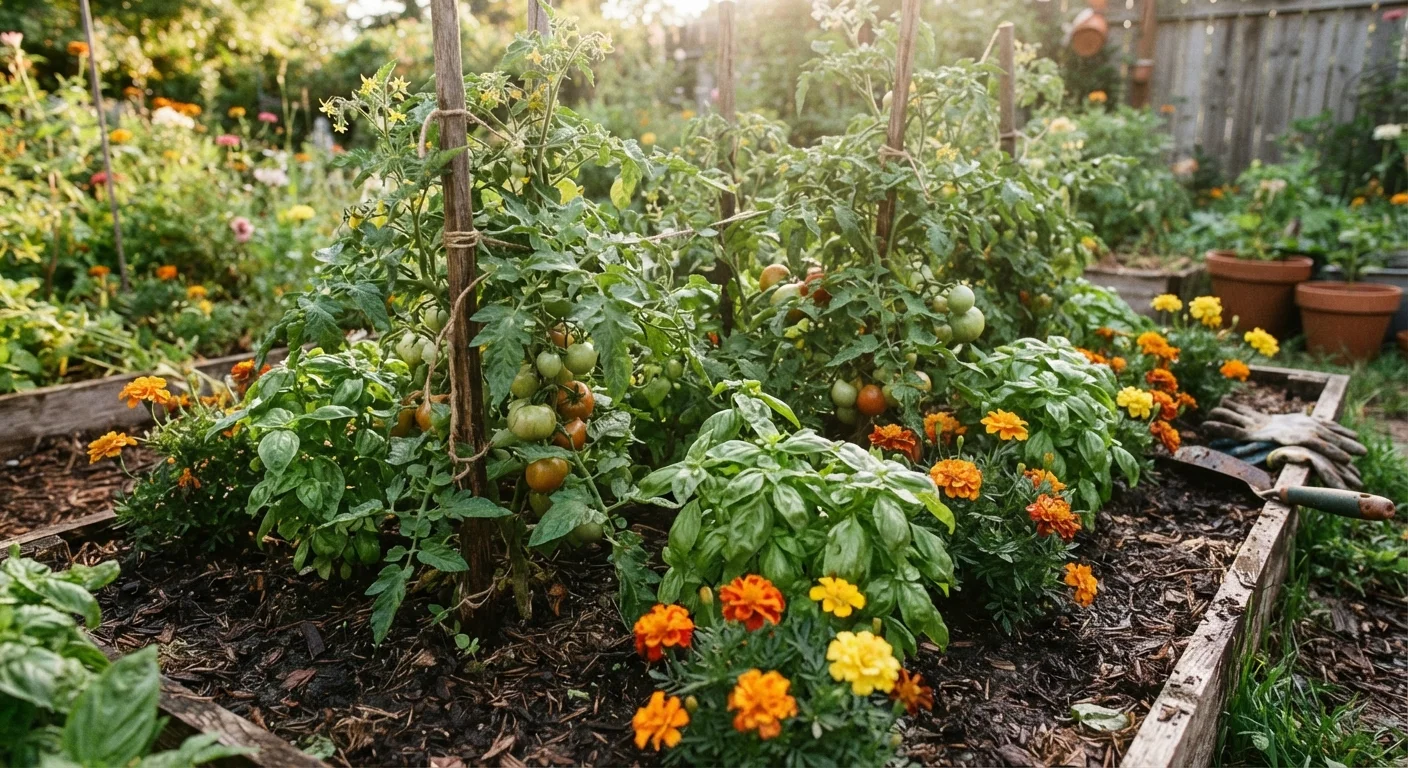
Key Takeaways
- Some companion planting pairings have genuine scientific support; many others are based on anecdote or folklore.
- The 'Three Sisters' method — corn, beans, and squash — is one of the best-documented, practically effective combinations.
- Marigolds offer measurable pest suppression in certain contexts, but placement and species matter considerably.
- Basil's repellent effect on tomato pests is largely unproven; the real benefit may be attracting beneficial pollinators.
- Allelopathy — where one plant chemically inhibits another — is real, making some pairings actively harmful.
- Testing combinations in your own garden over multiple seasons gives you the most reliable, site-specific results.
Why Companion Planting Gets Complicated
Companion planting — the practice of growing different plants close together for mutual benefit — has been part of home gardening culture for generations. The appeal is obvious: nature-friendly, low-cost, and potentially eliminating the need for chemical inputs. But the gap between what gardeners swear by and what research confirms is wider than most seed catalogs suggest.
Garden folklore travels fast. A pairing that worked well in one person's backyard gets repeated until it becomes conventional wisdom, even if the original observation was coincidental. That doesn't mean companion planting is useless — far from it. It means some combinations deserve confidence, some deserve skepticism, and a few should be avoided altogether.
If you're already thinking about bed layout, it's worth reading about raised beds versus in-ground planting — your setup affects how densely you can pair plants and how well roots interact underground.
Myth
Planting basil next to tomatoes repels pests and dramatically improves tomato flavor.
Fact
There is no strong scientific evidence that basil repels tomato pests or changes fruit flavor. Its main documented benefit is attracting pollinators.
The tomato-basil pairing is perhaps the most repeated companion planting claim in American home gardening. The idea that basil's aromatic oils confuse or repel hornworms, aphids, and whiteflies sounds plausible — but controlled studies have not consistently confirmed it. Basil does attract bees and other beneficial insects, which supports pollination and can indirectly help the broader garden ecosystem. That's a real benefit, just not the dramatic pest shield often advertised. Grow basil near tomatoes if you enjoy harvesting both, but don't count on it to replace other pest management strategies.
Myth
The Three Sisters — corn, beans, and squash — is a nice tradition but doesn't offer real agricultural advantages.
Fact
The Three Sisters is one of the most evidence-supported companion systems, offering nitrogen fixation, weed suppression, and moisture retention.
Developed over centuries by Indigenous peoples of North America, the Three Sisters system has a well-documented ecological logic. Beans fix atmospheric nitrogen through root nodules, feeding the heavy-feeding corn. Squash leaves spread across the soil, acting as a living mulch that suppresses weeds and retains soil moisture. Corn stalks provide a natural trellis for bean vines. Each plant genuinely supports the others through identifiable mechanisms. Modern agronomists have studied these interactions and confirmed their functional value. This is companion planting working as intended — not folklore, but applied ecology.
Myth
Marigolds are a universal pest repellent — plant them anywhere in the garden for protection.
Fact
Marigolds do suppress certain soil nematodes and can deter some insects, but only specific species, in specific quantities, near specific crops.
Marigolds (particularly Tagetes species) have genuine pest-suppression properties that researchers have documented, especially against root-knot nematodes in the soil. However, the effect requires dense planting over a full growing season — a few marigolds dotted around the border won't deliver meaningful nematode control. Their effect on above-ground pests like aphids or whiteflies is less conclusive. French marigolds (Tagetes patula) have the strongest evidence for nematode suppression when used as a cover crop rotation. Used correctly, marigolds earn their reputation. Used casually, they're mostly decorative.
Myth
You can plant anything next to anything — companion planting is always neutral at worst.
Fact
Some plant pairings are actively harmful due to allelopathy — chemical compounds one plant releases that suppress the growth of another.
Allelopathy is a real and well-studied phenomenon where plants release compounds — through roots, leaf litter, or decomposition — that inhibit neighboring plants. Black walnut trees are the most commonly cited example: they release juglone, a compound toxic to many garden plants including tomatoes, peppers, and certain herbs. Fennel is another notorious example; it inhibits germination and growth in a wide range of vegetables and should generally be isolated from the main vegetable garden. Understanding which plants to keep apart is just as important as knowing which to combine, and it's an area where bad companion planting advice can actively cost you a harvest.
Myth
Companion planting eliminates the need for other pest management entirely.
Fact
Companion planting is one useful layer of an integrated pest management approach, not a standalone solution.
Even the most well-supported companion combinations — Three Sisters, marigolds for nematodes, dill attracting predatory wasps — reduce pest pressure rather than eliminate it. In years of heavy infestation or in new gardens with poor soil biology, companion strategies may not be enough on their own. Integrated pest management (IPM) combines physical barriers, biological controls, cultural practices, and chemical intervention as a last resort. Companion planting fits naturally within IPM as a cultural practice, but expecting it to carry the entire load will likely lead to disappointment and crop loss.
What the Evidence Actually Supports
Peer-reviewed research on companion planting does exist, though it's less extensive than gardeners often assume. Studies have looked primarily at pest disruption, nitrogen fixation, and light competition — the mechanisms most likely to produce measurable results.
50–60%
Nematode reduction with dense marigold cover cropping
University extension research has documented meaningful root-knot nematode suppression when French marigolds are grown as a full-season cover crop prior to susceptible vegetables.
3-in-1
Simultaneous benefits delivered by the Three Sisters system
Agronomists recognize nitrogen fixation, weed suppression, and moisture retention as concurrent, documented advantages of the corn-bean-squash polyculture.
The clearest takeaway from the literature: companion planting works best when there's a specific, identifiable mechanism driving the benefit. Vague claims like "these plants like each other" rarely hold up. Concrete mechanisms — nitrogen fixing, physical barrier creation, volatile compound emission, or pollinator attraction — are what separate effective pairings from wishful thinking.
It's also worth noting that soil health, watering method, and climate play enormous roles. A pairing that suppresses pests in a dry Arizona garden may behave differently in a humid Georgia plot. For that reason, pairing advice from common fertilizing mistakes to companion choices should always be interpreted as a starting framework, not a guaranteed formula.
Watch Out for Allelopathic Plants Near Vegetables
Black walnut, fennel, and sunflowers can release growth-inhibiting compounds that harm nearby crops. Before placing any of these in or near your vegetable beds, research their allelopathic range. Fennel in particular should typically be grown in a container or isolated bed, away from tomatoes, peppers, and most brassicas.
Planning Pairings That Actually Work for Your Yard
Start with the combinations that have the most consistent support, then layer in your own observations over time. Keep a simple garden journal noting what you planted where, what pest pressure looked like, and what your yields were. One season isn't enough data — aim for two or three before drawing conclusions.
Spacing is critical and often overlooked. Companion plants too far apart won't interact meaningfully. Too close together and you create competition for water, nutrients, and light that can harm both crops. Check mature spread dimensions before planting, not just seedling size.
If you're working with limited ground space, container gardening can still accommodate some companion strategies — herbs alongside vegetables in large planters, for instance — though root-level interactions are more limited in containers.
Finally, consider integrating native plants into your companion strategy. Natives already support local beneficial insect populations, which means they bring built-in pest management potential without requiring you to engineer specific pairings from scratch. Sometimes the best companion is the plant that already belongs there.