

Key Takeaways
- Inconsistent schedules are one of the most common reasons house training stalls or regresses.
- Punishment after accidents is counterproductive; dogs cannot connect delayed correction to past behavior.
- Unsupervised access to the home before a dog is ready sets them up to fail.
- Medical issues such as urinary tract infections can mimic training failures — a vet visit may be warranted.
- Most house-training delays are caused by human habits, not a dog's intelligence or willingness.
Why House Training Feels Like It's Going Nowhere
Few things frustrate new dog owners more than cleaning up the same type of accident day after day, despite feeling like they're doing everything right. The truth is that house training is rarely a straight line — and when progress stalls, the cause is almost always something that can be identified and corrected.
Understanding why setbacks happen is far more useful than simply trying harder. If you're just starting out, it also helps to think about house training as part of a broader foundation. Our guide to building good habits in the first 30 days outlines what that foundation looks like from day one.
Using an inconsistent bathroom schedule instead of taking the dog out at predictable intervals.
Why it happens: Owners often react to visible signs of urgency rather than proactively scheduling outdoor trips, which means the dog never learns a reliable routine.
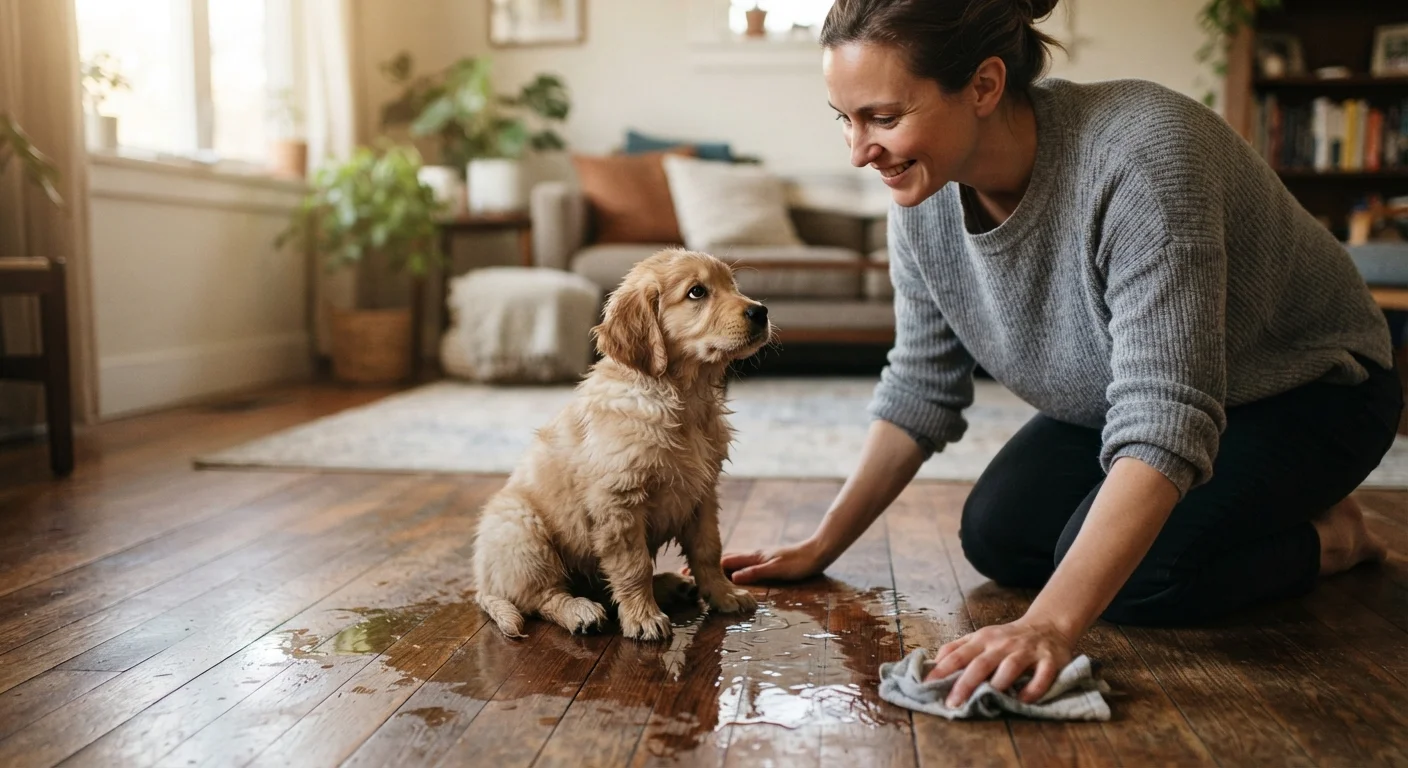
Punishing the dog after discovering an accident rather than in the moment it occurs.
Why it happens: It feels logical to connect correction to evidence, but dogs lack the ability to link a past event to a delayed response — the association simply doesn't form.
Giving the dog unsupervised access to the whole house before house training is reliable.
Why it happens: Owners underestimate how much space increases the opportunity for mistakes, or they trust early success too quickly and reduce supervision.
Cleaning accident spots with products that leave behind odor markers detectable to dogs.
Why it happens: Many standard household cleaners neutralize the visible stain but don't fully break down the urine compounds that dogs can still smell, which signals that spot as an appropriate toilet location.
Misreading a dog's pre-elimination signals and missing the window to redirect outside.
Why it happens: Signals like circling, sniffing the floor, or squatting can be brief and subtle, especially in younger or smaller dogs — owners who aren't watching closely miss them entirely.
What's Really Behind the Accidents
Most house-training problems trace back to a handful of recurring patterns. The good news: each one is correctable once you recognize it.
4–6 months
Typical house-training timeline for puppies
Veterinary behaviorists generally note that full house-training reliability in puppies takes four to six months under consistent conditions — longer for some breeds or rescue dogs.
12 weeks
Age when bladder control begins developing
Puppies younger than 12 weeks have very limited bladder control; expecting reliable training before this point is not developmentally realistic.
One factor many owners overlook is the dog's physical health. A dog that was reliably trained and suddenly starts having accidents may have developed a urinary tract infection, bladder stones, or another medical issue. Before assuming it's a behavior problem, rule out health causes with your veterinarian — especially if the change is sudden or accompanied by straining, blood, or excessive frequency.
Sudden Regression May Signal a Health Issue
A dog that was previously reliable and begins having frequent accidents indoors should be evaluated by a veterinarian before assuming the problem is behavioral. Conditions such as urinary tract infections, kidney disease, or hormonal disorders can all cause sudden changes in elimination habits. Addressing training alone will not resolve a medical cause.
For households where training dynamics are complicated by the presence of other animals, managing training in multi-pet homes requires its own set of strategies. And before any formal session begins, a quick review of your training session readiness checklist can help ensure conditions are set up for success.
If you're weighing whether to incorporate a crate into the process, crate training has genuine benefits and real drawbacks — understanding both helps you use it appropriately rather than as a default fix.
This article is for general informational purposes only and does not constitute veterinary advice. If you have concerns about your pet's health or behavior, consult a licensed veterinarian.