

Key Takeaways
- The first 30 days establish behavioral patterns that can persist for the dog's entire life.
- Consistent routines for feeding, sleeping, and bathroom breaks are the foundation of good behavior.
- Positive reinforcement — rewarding desired behavior — is the most reliable training approach.
- Overwhelming a new dog with visitors, outings, or rules changes slows adjustment and learning.
- House training setbacks are normal; consistency and patience are more effective than punishment.
- A veterinary visit in the first week helps catch health issues that can affect behavior.
Start here
Why the First 30 Days Matter So Much
Next
Setting Up Structure Before Your Dog Arrives
Then
The Core Habits to Build Right Away
Watch out for
What to Avoid in the First Month
When you're ready
When to Ask for Help
Why the First 30 Days Matter So Much
Bringing a dog home is one of the most exciting milestones in pet ownership — and one of the most consequential. The habits, expectations, and emotional associations your dog forms in the first month tend to calcify into long-term patterns. This is true whether you adopt a puppy or a fully grown adult dog new to your household.
Dogs are remarkably sensitive to social structure and environmental cues. When everything is unfamiliar, they look to their environment — and to you — for information about how the world works. That makes the early weeks a genuine window of opportunity. Rules established now feel natural; rules introduced months later often feel like unwelcome changes.
For a broader grounding in how dogs learn and what shapes their behavior, the complete guide to pet behavior and training is a useful companion to this article.
Positive reinforcement
A training method where desired behaviors are rewarded immediately, making the dog more likely to repeat them. Rewards can be treats, praise, or play.
Decompression period
The adjustment window a new dog needs to process an unfamiliar environment. During this time, behavior may be subdued, erratic, or inconsistent with the dog's true temperament.
Crate training
The practice of teaching a dog to view a crate as a safe, comfortable space rather than a punishment. It supports house training and provides a predictable retreat.
Recall
A trained behavior where a dog reliably returns to its owner when called, regardless of distractions. Considered one of the most important safety skills a dog can have.
Enzymatic cleaner
A cleaning product that uses enzymes to break down the biological compounds in pet waste, eliminating odors that might otherwise attract the dog back to the same spot.
Behavioral marker
A specific sound or signal — such as a clicker or the word 'yes' — used to precisely mark the moment a dog performs a desired behavior, bridging the gap before the reward arrives.
Setting Up Structure Before Your Dog Arrives
Good habits begin before the dog walks through the door. Decisions made in advance — about sleeping spots, feeding locations, and which rooms are off-limits — prevent the inconsistency that confuses new dogs most.
- Designate a sleeping area. A crate, dog bed, or specific room gives your dog a predictable, safe retreat. Crates, when introduced positively, support both house training and anxiety reduction.
- Agree on household rules as a family. If one person allows jumping and another corrects it, the dog receives conflicting information. Align before arrival.
- Prepare a feeding schedule. Dogs thrive on routine. Decide on meal times and stick to them. For guidance on what and how much to feed, Pet Nutrition 101 covers feeding fundamentals for new owners.
- Identify a primary bathroom spot outdoors. Taking your dog to the same area repeatedly reinforces the association between that location and elimination.
Schedule a veterinary appointment within the first week. A health check early on identifies any physical issues — pain, infection, parasites — that can directly affect behavior and learning capacity. The first-time owner's guide to veterinary care can help you navigate that first visit.
The Core Habits to Build Right Away
The first month is not the time to teach elaborate tricks. It is the time to establish a handful of foundational habits that make everything else easier.
Consistent Daily Routine
Dogs adapt faster when wake-up, meal, bathroom, walk, and bedtime happen at roughly the same times each day. Predictability reduces anxiety, which in turn makes dogs more receptive to learning.
Positive Reinforcement From Day One
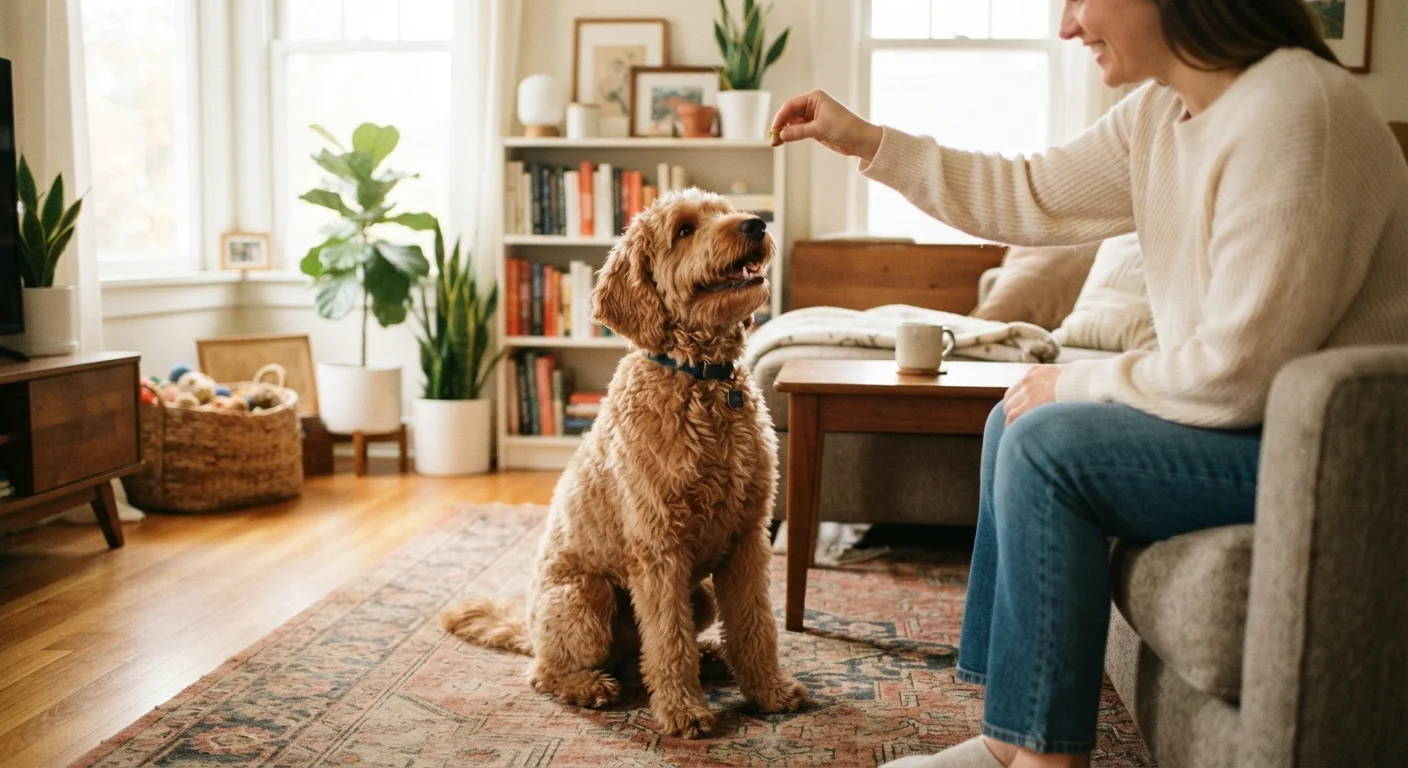
Reward the behaviors you want to see repeated — with treats, praise, or play — immediately after they happen. This approach, grounded in behavioral science, is more reliable and less damaging to trust than punishment-based methods. Keep early training sessions to 3–5 minutes to avoid mental fatigue.
Before each session, review the training readiness checklist to set yourself and your dog up for a productive outcome.
House Training
Take your dog outside frequently and on schedule. When accidents happen indoors — and they will — clean them thoroughly with an enzymatic cleaner and move on without punishment. Punishment after the fact does not help dogs understand what went wrong. If progress feels slow, common house-training pitfalls explains why and how to course-correct.
Name Recognition and Basic Recall
Teaching your dog that its name predicts good things — and that coming to you is always rewarding — is foundational safety work. Building a reliable recall takes consistent practice but starts with these earliest sessions.
Short Sessions, Big Results
Three focused 5-minute training sessions per day are more effective than one long, exhausting one. Dogs — especially new ones still adjusting — have limited capacity for sustained focus. Ending each session on a success keeps your dog engaged and eager for the next round.
What to Avoid in the First Month
Knowing what not to do is just as valuable as knowing what to prioritize.
Avoid Punishment-Based Corrections
Yelling, physical corrections, or aversive tools during the first month can cause lasting damage to your dog's trust in you and its sense of safety in the home. Dogs that associate their new environment with unpredictable negative experiences are more likely to develop fear-based behaviors. If a behavior needs to stop, redirect to something acceptable and reward that instead.
- Don't overwhelm with visitors. Everyone wants to meet the new dog, but a revolving door of strangers raises stress levels and slows decompression. Limit introductions for the first week or two.
- Don't change the rules. Allowing behavior one day and correcting it the next teaches the dog that the rules are unpredictable — which increases anxiety and makes training harder.
- Don't assume breed means fate. Breed tendencies are real but variable. Judge your individual dog's behavior, not a stereotype, and train accordingly.
- Don't skip mental enrichment. A physically tired but mentally bored dog finds its own entertainment — often destructive. Puzzle feeders, sniff walks, and short training sessions satisfy cognitive needs.
If you share your home with other pets, managing a multi-pet household addresses how to set clear expectations across species from the beginning.
When to Ask for Help
Seeking professional guidance is a sign of good ownership, not failure. Some situations genuinely benefit from expert eyes — and catching behavioral challenges early prevents them from becoming entrenched.
Consider reaching out to a certified professional dog trainer or a veterinary behaviorist if you observe:
- Growling, snapping, or any behavior that feels threatening to people or other animals
- Extreme fearfulness that doesn't ease with gentle routine and time
- Destructive behavior that escalates despite consistent management
- Refusal to eat or drink beyond the first 48 hours of adjustment
Your veterinarian is a good first call for any behavioral concern, as physical health and behavior are closely linked. For ongoing support on keeping your dog thriving long-term, the Pet Health & Care hub offers a broad range of practical guidance.
This article is for informational and educational purposes only. It is not a substitute for individualized guidance from a qualified veterinary or animal behavior professional. If your dog shows signs of illness or serious behavioral distress, consult a licensed veterinarian.