

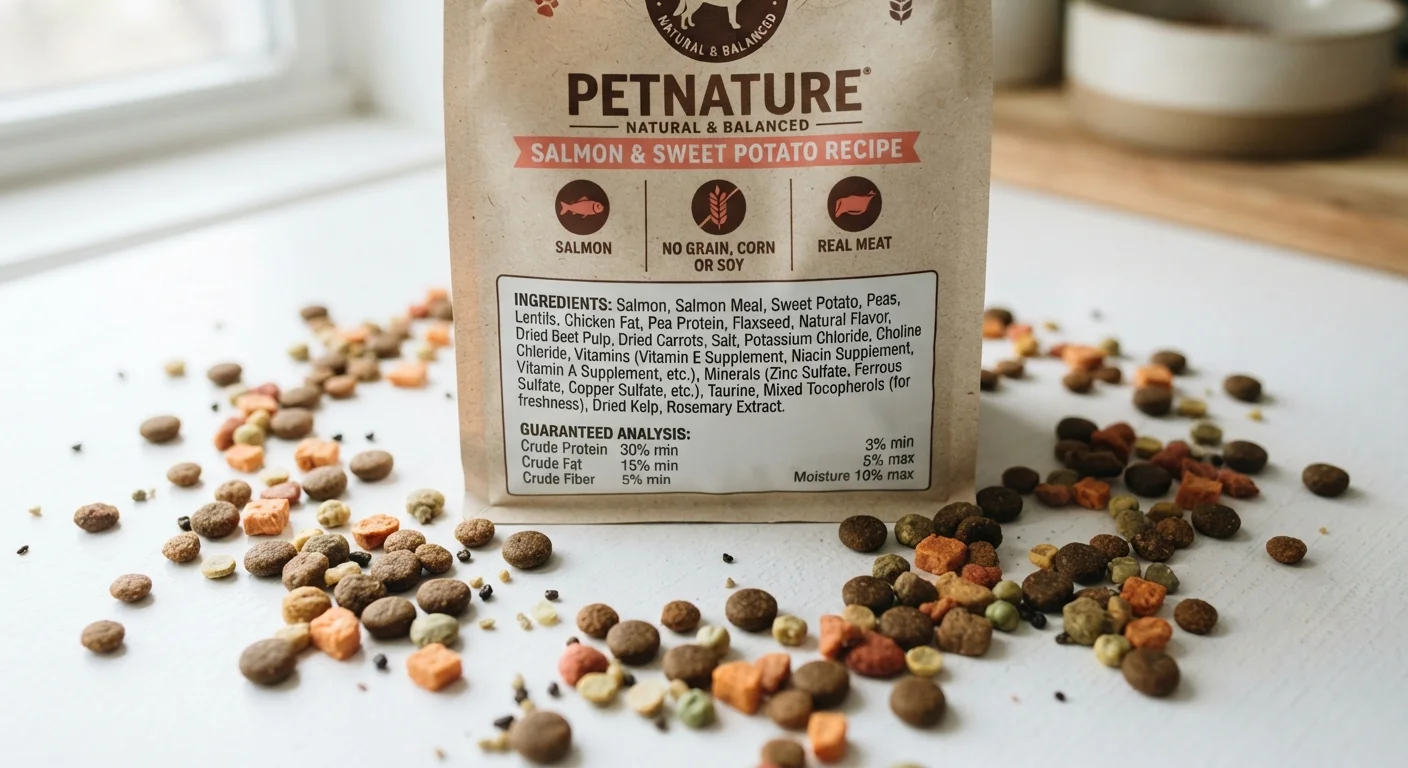
Why the Ingredient List Is Ordered the Way It Is
Pet food manufacturers in the United States are required by AAFCO and state regulations to list ingredients in descending order by weight before processing. That means the first ingredient listed is present in the greatest amount by weight — but weight includes moisture.
This matters because whole meats like chicken or beef contain roughly 70–75% water. After cooking, that weight drops substantially. A food that lists "chicken" first might actually deliver less protein per serving than one listing "chicken meal" — a concentrated, moisture-removed protein source — in the same position. Neither approach is automatically superior; understanding the difference helps you interpret what you're actually reading.
For a broader primer on the sections of a pet food label, see our guide on reading a pet food label without getting lost in the fine print.
Decoding Common Label Terms
Marketing language on pet food packaging is regulated to a degree, but certain phrases have precise meanings while others are almost entirely unregulated. Knowing which is which prevents misreading a label.
- "Complete and balanced": A regulated claim meaning the food meets AAFCO nutrient profiles for the stated life stage. Without this phrase, the food may be intended for intermittent or supplemental feeding only.
- "Natural": Means ingredients are derived from plant, animal, or mined sources without chemically synthetic processing — but it does not mean organic, additive-free, or superior in nutrition.
- "Grain-free": Describes what is absent, not what is present. Grain-free foods typically substitute legumes or potatoes as carbohydrate sources; the long-term nutritional implications of certain grain-free diets are still being studied by veterinary researchers.
- "Human-grade": Not formally defined by AAFCO for pet food labeling; use it as a prompt to investigate further rather than a guarantee of quality.
- "By-product": Refers to parts of an animal other than skeletal muscle meat — organs, blood, and bone. By-products are not inherently low quality; organ meat is nutrient-dense. The nutritional value depends on the specific by-product and its source.
To understand what AAFCO certification statements actually guarantee — and what they don't — visit our article on what AAFCO actually means.
Crude protein
A measure of total nitrogen in a food, mathematically converted to an estimated protein percentage. It does not indicate protein digestibility or biological value.
Dry-matter basis
A method of comparing nutrients across foods with different moisture levels by removing the water content from the calculation. Useful for comparing wet and dry foods fairly.
Meat meal
A concentrated, moisture-removed protein source made from rendered animal tissue. Contains significantly more protein by weight than whole meat ingredients because water has been removed.
By-product
Animal-derived ingredients other than skeletal muscle meat, such as organ meat, blood, or bone. Nutritional value varies by specific by-product and source.
Ingredient splitting
A labeling practice where multiple forms of the same ingredient are listed separately, making each appear lower on the ingredient list than the combined quantity would place them.
Life-stage statement
A label declaration indicating which animal life stages a food is formulated for, such as growth, adult maintenance, or all life stages. Determined by AAFCO nutrient profile standards.
The Guaranteed Analysis: What the Percentages Mean
Every commercial pet food sold in the U.S. must include a guaranteed analysis panel showing minimum percentages of crude protein and crude fat, and maximum percentages of crude fiber and moisture. Here's what those numbers actually tell you — and their limits.
Crude protein measures total nitrogen content and converts it to an estimated protein figure. It does not distinguish between highly digestible protein from meat and less digestible protein from, say, plant sources. Two foods with identical crude protein percentages can vary considerably in how much usable protein reaches your pet.
Moisture content is critical for comparisons. Wet food may show 10% crude protein at 78% moisture, while dry kibble shows 28% crude protein at 10% moisture. To compare them fairly, you need to calculate values on a dry-matter basis — divide the nutrient percentage by the percentage of dry matter (100% minus moisture %).
70–75%
Water content in whole meat before processing
This moisture level explains why whole meat ingredients lose significant weight — and relative label position — after cooking.
~300%
Protein concentration: chicken meal vs. whole chicken
Chicken meal is estimated to contain roughly three times the protein of whole chicken by weight due to moisture removal during rendering.
6
Required label sections on U.S. commercial pet food
AAFCO model regulations specify that pet food labels must include product name, net quantity, guaranteed analysis, ingredient list, nutritional adequacy statement, and feeding directions.
Crude fiber maximums indicate indigestible plant material, which can affect digestive health and stool volume. Fat minimums reflect energy density and palatability. These numbers are useful reference points, but they're starting points for evaluation, not complete nutritional verdicts.
If you're thinking about switching foods after reviewing a label, our practical checklist for switching pet food can help you evaluate options and transition safely.
Red Flags and Reassurances When Scanning Labels
A few label features are worth pausing on — not as automatic disqualifiers, but as prompts for closer review.
Ingredient splitting occurs when a manufacturer lists variations of the same ingredient separately (e.g., "ground corn," "corn gluten meal," "corn bran") so each appears lower on the list individually, even though corn is collectively a major component. If multiple forms of the same ingredient appear within the first several items, consider the combined contribution.
Vague protein sources such as "meat meal" or "poultry by-product meal" without a named animal species offer less traceability than "chicken meal" or "beef by-product meal." Named sources are not guaranteed to be superior in quality, but they are more specific.
Life-stage statements should match your pet's actual life stage. A food labeled for "all life stages" must meet the most demanding AAFCO standard — those for growth and reproduction — which means it is appropriate for puppies and kittens but may provide more of certain nutrients than an adult or senior pet needs.
Cats have particularly specific nutritional requirements, including nutrients like taurine and arachidonic acid that must come from animal sources. Learn more about nutrients every cat owner should understand if you're feeding a feline.
This article provides general educational information about pet food labeling and is not a substitute for personalized veterinary nutritional advice. Consult your veterinarian or a board-certified veterinary nutritionist before making significant changes to your pet's diet, especially for pets with health conditions.