

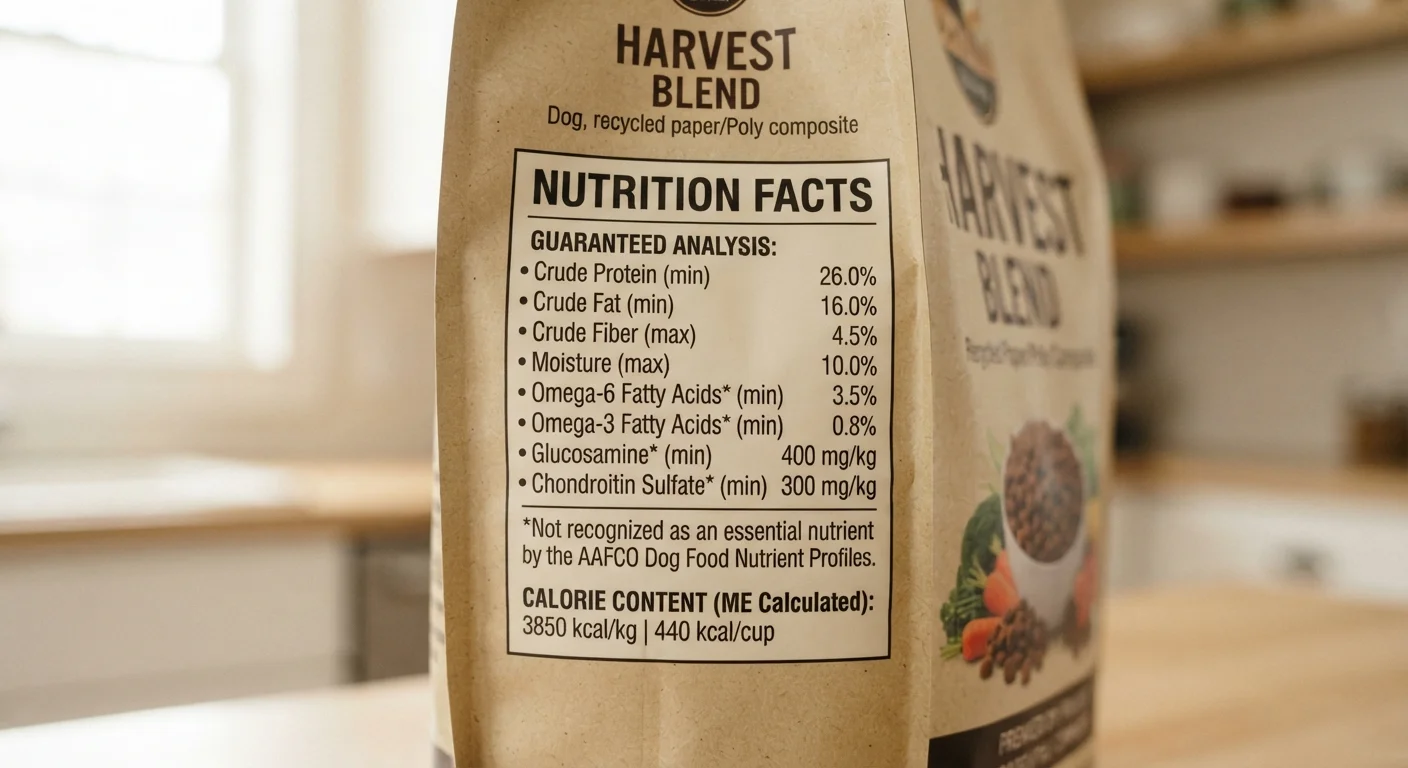
Key Takeaways
- AAFCO sets minimum and maximum nutrient profiles that define what 'complete and balanced' means for pet food.
- A label statement can reflect either computer-modeled formulation or an actual feeding trial — and that distinction matters.
- AAFCO does not inspect, approve, or regulate pet food manufacturers directly.
- Life stage designations (puppy, adult, all life stages) carry specific nutritional requirements under AAFCO profiles.
- An AAFCO statement is a meaningful baseline, but it does not guarantee ingredient quality or sourcing.
AAFCO
AAFCO stands for the Association of American Feed Control Officials. It is a non-governmental advisory body made up of state and federal regulatory officials that establishes the nutritional standards most U.S. pet foods are expected to meet. When a pet food label carries an AAFCO nutritional adequacy statement, it means the food has been formulated — or tested — to meet those defined standards for a particular life stage.
AAFCO itself does not test, approve, or certify pet foods; enforcement of labeling compliance is carried out by individual state feed control officials operating under their own statutes.
Why AAFCO Exists and What It Actually Does
Walk down any pet food aisle and you will find the same phrase printed on almost every bag: "formulated to meet the nutritional levels established by the AAFCO Dog (or Cat) Food Nutrient Profiles." For most pet owners, that sentence is easy to overlook. Understanding what it actually promises — and where its limits lie — is one of the most practical things you can do when evaluating what goes into your pet's bowl.
AAFCO, the Association of American Feed Control Officials, is not a government agency. It is a non-profit membership organization composed of state and federal feed control officials from across the United States. Its role is to develop model regulations and publish standardized nutrient profiles that define what constitutes nutritionally adequate pet food. Those profiles set minimum levels for nutrients like protein, fat, vitamins, and minerals, and in some cases establish maximums to prevent toxicity.
Because AAFCO operates as an advisory body, it does not manufacture, test, or recall pet food. Actual regulatory authority rests with individual states, which adopt AAFCO's model language into their own feed laws at varying levels of strictness. The FDA also oversees pet food safety under federal law but generally defers to AAFCO nutrient standards for adequacy determinations.
AAFCO Is Not a Regulatory Agency
Many pet owners assume AAFCO functions like the FDA and actively monitors or approves products. In practice, AAFCO publishes model standards and model regulations that states can choose to adopt. The actual authority to enforce pet food labeling rules rests with each individual state's feed control program, which means oversight can vary depending on where a product is sold.
For a fuller picture of how all the pieces of a pet food label fit together, see Reading a Pet Food Label Without Getting Lost in the Fine Print — it covers the guaranteed analysis, ingredient lists, and AAFCO statements in one place.
Formulated vs. Feeding Trial: The Statement That Changes Everything
The AAFCO adequacy statement on a label takes one of two forms, and the difference is significant.
- Formulation statement: The manufacturer used AAFCO's published nutrient profiles as a target and calculated the recipe to meet them on paper, typically using a nutrient database. The food was not necessarily fed to animals before going to market.
- Feeding trial statement: The food was fed to a group of animals according to AAFCO's standardized protocol — usually for 26 weeks — and the animals maintained acceptable health markers throughout. This is considered a more rigorous validation because it tests how the body actually absorbs and uses the nutrients as prepared.
Neither approach is automatically superior for every situation. Feeding trials provide real-world biological data, but they test only the specific batch used in the trial. Formulation-based foods can still deliver reliable nutrition when recipes are carefully constructed and ingredient sourcing is consistent. What matters is knowing which claim you are reading.
2
AAFCO life stage profile categories for dogs and cats
AAFCO publishes separate nutrient profiles for growth/reproduction and adult maintenance; an "all life stages" designation meets the more demanding growth threshold.
26 weeks
Minimum duration of an AAFCO feeding trial
AAFCO's standard feeding trial protocol requires animals to be fed the test food for at least 26 weeks while key health markers are monitored.
50+
Nutrients specified in AAFCO dog and cat profiles
AAFCO's nutrient profiles cover proteins, fats, vitamins, and minerals — including minimums and, for certain nutrients, maximum safe levels.
If you want to go deeper on what the ingredients list beneath the AAFCO statement is actually communicating, Decoding Pet Food Labels breaks down how ingredient order, splitting, and terminology work.
Life Stages, Limits, and What AAFCO Doesn't Cover
AAFCO profiles are organized by life stage. The main categories are adult maintenance, growth and reproduction (covering puppies, kittens, and breeding animals), and all life stages — which meets the higher growth-and-reproduction thresholds and is therefore suitable for animals of any age.
Choosing the right life stage designation matters. A food meeting only adult maintenance standards is not appropriate as the sole diet for a growing puppy or a pregnant cat. Conversely, feeding an "all life stages" food to a healthy adult dog is not harmful, but it is not necessarily more beneficial either.
Where AAFCO falls short is ingredient quality. The profiles measure nutrient quantities, not where those nutrients come from or how digestible they are in the finished product. A food can technically meet AAFCO minimums using lower-digestibility protein sources and still carry a compliant label statement. This is why an AAFCO statement is a meaningful floor, not a ceiling.
Check the Life Stage Before You Buy
Always confirm that the AAFCO statement on a food matches your pet's current life stage. A food validated only for adult maintenance is not an appropriate sole diet for puppies, kittens, or pregnant or nursing animals. When in doubt, ask your veterinarian which designation is right for your pet's age, size, and health status.
Cats present a particularly important case. Because cats cannot synthesize certain nutrients — including taurine — that dogs can produce internally, AAFCO maintains entirely separate profiles for feline diets. For a closer look at those cat-specific requirements, Nutrients Every Cat Owner Should Understand is a useful companion read.
If you are new to pet ownership and want to build from the ground up, Pet Nutrition 101 provides a practical starting point covering macronutrients, portions, and feeding schedules.
This article is for general informational and educational purposes only. For guidance on your specific pet's dietary needs, consult a licensed veterinarian or board-certified veterinary nutritionist.