

Key Takeaways
- Ingredients are listed by weight before processing, so moisture content affects where items rank.
- The guaranteed analysis shows minimum or maximum nutrient percentages, not exact amounts.
- An AAFCO nutritional adequacy statement tells you whether a food is complete or supplemental.
- Life-stage designations on labels — puppy, adult, senior — have real regulatory meaning.
- The ingredient list alone cannot tell you the quality or digestibility of individual components.
- Your veterinarian is the best resource for interpreting labels in the context of your pet's specific health needs.
Pet Food Label
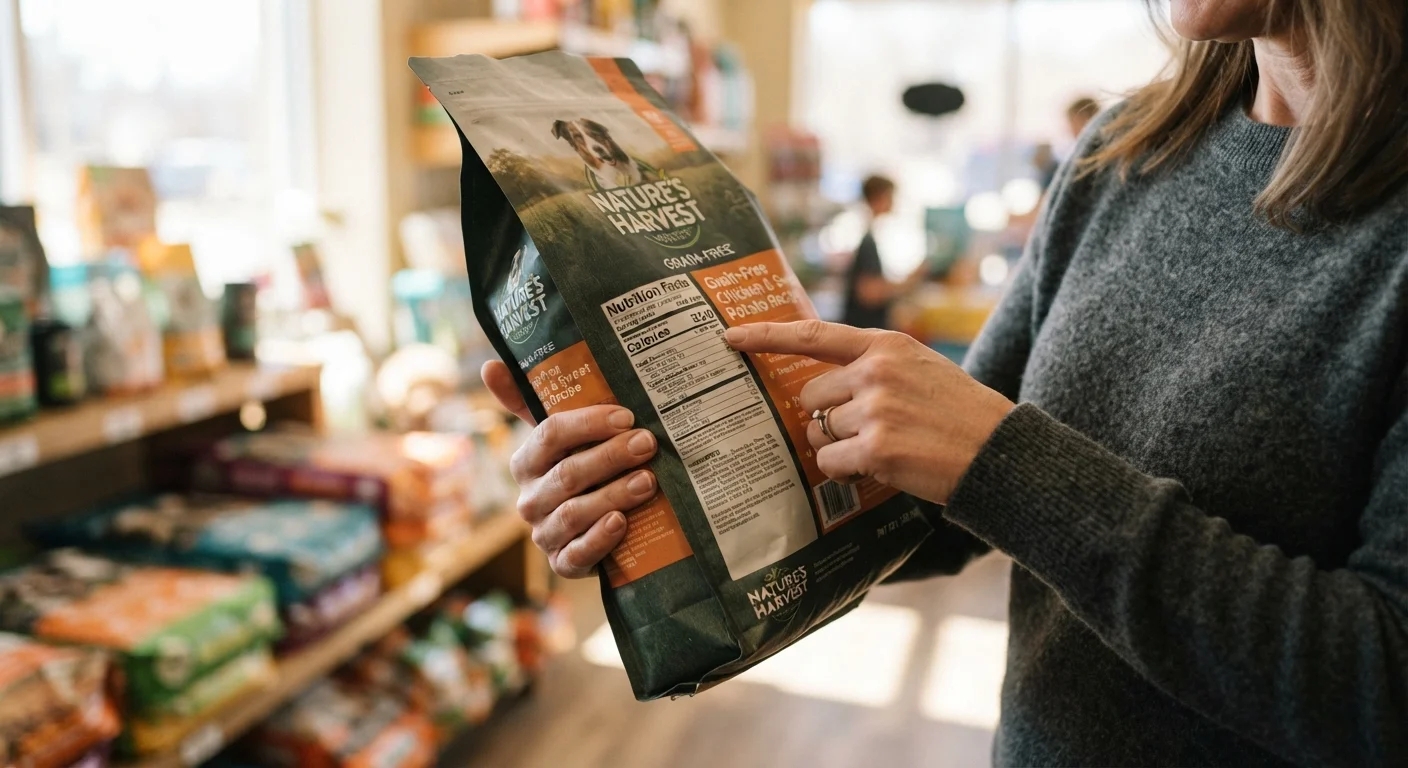
A pet food label is the regulated printed information on every commercially sold pet food package. It includes the product name, ingredient list, guaranteed analysis, feeding directions, and a nutritional adequacy statement. Each section is governed by federal and state regulations designed to ensure consumers can evaluate what they're feeding their animals.
In the U.S., the Association of American Feed Control Officials (AAFCO) publishes model regulations that most states adopt; the FDA oversees labeling accuracy under the Federal Food, Drug, and Cosmetic Act.
Why Pet Food Labels Are Worth Your Attention
Standing in a pet supply aisle, it's easy to focus on the front-panel marketing — words like "natural," "premium," or "ancestral recipe" — and miss the regulated information printed elsewhere on the package. The front panel is largely unregulated territory. The back and side panels are where the meaningful data lives.
Understanding what each section of a label actually communicates helps you move past marketing language and evaluate food on factual grounds. If you're new to thinking about this, the fundamentals of pet nutrition provide useful context before diving into label specifics.
Front-Panel Claims Are Largely Unregulated
Terms like 'natural,' 'holistic,' 'premium,' and 'human-grade' have little or no legal definition in pet food labeling. AAFCO has guidance on 'natural' but many other descriptors are marketing language without standardized regulatory backing. The regulated information — ingredient list, guaranteed analysis, AAFCO statement — appears on the information panel, not the front of the bag.
The Ingredient List: What It Shows and What It Doesn't
Ingredients are listed in descending order by weight before cooking or processing. This matters because raw meat contains significant moisture — sometimes 70% or more — which evaporates during manufacturing. A chicken listed first in a kibble may contribute less actual protein than a dry ingredient like chicken meal listed third.
This doesn't mean the first ingredient is unimportant, but it does mean the full list deserves attention. Watch for "ingredient splitting," a practice where a single ingredient — say, corn — appears multiple times under different names (corn flour, corn gluten meal), pushing it lower on the list while still representing a large combined portion.
Named protein sources (chicken, salmon, beef) are more transparent than vague terms like "poultry" or "meat." Similarly, named byproducts such as chicken liver are regulated and nutritionally dense, while generic "animal byproducts" offer less clarity about origin. For a deeper look at what specific label terms signal, see what the ingredients list is really telling you.
70%+
Moisture in raw meat before processing
Raw ingredients like chicken can contain over 70% water, which largely evaporates during kibble manufacturing — significantly affecting ingredient weight rankings.
4
Guaranteed analysis values required by law
U.S. regulations mandate that pet food labels display minimum crude protein, minimum crude fat, maximum crude fiber, and maximum crude moisture.
2
Ways an AAFCO statement can be substantiated
Pet food manufacturers may support a nutritional adequacy claim through nutrient-profile formulation or through live animal feeding trials, each with different standards.
The Guaranteed Analysis: Numbers With Limits
The guaranteed analysis panel lists four values required by law: minimum crude protein, minimum crude fat, maximum crude fiber, and maximum crude moisture. Some manufacturers voluntarily add others, such as omega-3 fatty acids or taurine.
These figures are not exact measurements — they're regulatory thresholds. A food guaranteeing "minimum 26% crude protein" may contain significantly more. The word "crude" refers to the measurement method (nitrogen-based), not the quality or digestibility of the protein source.
One practical limitation: comparing wet and dry foods using guaranteed analysis percentages is misleading because moisture content differs dramatically. A wet food at 10% protein and 78% moisture contains a much higher protein percentage on a dry-matter basis than the label suggests. To compare accurately, nutritionists use dry-matter basis calculations — dividing the nutrient percentage by the percentage of dry matter (100 minus moisture).
Convert to Dry-Matter Basis for Fair Comparisons
To compare wet and dry foods accurately, subtract the moisture percentage from 100 to get the dry matter percentage, then divide the nutrient value by that figure. For example, a wet food with 10% protein and 78% moisture has a dry-matter protein of roughly 45% — far higher than the label figure implies. This calculation gives you a like-for-like comparison across food formats.
The AAFCO Statement: The Most Important Line on the Label
The nutritional adequacy statement — often called the AAFCO statement — tells you whether a food is intended to serve as a pet's sole diet or only as a supplement or treat. It appears in a standard format: " is formulated to meet the nutritional levels established by the AAFCO Food Nutrient Profiles for ."
This statement can be supported in one of two ways: formulation (the recipe was designed to meet AAFCO nutrient profiles) or feeding trials (the food was tested on animals over time). Neither method is perfect, but feeding-trial-verified foods have cleared an additional real-world hurdle.
Foods labeled "for intermittent or supplemental feeding only" are not nutritionally complete. Feeding them as a primary diet over time can lead to deficiencies. For a thorough breakdown of what AAFCO oversight does and does not guarantee, see what AAFCO actually means.
Life Stage, Feeding Directions, and What Comes Next
Life-stage designations carry regulatory weight. A food labeled for "growth" or "all life stages" must meet higher nutrient thresholds than one for adult maintenance. Senior designations, however, have no AAFCO-defined standard — that label reflects the manufacturer's marketing choice, not a separate regulatory category.
Feeding directions provide a starting point, not a prescription. They're typically calculated for an average, healthy animal of a given weight. Factors like activity level, reproductive status, and underlying health conditions all affect actual caloric needs. Use feeding guidelines as a baseline and adjust based on your pet's body condition over time.
If you're considering switching foods based on what you find on a label, this checklist for switching pet food walks through how to evaluate a new food and transition safely. And if you're exploring specific dietary trends, such as grain-free options, reviewing what the research shows on grain-free diets is a worthwhile step before making a change.
This article is for general informational and educational purposes only and is not a substitute for professional veterinary advice. Always consult a licensed veterinarian before making significant changes to your pet's diet, especially if your pet has underlying health conditions.