

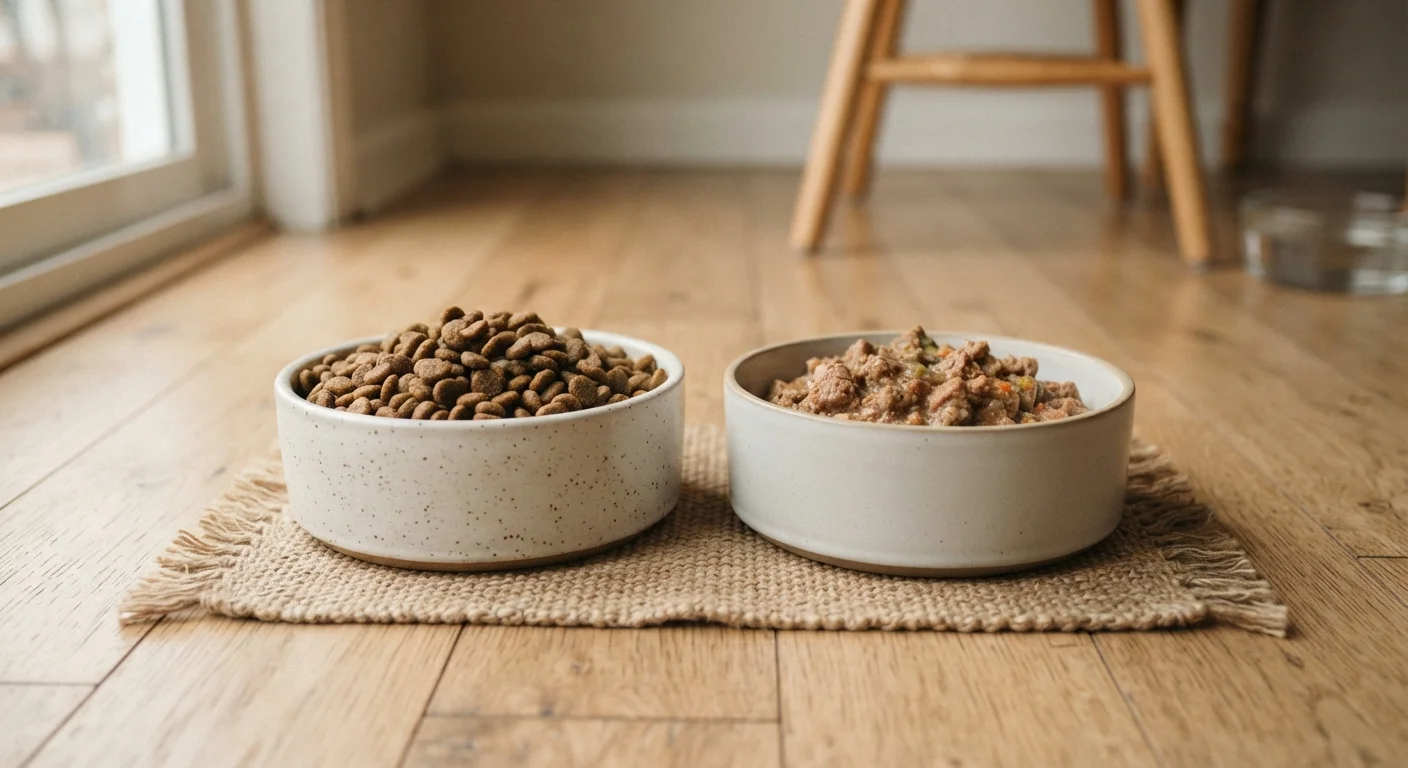
Key Takeaways
- Wet food contains roughly 70–80% moisture; dry kibble typically contains only 8–12%.
- Neither format is universally superior — the right choice depends on your pet's health, age, and preferences.
- Dry kibble may provide mild mechanical dental benefit, but it is not a substitute for dedicated dental care.
- Wet food can support urinary tract health, especially in cats prone to chronic dehydration.
- Mixing both formats is a common, vet-supported approach that balances palatability and convenience.
- Always verify that any food you choose carries an AAFCO statement for nutritional completeness.
Option A
Dry Kibble
The convenient, shelf-stable staple of most American households.
Best for: Pet owners who prioritize ease of storage, portion control, and dental abrasion benefits.
Option B
Wet Food
The moisture-rich, highly palatable option for pets with specific health needs.
Best for: Pets who need extra hydration, have dental pain, or are finicky about texture and flavor.
If your cat has a history of urinary tract issues or kidney disease
Wet Food
The high moisture content in wet food supports kidney function and urinary tract health — a meaningful advantage for cats, who have a naturally low thirst drive.
If you need a practical, budget-friendly daily feeding option
Dry Kibble
Dry kibble is more economical per calorie, stays fresh in the bowl longer, and is easier to measure for portion control across multiple daily feedings.
If your pet is a senior, recovering from illness, or has dental pain
Wet Food
The soft texture of wet food is easier to chew and more palatable for pets whose appetite may be reduced due to age or discomfort.
If you want to support dental hygiene through diet
Dry Kibble
The mechanical action of chewing kibble provides some abrasive cleaning effect on tooth surfaces, though professional dental cleanings remain essential.
If your pet is a picky eater or has poor appetite
Wet Food
Wet food's stronger aroma and richer texture tend to be more enticing to finicky pets, making it useful for encouraging intake during illness or transitions.
The Core Difference: Moisture and Macronutrient Ratios
The most fundamental distinction between dry kibble and wet food is water content. Dry kibble is processed at high heat and typically contains 8–12% moisture, while canned wet food usually ranges from 70–80% moisture. That gap has cascading effects on caloric density, palatability, and how nutrients are delivered to your pet's body.
Because kibble is so calorie-dense by weight, smaller portions deliver the same energy as much larger servings of wet food. This makes portion control more precise with dry food — but it also means pets eating only kibble must rely almost entirely on their water bowl for hydration. Dogs tend to drink enough water to compensate; cats, whose ancestral diet was moisture-rich prey, often don't drink adequately on their own. This is one reason veterinarians frequently recommend wet food — or at minimum, a water fountain — for cats.
On a dry-matter basis (meaning after you strip away the water), both formats can deliver comparable protein, fat, and carbohydrate levels, though wet foods often skew toward higher protein and lower carbohydrates. For pets with specific dietary needs, these ratios matter. Understanding the basics of pet nutrition is the foundation for making an informed comparison between formats.
| Criterion | Dry Kibble | Wet Food |
|---|---|---|
| Moisture content | 8–12% | 70–80% |
| Caloric density (by weight) | Higher — smaller portions needed | Lower — larger volumes per calorie |
| Typical cost per serving | Lower | Higher |
| Shelf life after opening | Weeks (sealed bag) | 1–3 days (refrigerated) |
| Dental abrasion benefit | Mild mechanical effect | Minimal to none |
| Palatability for picky eaters | Moderate | Generally higher |
| Hydration support | Low — relies on water bowl | High — moisture delivered in food |
| Portion control ease | Easy to measure by cup or weight | Moderate — measured by can or packet |
Dental Health: What the Evidence Actually Says
One of the most persistent beliefs about dry kibble is that it cleans teeth. The reality is more nuanced. The mechanical action of chewing hard kibble does create some abrasive contact with tooth surfaces, which may slow tartar accumulation modestly. However, most kibble shatters on contact with little significant scrubbing effect — and dental disease in pets is far more common than most owners realize, regardless of diet format.
Wet food, by contrast, has essentially no mechanical dental benefit. Its soft texture leaves residue on teeth that, if not addressed, can contribute to plaque buildup. However, this does not mean wet food causes dental disease — it simply means dental hygiene requires separate, active effort: regular tooth brushing, veterinary cleanings, or products specifically approved by the Veterinary Oral Health Council (VOHC).
The takeaway: neither format is a dental care solution. Pets on dry kibble still need dedicated dental care; pets on wet food can maintain excellent oral health with the right hygiene routine.
The VOHC Seal: A Reliable Dental Benchmark
The Veterinary Oral Health Council (VOHC) evaluates and certifies pet dental products — including certain foods and treats — that have demonstrated effectiveness at reducing plaque or tartar in controlled trials. If dental health is a priority, look for the VOHC seal on any product you're considering, rather than relying on general format claims. A VOHC-recognized dental diet or treat is a more reliable tool than kibble alone.
Hydration, Urinary Health, and When Moisture Really Matters
For cats especially, chronic low-level dehydration is a genuine health concern linked to urinary tract disease, kidney stress, and the formation of crystals or stones in the bladder. Because cats evolved as desert predators who obtained most of their moisture from prey, they have a weaker thirst response than dogs. A cat eating dry kibble exclusively may consistently consume less water than her body needs — even with fresh water always available.
Wet food addresses this gap directly. Feeding wet food — or even partially replacing dry food with wet — meaningfully increases a cat's total daily fluid intake without requiring any change in drinking behavior. Veterinarians working with cats prone to urinary issues frequently recommend this approach as a first-line dietary adjustment.
Dogs are generally better self-regulators of water intake, but wet food can still benefit dogs with kidney disease, those prone to urinary calcium oxalate stones, or older dogs whose sense of thirst may diminish. If your pet has a urinary or kidney diagnosis, discuss the role of diet format with your veterinarian before making changes.
70–80%
Moisture content in typical wet pet food
Compared to just 8–12% in dry kibble, this difference directly affects how much fluid a pet receives through diet alone.
~60%
Of adult cats affected by urinary issues
Veterinary literature consistently identifies low water intake as a contributing factor in feline lower urinary tract disease (FLUTD), making dietary moisture a clinically relevant consideration.
2–3x
More fluid intake in cats fed wet vs. dry food
Studies on feline hydration have found that cats consuming wet food take in substantially more total fluid daily compared to cats on dry kibble, even accounting for water bowl access.
Cost, Convenience, and Practical Feeding Logistics
From a purely practical standpoint, dry kibble wins on convenience and cost. A bag of kibble can be stored for weeks, measured easily, and left in a bowl without spoiling within hours. Wet food is more expensive per calorie, requires refrigeration after opening, and typically needs to be discarded if uneaten after a short time — an important consideration for free-feeding households.
That said, a mixed feeding approach is increasingly popular and well-supported: dry kibble as the daily staple with wet food offered as a portion of the meal or a topper. This strategy balances the cost and storage advantages of kibble with the hydration and palatability benefits of wet food. It also tends to keep even finicky pets interested in their meals.
Whatever format you choose, the most important factor is nutritional completeness. Look for an AAFCO (Association of American Feed Control Officials) nutritional adequacy statement on the label — it indicates the food has been formulated or tested to meet established nutrient profiles for your pet's life stage. Reading a pet food label carefully will help you verify this and understand what the ingredient list is actually telling you. If you're considering a format switch, review a practical checklist before changing your pet's food to make the transition safely.
This article is for general informational and educational purposes only and is not a substitute for professional veterinary advice. Always consult your veterinarian before making significant changes to your pet's diet, especially if your pet has an existing health condition.