
Key Takeaways
- Drip irrigation delivers water directly to roots, reducing evaporation and limiting weed growth.
- Sprinkler systems cover large areas quickly but lose more water to evaporation and overspray.
- Drip systems cost more to install but typically lower water bills over time.
- Sprinklers suit lawns and densely planted beds; drip excels in vegetable gardens and shrub borders.
- Both systems benefit from timers and regular maintenance to stay efficient.
Our Verdict
Neither system is universally superior — the right choice depends on what you're growing and how your yard is laid out. Drip irrigation is the stronger performer for water efficiency and targeted plant care, while sprinkler systems earn their place on lawns and large ornamental beds where coverage matters most. Many homeowners find that combining both approaches across different zones gives them the best of each method.
| Best for | Recommended |
|---|---|
| Vegetable gardens, raised beds, and shrub borders | Drip Irrigation |
| Lawns and wide ornamental planting areas | Sprinkler Systems |
| Homeowners prioritizing long-term water savings | Drip Irrigation |
| Yards with varied zones needing flexible coverage | Combined System with Separate Zones |
How Each System Works
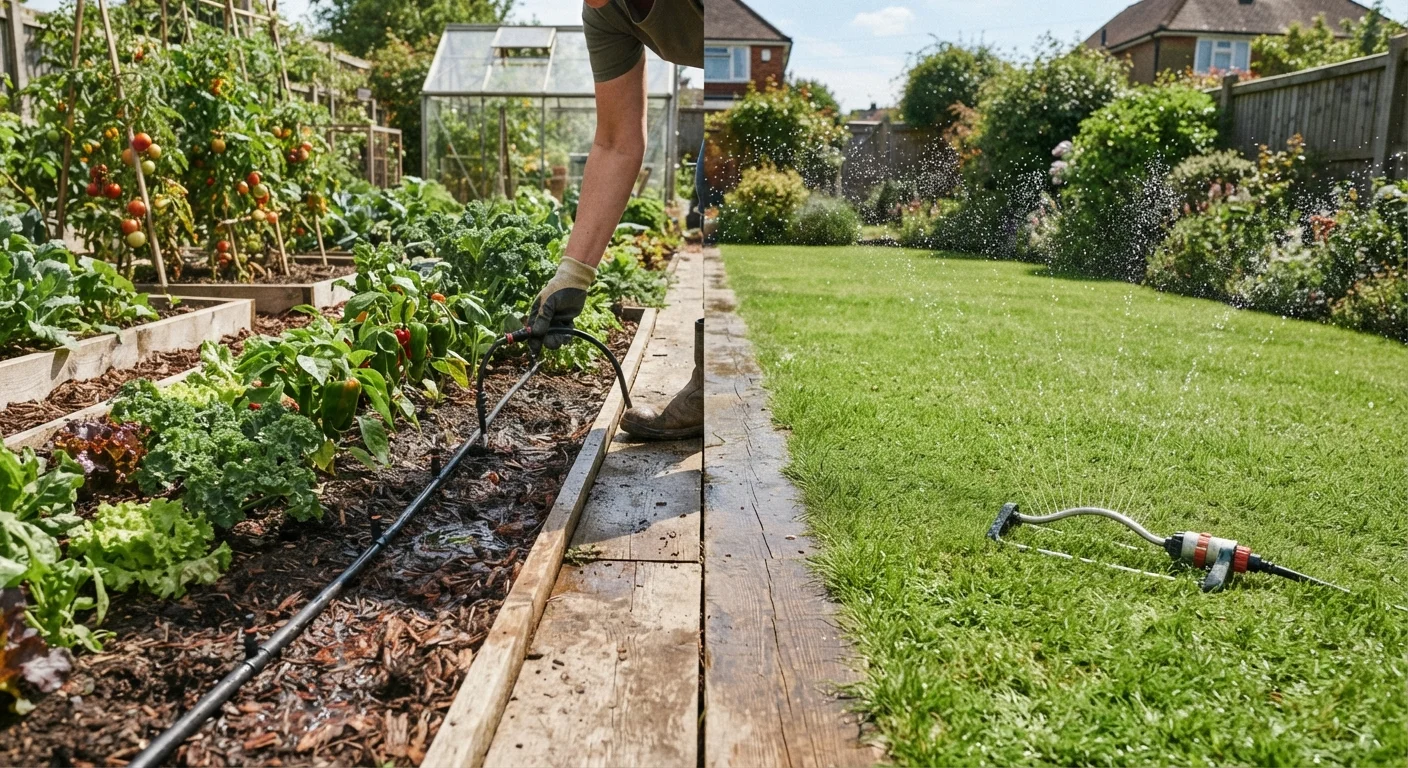
Drip irrigation delivers water slowly and directly to the soil at the base of each plant through a network of flexible tubing and emitters. Water seeps into the root zone at a low flow rate, minimizing runoff and surface evaporation. Kits range from simple soaker-hose setups to more elaborate zoned systems with pressure regulators and inline filters.
Sprinkler systems distribute water overhead in a spray or rotating pattern, mimicking rain. Pop-up heads, rotary nozzles, and oscillating heads are the most common residential types. They connect to a main water supply line and can be programmed to run on a timer, covering broad areas with relatively little installation effort per square foot.
Understanding watering habits that stress plants is useful context before choosing either system — how and when you water matters as much as which hardware you use.
Water Efficiency: Where the Numbers Diverge
Water use is arguably the most consequential difference between the two approaches. Drip systems are generally estimated to be 30–50% more efficient than overhead sprinklers, largely because water goes directly to the root zone with minimal evaporation. Sprinklers lose a meaningful portion of output to wind drift, surface evaporation, and overspray onto pavement or structures.
30–50%
Water savings with drip vs. overhead
Drip systems are widely cited by water conservation agencies as delivering 30–50% greater efficiency than conventional sprinkler irrigation.
50%
Sprinkler water lost to evaporation
According to the U.S. Environmental Protection Agency's WaterSense program, conventional sprinkler systems can lose up to half their output to evaporation and runoff.
Sprinklers also wet foliage, which can encourage fungal diseases in humid climates — a consideration for vegetable crops in particular. Drip systems keep leaves dry, which supports plant health in regions prone to powdery mildew or blight. That said, in very arid conditions, some plants benefit from the brief humidity that overhead watering provides.
If water conservation or a high utility bill is driving your decision, drip is the more defensible starting point — though proper timer scheduling dramatically improves sprinkler efficiency too.
Coverage, Plant Types, and Garden Layout
Sprinklers shine where uniform coverage across open ground is the goal — established lawns, wildflower meadows, or large mixed perennial beds where plants are densely packed. Rotating heads can cover areas up to 30 feet in radius with minimal hardware. If you're working with a mix of perennials and annuals, an overhead system is often simpler to adjust as plantings change seasonally.
Drip excels in defined planting areas: vegetable rows, container clusters, raised beds, and foundation shrub borders. If you garden in raised beds or in-ground plots, emitters can be positioned precisely per plant. This precision is harder to replicate with spray heads and becomes especially useful as plant spacing varies.
| Drip Irrigation | Sprinkler Systems | |
|---|---|---|
| Water efficiency | High — targets root zone directly | Moderate — loses water to evaporation |
| Best plant types | Vegetables, shrubs, containers | Lawns, dense ornamental beds |
| Coverage area | Defined zones, precise placement | Wide, uniform open areas |
| Installation complexity | Low to moderate, no trenching needed | Moderate to high, may require trenching |
| Upfront cost | Low to moderate for DIY kits | Higher for in-ground systems |
| Foliage wetting | Minimal — keeps leaves dry | High — wets leaves overhead |
| Weed suppression | Moderate — dry soil between plants | Low — wets soil broadly |
| Winterizing requirement | Drain and store tubing | Blow out lines with compressor |
Irregular yard shapes can complicate sprinkler layouts, creating dry spots at the edges of spray arcs or wet overlap zones. Drip systems are easier to route through curved or oddly shaped beds without coverage gaps.
Setup, Cost, and Ongoing Maintenance
A basic sprinkler system is relatively quick to install and intuitive to expand, but an in-ground system with multiple zones typically requires trenching, a backflow preventer, and — in many municipalities — a permit. Always verify local permitting requirements before connecting any new irrigation line to your main water supply.
Add a Timer Before Anything Else
Regardless of which system you choose, installing a programmable timer is the single most impactful upgrade you can make. Timers eliminate the guesswork of manual watering, prevent overwatering, and let you run the system during early morning hours when evaporation rates are lowest. Many affordable models attach directly to a standard outdoor hose bib and require no wiring.
Drip systems are more DIY-accessible for small to mid-sized gardens. Kits available at home improvement stores connect to a standard hose bib and can be assembled in an afternoon without trenching. Larger drip setups covering multiple beds still require planning but rarely need permits unless tied into a pressurized supply line.
Both systems need seasonal attention: flushing lines, checking emitter clogs, inspecting heads for damage, and winterizing before the first freeze in cold climates. Drip tubing is susceptible to UV degradation over several years outdoors, while sprinkler heads can crack if water isn't properly drained before a hard freeze. Budget for periodic component replacement in either case.
For homeowners managing raised garden beds, drip tubing routed along the inside perimeter of each bed is a particularly tidy, low-maintenance solution.
Making the Right Choice for Your Yard
Start by mapping what you actually need to water. A lawn-heavy yard with few defined beds leans toward sprinklers. A vegetable garden, a collection of shrub borders, or a yard with defined planting zones leans toward drip. Many homeowners ultimately run both — sprinklers on a lawn zone, drip on garden beds — using a multi-zone timer to manage each independently.
Whichever system you install, a programmable timer is one of the highest-value additions you can make. Early-morning watering (before temperatures peak) reduces evaporation for both systems and gives foliage time to dry before nightfall. Pairing a timer with a rain sensor prevents the system from running unnecessarily after rainfall, which is good for your plants and your water bill.
For broader context on keeping plants healthy through consistent care, see the home maintenance hub for seasonal guidance that applies across your entire outdoor space.