

Key Takeaways
- Choosing plants suited to your soil and climate dramatically reduces long-term maintenance demands.
- Mulching planting beds is one of the highest-return tasks any homeowner can do each season.
- Native and regionally adapted plants typically need less water, fertilizer, and pest management.
- Good garden design front-loads labor so the landscape largely sustains itself once established.
- Reducing lawn area is one of the most effective ways to cut overall yard maintenance time.
Start With the Right Plants in the Right Place
The single biggest driver of garden maintenance is mismatched plants — sun-lovers in the shade, moisture-lovers in dry soil, or cold-sensitive shrubs in a harsh-winter climate. When plants struggle against their environment, you spend your weekends compensating: extra watering, fertilizing, pest spraying, and replacing failures.
Before purchasing anything, assess your site conditions honestly. Note where full sun falls for six or more hours per day, where shade pools under trees, and where water tends to collect after rain. Match plant selections to those conditions rather than forcing plants to adapt. This single discipline prevents more problems than any maintenance routine.
For established landscapes, native and regionally adapted plants are especially worth considering. Because they evolved in local conditions, they typically require less supplemental watering once established and show stronger natural resistance to regional pests and diseases.
Hardiness Zone Is Just the Starting Point
USDA Hardiness Zones tell you whether a plant can survive your winters, but they don't address summer heat, humidity, soil type, or rainfall patterns. Check your local cooperative extension service's plant recommendations for guidance tailored to your specific region — they're a free, research-based resource most homeowners underuse.
Build Smarter Plant Beds
Bed design has an outsized effect on how much time you'll spend maintaining your landscape year after year. Three principles make the biggest difference:
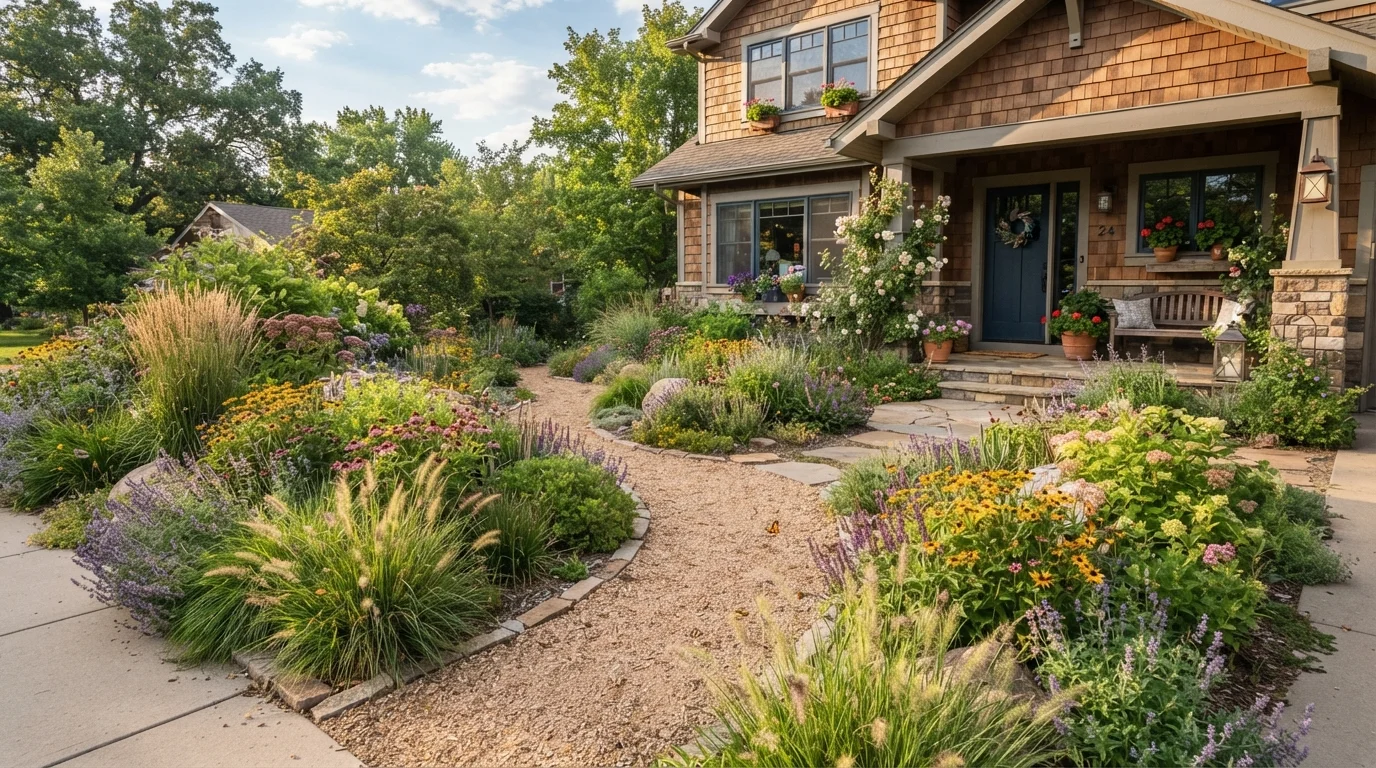
- Cover the soil. Bare soil is an open invitation for weeds. Applying 2–3 inches of organic mulch — wood chips, shredded bark, or leaf mold — suppresses weed germination, retains soil moisture, and moderates soil temperature. Plan to refresh mulch once or twice per year.
- Plant densely enough to crowd out weeds. Mature plants that touch or slightly overlap at full size leave little room for weeds to establish. Space plants according to their mature — not current — size.
- Define clear bed edges. A clean edge between lawn and bed prevents grass from creeping in and reduces the need for hand-weeding along borders. Steel, stone, or a simple mow-strip of concrete all work well.
Reducing how much lawn you maintain is also worth evaluating. Turf requires mowing, edging, fertilizing, aerating, and often irrigation — a significant time and resource commitment. Replacing sections of lawn with mulched beds, groundcovers, or hardscape can meaningfully reduce total workload. See our guide on designing an outdoor space you'll actually use all season for ideas on integrating hardscape thoughtfully.
Match every plant to its site conditions before you buy.
Plants in the wrong environment require ongoing intervention — more water, more fertilizer, more pest control — to survive. Getting the match right from the start eliminates most corrective maintenance.
Mulch all planting beds with 2–3 inches of organic material each season.
Mulch is one of the highest-return tasks in the garden: it suppresses weeds, retains moisture, moderates soil temperature, and feeds soil biology as it breaks down. Skipping it means far more weeding and watering.
Water deeply and infrequently rather than a little every day.
Deep watering trains roots to grow down toward stable moisture reserves, building plants that can tolerate dry spells. Shallow daily watering creates root systems that depend on you for survival.
Reduce lawn area wherever it isn't actively used.
Turf is the most labor- and resource-intensive component of most American yards. Every square foot of lawn converted to mulched beds or groundcover eliminates ongoing mowing, edging, and fertilizing.
Choose slow-growing shrubs appropriate to your space's mature dimensions.
Fast-growing shrubs planted in confined spaces require frequent pruning to stay in bounds. Selecting plants whose mature size suits the site prevents a cycle of constant cutting back.
Water Wisely From the Start
Irrigation habits established early in a planting's life shape how self-sufficient it becomes. Deep, infrequent watering encourages roots to grow downward in search of moisture, building drought tolerance over time. Frequent, shallow watering keeps roots near the surface where they're vulnerable to heat and dry spells — creating plants that need you constantly.
For most garden plants, watering deeply once or twice per week during the growing season — and adjusting based on rainfall — is more effective than daily light watering. A simple rain gauge helps you track natural precipitation and avoid overwatering, which is actually the more common mistake. Our article on watering habits that silently ruin healthy plants walks through the most common errors in detail.
Drip irrigation or soaker hoses deliver water directly to root zones with minimal evaporation loss and keep foliage dry, which reduces fungal disease pressure. These systems can be timer-controlled, removing the daily decision of whether to water at all.
2–3 inches
Recommended mulch depth for weed suppression
According to university cooperative extension guidance, maintaining this depth throughout the season is the most effective non-chemical weed management approach for home gardens.
~50%
Estimated water savings with drip vs. overhead irrigation
The EPA's WaterSense program notes that drip and micro-irrigation systems can use significantly less water than traditional sprinkler systems by delivering water directly to root zones.
40%+
Of a typical yard devoted to lawn
Research from landscape ecology studies suggests turfgrass covers an estimated 40 million acres in the U.S., making it the single largest irrigated crop by area.
Lean Into Perennials and Seasonal Planning
Annuals give immediate color impact but require replanting every year, which adds cost and labor each spring. Perennials, by contrast, return on their own season after season with comparatively little effort once established. Building the backbone of your garden from perennials — and using annuals selectively for seasonal accent — shifts the maintenance balance significantly in your favor.
Good plant layering also helps: tall shrubs or ornamental grasses at the back, mid-height perennials in the middle, and low groundcovers at the front. Each layer fills its niche, leaving less opportunity for weeds and creating visual interest without requiring constant replanting. Our guide on perennials vs. annuals covers how to balance both plant types effectively.
At season's end, resist the impulse to cut everything down. Many perennial seed heads provide winter food for birds, and leaving stems in place protects crown tissue from hard freezes. Our fall garden cleanup guide explains what to remove and what to leave for ecological and practical benefit.